
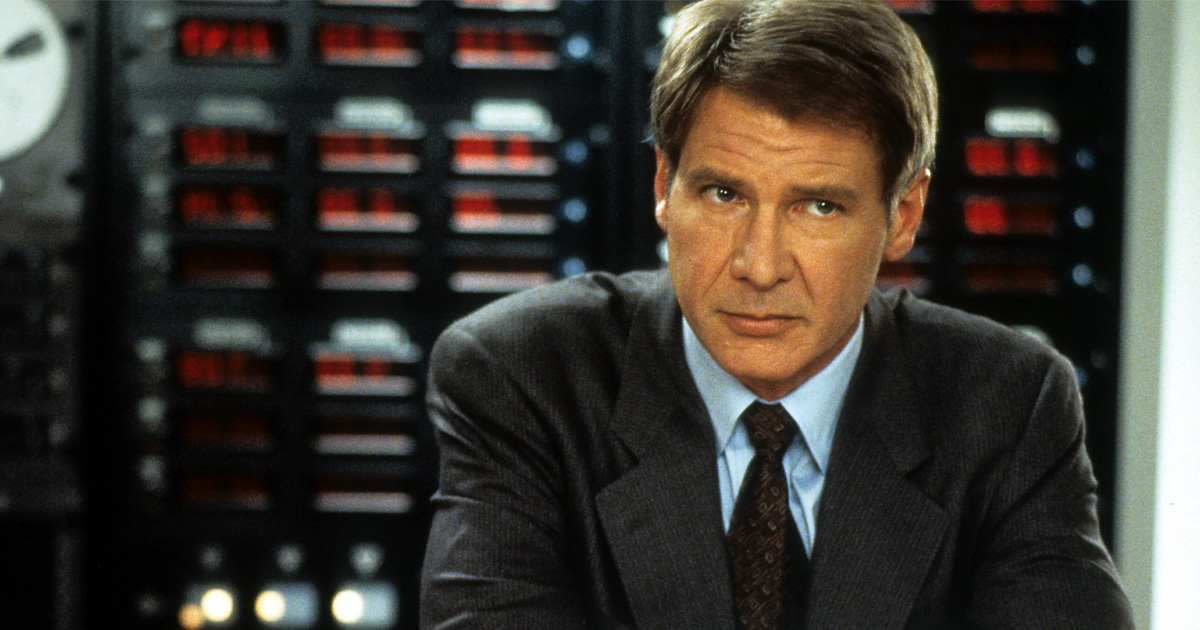

When Patriot Games came out in 1992, it was a solid box office hit, but it earned about a third less domestically than its predecessor, The Hunt for Red October, despite having a much bigger star in the lead, with Harrison Ford replacing Alec Baldwin as CIA analyst Jack Ryan. Considering how much author Tom Clancy hated the movie, openly blasting it in the press, and the somewhat diminished returns, a sequel was nevertheless released within two years. Would this be the movie in the franchise that would finally win over Clancy, score with audiences in the same way The Hunt for Red October did, and steer clear of the political controversies that marred the release of Patriot Games? Here’s how Clear and Present Danger came together.
Why Paramount brought Harrison Ford back as Jack Ryan
When it was released in the summer of 1992, Patriot Games made $83 million domestically, which was a solid number but a far cry from the $122 million The Hunt for Red October had made two years earlier. Yet that was still a very solid number for 1992, and while perhaps a minor disappointment, it earned the studio a hefty return, especially once the foreign gross was figured in, with the film outperforming Red October overseas by about $16 million. It also made a lot of money on VHS and became a cable staple. As such, putting a sequel into production was a no-brainer for Paramount Pictures, which would reunite much of the creative team.
But they had a big problem: the author of the Jack Ryan novels, Tom Clancy, was not happy with how Patriot Games turned out and made his displeasure uncomfortably clear in the press. Many involved with the film, including Harrison Ford, believed that Clancy had sabotaged the film’s release, which in turn hampered the box office.
Patriot Games came along at what might have been an uncertain time in Ford’s career. The Indiana Jones series was over—for the moment—and while his first pivot to drama, Presumed Innocent, fared well at the box office, he’d had an embarrassing flop with his follow-up, Regarding Henry. He wanted a solid action franchise and, as such, coveted the role of Jack Ryan, openly bemoaning turning it down in The Hunt for Red October.
Yet, by the time Clear and Present Danger went into production, Ford wasn’t quite as hungry, as he’d had one of the biggest hits of his career during the summer of 1993, The Fugitive. That movie firmly established that Ford, even outside of Indiana Jones, was still a megastar, and Paramount was happy to capitalize on that movie’s success with Clear and Present Danger.
In fact, it would carry a significantly larger budget than either previous Jack Ryan movie and would be filmed on an epic scale, but with one key difference. Patriot Games had been different from The Hunt for Red October in that it was an unapologetically R-rated adult action film. Clear and Present Danger would take a note from The Fugitive and aim for a PG-13 rating.
How Clear and Present Danger changed Tom Clancy’s novel

Ironically, the plan initially had been to film Clear and Present Danger as a direct sequel to The Hunt for Red October before it was cancelled in favour of Patriot Games. It actually had a script by John Milius, one of the New Hollywood directors who was most famous for Conan the Barbarian but was also a much-in-demand screenwriter and script doctor at the time. The book’s structure was similar to The Hunt for Red October in that it was an ensemble piece featuring many characters, including Clancy’s second-most-popular hero after Ryan, John Clark, a shadowy CIA operative who would go on to get his own series, starting with Without Remorse and leading into Rainbow Six.
With Ford at the height of his stardom, the script would deviate significantly from the book, but perhaps not as much as Patriot Games did.
Both Clancy’s novel and the 1994 film Clear and Present Danger follow the same basic plot: after an American businessman with ties to Colombian drug money is murdered along with his family, the U.S. president secretly authorizes a covert war against the Colombian cartels. CIA operatives insert American soldiers into Colombia to gather intelligence and help carry out attacks on cartel targets, while Jack Ryan, rising through the CIA as Admiral Greer becomes gravely ill, is deliberately kept in the dark about the operation.
Colombian intelligence operative Felix Cortez discovers what the Americans are doing and attempts to manipulate the situation for his own benefit. When the covert campaign becomes politically dangerous, officials in Washington abandon the American soldiers in Colombia to cover their tracks. Ryan eventually discovers the secret operation and the betrayal of the troops, leading him to work with John Clark to save the surviving soldiers and hold those responsible for the illegal operation accountable.
As in Patriot Games, the major difference would be the ending. In the book, John Clark and his sidekick, Ding Chavez, are the ones who rescue the abandoned soldiers in Colombia. In the movie, Ryan himself goes to Colombia to put together the operation, taking a major role in the battle—although, unlike in Patriot Games, this doesn’t mean he gets into gunfights. In fact, he never once uses a gun in the movie, which is a stark departure from Patriot Games, which portrayed him as a more conventional action hero. Then again, he never used a gun in The Fugitive either, so perhaps that has something to do with it.
The script battles that angered Tom Clancy
Once again, Philip Noyce was back as director. In the year between Patriot Games and this, he had directed a big-budget Sharon Stone thriller for Paramount called Sliver, which was marred by behind-the-scenes issues, including tension between Stone and co-star William Baldwin, the demands of producer Robert Evans, and test-screening reactions that led to an expensive reshoot of the ending.
While not a big hit, it further established him as one of Hollywood’s big techno-thriller directors. While Clancy didn’t seem to care for him, he worked well with Ford, and the studio was quite happy with his work. He would go on to make The Saint for them as well some years later.
The trouble with Clancy started with the script. Originally, it was penned by Milius, and Clancy loved it because, according to Milius, it was very faithful to the novel. But being faithful to the novel meant Ryan was no longer the clear-cut lead, and in a world where Ford was one of the biggest stars, that didn’t quite fly.
As Noyce told Entertainment Weekly at the time, “There was no place for Harrison Ford in that film… There was a place, but the audience would have rioted.”
As such, they hired screenwriter Donald Stewart, who penned the Jack Lemmon classic Missing, to write a new screenplay—but Clancy hated it. He told a Washington Post reporter that it was awful, but then a memo he sent to the production team leaked, listing his many complaints. Some were petty, such as changes to character names and the wrong nautical terms being used, while others were more pointed. He called the committee responsible for the script a “panel of maniacs,” while also taking a potshot at Noyce, saying that if the script was shot, it would make his last film, Sliver, which was panned by critics, look like Citizen Kane.
Steven Zaillian, who had worked on Patriot Games and written Schindler’s List, was brought on for another rewrite that made the movie closer to Clancy’s novel while still centring Ryan. But it came at the expense of material meant for Anne Archer, who would return as Ryan’s wife, reprising her role from Patriot Games in what essentially amounted to a bit part.
Surely this would pacify Clancy, right? Not even close. He hated the new script even more, especially due to an ending that featured Ryan testifying about the president’s covert drug war. Clancy thought that was a foolish idea, as he had nothing but contempt for Congress and seemingly had some sympathy for the president in his original book.
Despite the many writers, Milius, who wrote the initial rejected draft, actually returned to punch up the movie’s action scenes. He was responsible for what would become the movie’s most acclaimed set piece, when a convoy of Chevy Suburbans is ambushed on the streets of Bogotá.
Willem Dafoe makes his debut as John Clark

As far as casting went, outside of Ford, several key cast members returned for Clear and Present Danger, with Archer and Thora Birch reprising their roles as Ryan’s wife and daughter in much smaller parts. Notably, James Earl Jones, the only actor to appear in all three films, would reprise his role as Admiral Greer, who has a moving storyline involving his death from cancer and Ryan’s appointment as his successor.
The supporting cast would be strong, with Donald Moffat—of The Thing—playing the president, while Harris Yulin and Henry Czerny would play his duplicitous advisers. There would also be key roles for performance artist Ann Magnuson, as well as former Disney leading man—and star of The Love Bug—Dean Jones, who would play against type as the director of the CIA. Joaquim de Almeida would play the movie’s main villain, Felix Cortez, while Miguel Sandoval would play the Pablo Escobar-esque drug lord Ernesto Escobedo.
However, two characters who would become very important to the Rainbow Six franchise also made their first on-screen appearances here. The film would mark the debut of John Clark, who, in later films, would be played by Liev Schreiber and then Michael B. Jordan. Many believe they got the casting exactly right here, with Willem Dafoe making for a memorably intense Clark, who gives the film a unique energy in his scenes opposite Ford.
Raymond Cruz, who would later famously appear on Breaking Bad, would play his associate Ding Chavez, while Benjamin Bratt would also get an early role as Captain Ramirez. Dafoe and Cruz are a strong enough pair that one wonders why Paramount didn’t spin them off into a Rainbow Six franchise, but that just wasn’t the way Hollywood worked back then.
A difficult shoot and a disputed ending
Clear and Present Danger would be a bigger production than Patriot Games, costing $62 million, compared to Patriot Games’ $45 million and the $30 million spent on Red October.
Another issue was that Ford had hurt his knee filming The Fugitive. Given that he had to go right from one movie into another, the decision was made to postpone all action scenes until the end of shooting. This didn’t help morale on the set, especially when shooting the big Chevy Suburban set piece in Mexico City. Both Ford and Noyce were frustrated by how the script was constantly changing, with rewrites being done on the fly while they were trying to film these technically intricate moments.
Rumours flew about Ford and Noyce bickering on the set, which both admit was true, but they say it was never in an explosive way. Both wanted to make the best movie they could.
The ending also proved to be a point of contention, as Paramount felt the movie was getting too expensive and rejected a last-minute chase and fistfight between Ford and the main villain as too costly. Noyce said publicly that this was a mistake, as it left the film ending on an action sequence that clearly isn’t as good as the Chevy Suburban one.
Dafoe was also frustrated, as he had taken on the role of John Clark because he was interested in making an action film but found himself sidelined during the ending, where he’s basically on a helicopter screaming, “We have to get Ryan,” while Ford gets all the action. It’s a shame because this is the one place the movie comes up short. Dafoe is excellent casting as John Clark, but his role is undercut by the need to centre Ford in virtually every major sequence.
The film also ran into trouble in the editing room, as it came in on the long side. Noyce and his editors couldn’t get it below 142 minutes. Any time he cut footage, the movie’s pace fell off, and in the end, the studio, which was run by Sherry Lansing, actually asked him to reinstate footage to make it longer.
This is an interesting note, as while a 142-minute action blockbuster is very normal now, in the nineties most movies like this ran under two hours. Lansing was known as one of the few studio bosses who didn’t mind a longer film, having previously encouraged Ridley Scott to reinstate a lot of footage he cut while making Black Rain, a movie she produced.
Clear and Present Danger becomes a box office hit
While making Clear and Present Danger was a major ordeal, it made for a good movie, earning significantly stronger reviews than Patriot Games, even if it wasn’t as celebrated as The Hunt for Red October.
It would prove to be a major hit at the box office, grossing $122 million in North America—roughly the same amount as Red October—despite competition from Forrest Gump, The Lion King, The Mask and True Lies. It would make another $94 million overseas, bringing the worldwide total to $215.9 million and making it the highest-grossing film in the series at the time, although Red October was more profitable. It also wasn’t the worldwide phenomenon The Fugitive was, but that was never something anyone reasonably expected.
In the end, Ford would seemingly have his fill of Tom Clancy with this one, opting out of any further Jack Ryan movies despite the studio and producer Mace Neufeld buying the rights to more books.
Ironically, in later Ryan novels, he would become president. Ford would make his own Jack Ryan-style techno-thriller with himself as a formidable president in Air Force One, which, after The Fugitive, would become his most successful film of the nineties. It’s a very Jack Ryan-esque film in some ways, but without Clancy’s behind-the-scenes complaints.
It would also be the last Tom Clancy movie for Noyce, although he would reteam with the producers and Paramount to adapt the old TV series The Saint, which he would reimagine as a very Jack Ryan-esque techno-thriller. And, like all three other movies Noyce would make with the studio, it would have a famously reshot ending.
What happened to the Jack Ryan franchise?
Clancy would sell the rights to Without Remorse to Savoy Pictures around the time Clear and Present Danger came out, with the promise that he would have more of an active role in developing it. But the studio went bankrupt, and the film rights bounced around for years before it was made by Paramount with Michael B. Jordan in the lead, although they sold the rights to Amazon during the pandemic.
If Clancy was upset with the Ryan films, he would have had a field day with Without Remorse, which departed hugely from his novel, although Jordan was well received in the part, and there’s been talk about him reprising the role in a spin-off film based on Rainbow Six.
As for the Ryan movies, Paramount kept making them. In 2002, Ben Affleck would play a younger version of Jack Ryan in The Sum of All Fears, which was only a minor box office success. Clancy hated that one just as much as the others, but, in a wild choice by the studio, he actually did a commentary track on the DVD where he essentially just complained about the film from start to finish.
He would pass away in 2013, the year before Paramount would try to reboot the character one last time with Jack Ryan: Shadow Recruit, a film starring Chris Pine in the title role that was supposed to launch a Clancy universe. It never happened for Paramount, but when Amazon acquired the rights, they were able to make the character the lead of a successful franchise, with John Krasinski playing him in a TV series and a follow-up feature film—with more, apparently, to come.
All that said, as the franchise continued, it got further and further away from Clancy’s concept of the techno-thriller, and it’s amusing to watch the original Jack Ryan trilogy knowing that he was never happy with how much they departed from the books. Compared to many book-to-film adaptations, they are actually pretty respectful and faithful. Perhaps, had he lived to see Shadow Recruit or Without Remorse, he would have had nicer words for Noyce and Ford.
















The comment section exists to allow readers to discuss the article constructively and respectfully, focused on the topic at hand.
What’s Not Allowed