

The Rise of Michael Dudikoff
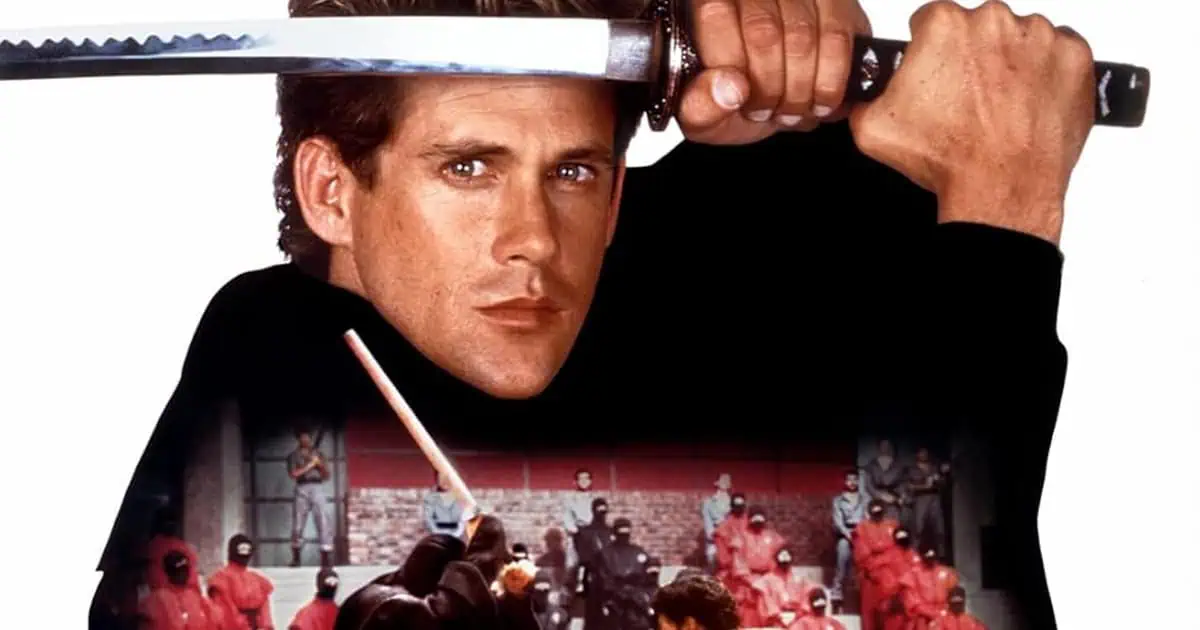
American Ninja was one of Cannon Films’ most profitable movies of 1985, while also introducing a brand-new action hero to their stable, Michael Dudikoff. A sequel was a no-brainer, but where most companies would have put more resources into a follow-up and tried to build on the first film’s success, that wasn’t how things rolled at Cannon.
They wanted a cheap sequel they could release quickly. While that could have spelled disaster, a top-tier creative team managed to deliver a rock-solid, action-packed sequel that many Cannon fans believe might be the studio’s most entertaining action yarn. Best of all, it wasn’t just packed with ninjas—it had MUTANT ninjas. Such is the story of American Ninja 2: The Confrontation!
Michael Dudikoff was unique among Cannon’s stable of action stars. While he wasn’t their biggest moneymaker of the decade—that honour probably goes to Chuck Norris or Charles Bronson—he differed from those guys in one key respect: he was a total unknown when they cast him in American Ninja.
By the time Bronson made his first movie with Cannon, Death Wish II, he was already a star, albeit one in decline, while Chuck Norris had already scored several hits before making Missing in Action.
Dudikoff was decades younger than both men and had the looks and charisma of a crossover Hollywood star who, given the right build-up, could have emerged as a major action star for the company.
After all, Dudikoff could do things Bronson and Norris couldn’t—namely play a romantic lead. Yet Cannon rarely took advantage of that side of his appeal, usually limiting any love interest to a minor subplot.
Could Cannon Have Made Dudikoff a Bigger Star?
Had he gotten the right kind of push, it’s easy to imagine Dudikoff enjoying a career that outlasted Cannon itself. Jean-Claude Van Damme, another Cannon discovery, was arguably fortunate the company went bust when it did, allowing him to transition into mainstream studio fare.
Dudikoff, on the other hand, was quickly slotted into a long series of B-movies, which ultimately typecast him and limited his opportunities. By the time Cannon stopped making movies, his moment seemed to have passed.
The Road From Avenging Force to American Ninja 2
After the success of American Ninja, Dudikoff was quickly plugged into Avenging Force, which was initially conceived as a sequel to Invasion U.S.A., with Dudikoff’s character even sharing Chuck Norris’s name from that film—Matt Hunter.
Otherwise, the movie, as released, bears little resemblance to Invasion U.S.A., instead reuniting Dudikoff with both his American Ninja director, Sam Firstenberg, and co-star Steve James.
The film was a modest success, and the same creative team was enlisted to make American Ninja 2: The Confrontation.
Yet, instead of receiving a larger budget thanks to the original’s success, the sequel was produced on an even tighter budget. If Wikipedia is to be believed, it cost only $350,000—less than a third of the original film’s budget. Frankly, I don’t buy it.
There’s no way they could have put what’s on-screen here together for that amount of money. Whatever the real figure was, though, it was still cheap.
Why Was American Ninja 2 Made So Cheaply?
How cheap was it? Well, Cannon traded one controversial shooting location for another, moving from the Marcos-era Philippines to apartheid-era South Africa.
The decision was wildly controversial, as much of the Western world was observing a cultural boycott against the country due to its policies. But with incentives on offer and budgets tighter than ever, Cannon heads Menahem Golan and Yoram Globus ignored any potential backlash and went full speed ahead on their cheapie sequel.
Cannon’s Big Hollywood Gamble
So why did they opt to make American Ninja 2 on the cheap when they had an opportunity to build a potentially lucrative franchise?
To understand that, you have to look at what was happening at Cannon Pictures in 1986 and 1987.
The company had scored several hits and was eager to break into the A-list movie business. As such, they threw wads of cash at prestige projects with little commercial potential, such as Norman Mailer’s Tough Guys Don’t Dance, while also financing would-be blockbusters they arguably couldn’t afford, including Over the Top and Masters of the Universe.
To Cannon, American Ninja 2 was the kind of movie they could dump into theatres, maybe break even on domestically, and then make their real money through international sales, cable television, and VHS.
The Mistakes That Crippled Cannon Films
The strategy wasn’t entirely misguided. Most of Cannon’s Chuck Norris and Charles Bronson films turned a profit.
The difference was that Norris got comparatively healthy budgets for films like Invasion U.S.A. and The Delta Force, while Dudikoff’s movies were treated more like assembly-line productions.
Unfortunately for Cannon, both Over the Top and Masters of the Universe underperformed. The real disaster, however, was Superman IV: The Quest for Peace.
After having its budget slashed during production, it became such an infamous flop that it turned Cannon into a Hollywood punchline.
Sam Firstenberg: Cannon’s Secret Weapon
In hindsight, the company probably would have been better served investing more money in a proper American Ninjasequel.
Yet, for what it is, American Ninja 2: The Confrontation is almost shockingly good. Firstenberg was easily Cannon’s most talented director, an expert at delivering high-end action on a budget, and he worked exceptionally well with both Dudikoff and Steve James.
How Gary Conway Shaped the Sequel
Oddly enough, the genesis of what became American Ninja 2 actually begins with Over the Top.
Gary Conway, a television star from the sixties and seventies who was best known for Land of the Lost, originally came up with the idea and intended to make the movie himself, starring in the lead role.
Conway had done something similar before with the cult revenge film The Farmer. However, when Golan and Globus acquired Over the Top, they reworked it into a vehicle for the biggest star in Hollywood at the time, Sylvester Stallone.
Still, Conway remained in the Cannon fold, with the studio hiring him to co-write American Ninja 2 and play the film’s villain.
The Mutant Ninja Plot Explained
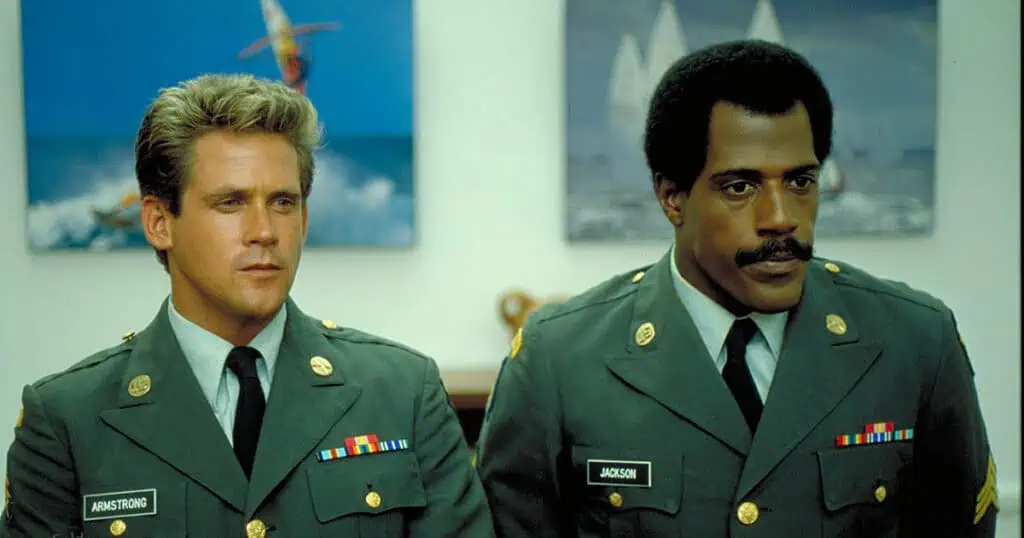
In the sequel, Joe Armstrong and Curtis Jackson, once again played by Dudikoff and James, have both been promoted to Sergeants and now serve as Army Rangers who are essentially a two-man anti-ninja task force. They’re dispatched to a remote Caribbean island where Marines have been mysteriously disappearing.
The island is unstable and effectively controlled by a powerful drug lord known only as “The Lion,” played by Conway, who appears untouchable. But the situation turns out to be even worse than expected. The Lion has enlisted a scientist to build him an army of genetically engineered mutant ninjas, using kidnapped Marines as the raw material for his mindless killing machines.
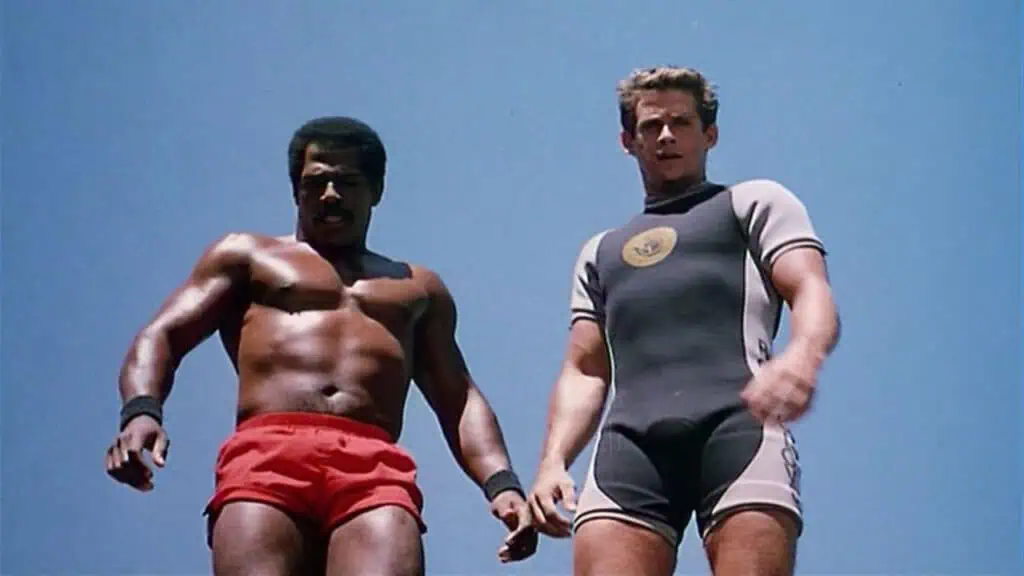
Fortunately, Joe and Curtis find an ally in Marine captain Wild Bill, who disguises himself as a laid-back surfer dude. Joe also discovers that the scientist is working under duress, thanks to the efforts of his daughter Alicia, a local whistleblower who naturally becomes his love interest.
It all culminates in a genuinely kick-ass battle royale at The Lion’s island fortress, with Joe infiltrating the compound and squaring off against the villain’s deadliest ninja, Tojo Ken, while Curtis, Wild Bill, and a squad of Marines ride in to save the day.
Sam Firstenberg’s Secret Weapon
While all of this sounds like complete nonsense—and it is—Sam Firstenberg was a master at taking ridiculous premises and turning them into movies that were far better than they had any right to be. Just look at Revenge of the Ninja, Breakin’ 2: Electric Boogaloo, and the legendary Ninja III: The Domination. He had a sense of humour that many action directors lacked, always winking at the audience and finding ways to maximize the fun factor.
At only ninety minutes, American Ninja 2 doesn’t have an ounce of fat on it. The movie is loaded with action sequences, moving at a brisk pace from beginning to end. While Dudikoff wasn’t a trained martial artist, he was a good enough athlete to sell the fight scenes, coming across as a surprisingly credible screen fighter. He also had a great look and—most importantly—was incredibly likable.
That appeal is amplified by the presence of Steve James, who was one of Cannon’s secret weapons. Not only was he an accomplished martial artist and bodybuilder, but he was also a genuinely talented actor who had been mentored by Sidney Poitier. Dudikoff has often said James was one of his closest friends during their Cannon years, and their chemistry is obvious. James makes Dudikoff seem relaxed and natural in a way that stars like Bronson and Norris rarely did.
Filming in South Africa
Ironically, both James and Dudikoff had reservations about filming in South Africa due to apartheid. According to Dudikoff, one of the ways the production rationalized the decision was that the cast and crew were considered tourists and therefore weren’t subject to many of the restrictions imposed on the local population.
While that hardly makes the decision any less controversial, it’s worth noting that many of the actors who appear in the movie were local performers who may not have otherwise had access to a production of this scale.
That said, South Africa hurts the movie in at least one major way. We’re supposed to believe the story takes place in the Caribbean, yet the location never resembles the Caribbean for even a second. The illusion is further undermined by the fact that many of the local performers have unmistakably Afrikaans accents.
Had Cannon been willing to spend a little more money and shoot in an actual Caribbean location, the movie would have had far more atmosphere. Instead, George S. Clinton’s score works overtime, layering steel drums throughout the soundtrack in a desperate attempt to convince us we’re somewhere tropical. Nice try, George.
Why the Action Still Works
What absolutely does work, however, is the action.
The movie’s secret weapon is Mike Stone, the real-life martial arts legend who trained Dudikoff and plays The Lion’s chief henchman, Tojo Ken. Built up as an unstoppable ninja throughout the film, he’s the one villain who feels like a legitimate match for Joe Armstrong, and their climactic showdown is genuinely excellent.
Steve James also gets far more to do than he did in the original film, with one of the movie’s running gags involving the seemingly endless number of shirts he manages to destroy during fights.
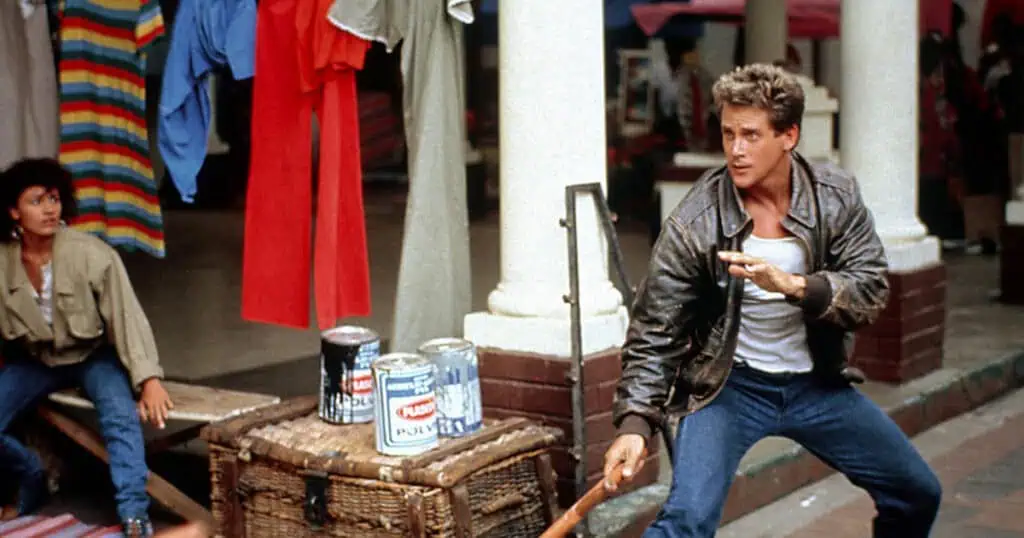
I was also a fan of Jeff Celentano—billed here as Jeff Weston—as the unapologetically kick-ass Marine captain Wild Bill. Larry Poindexter provides solid comic relief as the sidekick Marine who follows Joe and Curtis around, while Joe even gets a kid sidekick named Toto who feels very much inspired by Short Round from Indiana Jones and the Temple of Doom.
Michelle Botes makes for a perfectly serviceable love interest, but Gary Conway feels underserved as The Lion. Despite co-writing the screenplay, he simply isn’t given enough scenes to establish himself as a memorable villain. In the end, it’s really Stone’s Tojo Ken who emerges as the movie’s true antagonist.
Why American Ninja 2 Failed at the Box Office
Despite being made with a surprising amount of skill and enthusiasm, American Ninja 2 wasn’t a major success upon release. The film grossed only about $4 million domestically, although that figure comes with an important caveat.
By the time the movie hit theatres in May 1987, Cannon was already heading toward one of the most disastrous years in its history. Over the Top had underperformed, cash flow was tightening, and expensive productions like Masters of the Universe and Superman IV: The Quest for Peace were consuming whatever marketing resources remained.
As a result, American Ninja 2 never received a proper push. It opened on only 397 screens and arrived with very little promotion.
The End of an Era
Fortunately, the movie performed much better overseas and became a major success on home video. In fact, it did well enough that Cannon immediately put American Ninja 3: Blood Hunt into production.
Unfortunately, by that point Firstenberg had grown tired of being asked to make these movies on ever-shrinking budgets and moved on. Dudikoff followed him out the door, partly because he was also reluctant to return to South Africa.
As a result, Cannon turned to a new discovery, David Bradley, to headline American Ninja 3. It would be the final entry in the series released during Menahem Golan’s tenure at Cannon before he departed to launch 21st Century Films.
Dudikoff would continue working for the company, starring in lower-budget vehicles such as Midnight Ride and later returning for American Ninja 4: The Annihilation, which paired him with Bradley.
Steve James, meanwhile, appeared to be on the verge of breaking out. He earned strong notices for his performance as Kung Fu Joe in I’m Gonna Git You Sucka and landed a prominent supporting role opposite Christopher Walken in McBain. Tragically, he was diagnosed with pancreatic cancer and passed away in 1993.
The Legacy of Michael Dudikoff and Cannon Films
Golan’s departure wasn’t actually the end of Cannon. Yoram Globus continued operating the company while also taking on a major role at MGM, even serving as president of production.
The studio released several additional films, including Delta Force 2, which at one point was reportedly going to pair Norris and Dudikoff together. That never happened, and the film ultimately underperformed. Cannon also produced the Jean-Claude Van Damme vehicle Death Warrant, although MGM handled its release.
As budgets continued to shrink, the quality of Cannon’s output increasingly suffered, resulting in films such as Lambada and the underwhelming Norris vehicle The Hitman.
Dudikoff remained loyal to the company, starring in movies such as The Human Shield and Midnight Ride. In fact, he would headline the final Cannon-produced film, Chain of Command, which went direct-to-video in 1994.
His career as a leading action star gradually wound down after Cannon’s collapse. He later showed a surprising comedic side in the Jerry Springer comedy Ringmaster before largely stepping away from acting, although he still occasionally appears in supporting roles.
Despite arguably being underserved by Cannon throughout his career, Dudikoff has never seemed bitter about the experience. He’s remained a regular participant in documentaries such as Electric Boogaloo: The Wild, Untold Story of Cannon Films and The Go-Go Boys, while also appearing in numerous retrospectives celebrating both Cannon and Firstenberg’s work.
Final Verdict
As far as Dudikoff’s filmography goes, American Ninja 2: The Confrontation may well represent him at his peak. It’s fast, funny, packed with action, loaded with memorable characters, and features mutant ninjas.
Really, what more could an ’80s action fan ask for?













The comment section exists to allow readers to discuss the article constructively and respectfully, focused on the topic at hand.
What’s Not Allowed