


Horror and religion go together like peanut butter and jelly. And while the genre often leans into possession stories, every now and then something comes along that breaks boundaries. And who better to do that than John Carpenter?
After the heartbreak of Big Trouble in Little China, he felt the need to go smaller so he could have full creative control. Bringing in Carpenter regulars like Donald Pleasence, Victor Wong, and Dennis Dun, they set out to make a film that, while rooted in religion, completely flipped the concept on its head. Because Satan has been portrayed in many ways: from terrifying beasts to more traditional demonic figures. But what about a large container holding a green liquid, something that can only be described as Satan’s stew?
Let’s get into it as we break down what happened to Prince of Darkness.
Alive Films
The year was 1986, and Big Trouble in Little China had just taken a thrashing at the box office. Audiences didn’t quite understand its subversive take on the action genre, and no one felt that more than Carpenter himself. Every time he made something he truly believed in, like The Thing, it seemed to crash and burn. He even took on more studio-driven projects like Starman and Christine. But that wasn’t why he got into filmmaking.
Carpenter had grown tired of the studio system. He wanted to return to a low-budget approach, where he could have complete creative control. So he set up a multi-film deal with Alive Films, with one key condition: full creative freedom, and a modest $3 million budget.
Influenced by a book on quantum mechanics and subatomic particles, Carpenter found his perception of reality shifting. He wanted to channel that into something different, something built on unease and dread. He felt too many horror films were derivative, with nothing new to say.
Carpenter often described his work as falling into two categories:
- The journey film, focused on a character’s emotional arc
- The siege film, where characters are trapped and under attack
Prince of Darkness would follow the siege blueprint, prioritizing dread above all else. But more than that, Carpenter wanted to explore a terrifying idea: the concept of an anti-God. The ultimate evil.

The Story
The story centers on a group of graduate students assisting a Catholic priest at an old monastery. Beneath it lies a hidden secret—an ancient container holding the liquid embodiment of Satan himself. The Catholic Church has guarded it for centuries. But this is a horror movie… so things go wrong.
One by one, the students are turned into zombie-like beings. Possession takes hold. Reality begins to unravel. There’s even a wild implication that Jesus may have been an alien sent to warn humanity about the container.
Meanwhile, Satan seeks to reunite with the anti-God force and regain full power. No bueno.
Cast
Carpenter regulars return in force.
Donald Pleasence leads as the priest, while Victor Wong plays Professor Howard Birack. After Big Trouble in Little China, Carpenter brought back Dennis Dun as Walter Fong in the first of several collaborations. Peter Jason appears as Dr. Paul Leahy. Carpenter gave him the script and encouraged him to shape the character himself, a rare level of creative trust.
Jason even suggested that the possessed characters represent the Seven Deadly Sins. Carpenter liked the idea, but scrapped it due to the cost of rewriting at that stage.
While the film is an ensemble, Brian Marsh (Jameson Parker) and Catherine Danforth (Lisa Blount) feel like the emotional core. Their budding romance gives the story weight and leads to a devastating payoff.
Catherine ultimately sacrifices herself to stop Satan, trapping herself in another dimension. It’s a bleak, tragic ending that reinforces the film’s tone.
In Dreams
Dreams play a crucial role in Prince of Darkness. The characters all share the same recurring vision: a mysterious figure emerging from a church. These dreams are later revealed to be messages, tachyon transmissions, warning them of what’s to come.
Then comes the final twist: a dream within a dream. It’s this blend of science and the abstract that gives the film its identity.
Production
With a $3 million budget, Carpenter filmed in Los Angeles, using familiar locations. The college seen early in the film is USC, where he once studied before dropping out to make Dark Star. Despite the tight budget, he still splurged when it mattered, like securing a classic Tom and Jerry cartoon featuring the devil tossing Tom into a boiling pot. The thematic parallel was too perfect to pass up.
For effects, Carpenter relied on old-school techniques, like flipping the camera upside down to make liquid appear to flow upward.
The dream sequences required something special. Carpenter filmed actor Jesse Ferguson on video, played the footage back on a television, then re-filmed the screen. The result is a haunting, low-fi aesthetic that still feels eerie today.
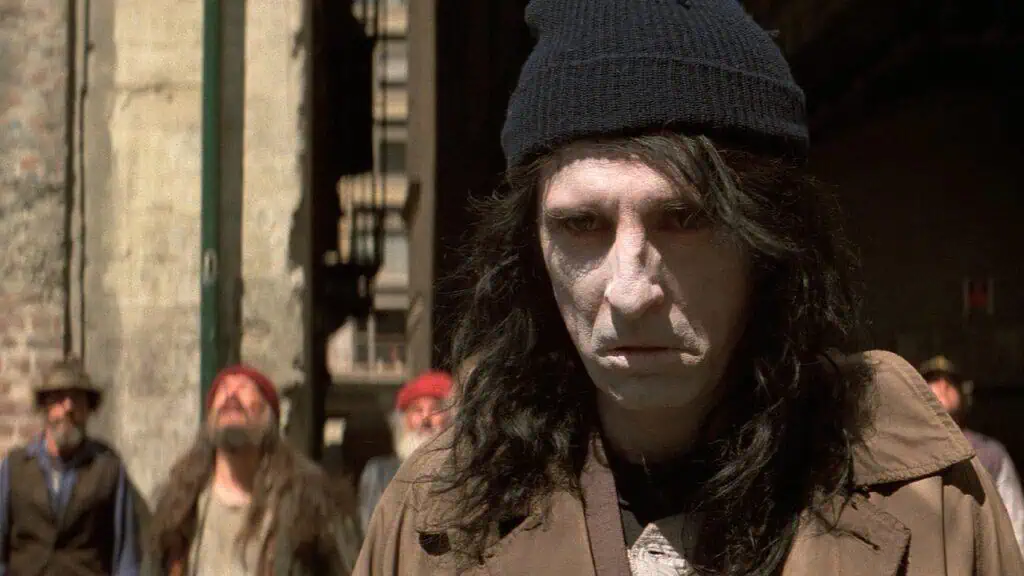
Alice Cooper
And then… there’s Alice Cooper.
His involvement came through producer Shep Gordon, who also managed Cooper. Carpenter had previously met him at WrestleMania, where Cooper expressed interest in appearing in a horror film. Carpenter agreed, with one condition: Cooper had to perform his signature bicycle impalement gag.
The result? One of the film’s most memorable kills.
Post and Release
Ironically, post-production took place at Walt Disney Studios, a stark contrast to the film’s dark subject matter.
Carpenter also chose not to credit himself as writer, instead using the pseudonym “Martin Quatermass,” a nod to the classic sci-fi character.
For the score, Carpenter teamed up once again with Alan Howarth, creating a synth-heavy soundtrack that earned a Saturn Award nomination (they lost to Predator).
Prince of Darkness was released in the United States on October 23, 1987. It grossed over $14.2 million worldwide, an impressive return on its $3 million budget. The success led to one more collaboration with Alive Films: They Live.
For its TV release, several changes were made, most notably an altered opening that suggests the entire film might be Brian Marsh’s dream. Yeah… that’s a choice.
A standout modern release comes from Scream Factory, whose 4K edition is widely considered the best way to experience the film. The included commentary with Carpenter and Peter Jason is a highlight, full of humor, stories, and the kind of chemistry you only get from longtime collaborators.
Among Carpenter’s filmography, Prince of Darkness may not be the flashiest. But it’s one of his most unique, offering a version of Satan unlike anything seen before. And that alone makes it worth revisiting. Because even when it ends, it never really feels over.
What do you think of Prince of Darkness? Let us know by leaving a comment! A couple of the previous episodes of the show can be seen below. To see more, head over to our JoBlo Horror Originals YouTube channel – and subscribe while you’re there!










The comment section exists to allow readers to discuss the article constructively and respectfully, focused on the topic at hand.
What’s Not Allowed