
Plot: Innocence descends into savagery when a group of English schoolboys become desert island castaways in the first television adaptation of William Golding’s landmark dystopian classic.
Review: One of the most important novels of the twentieth century and a common volume of required reading in schools, Lord of the Flies has never been adapted for television before. While it has inspired shows like Yellowjackets and films including The Hunger Games and Battle Royale, William Golding’s novel has been adapted for the screen in 1963 and 1990, with a Filipino version made in 1975. The new BBC version, debuting on Netflix, is written by Jack Thorne and directed by Marc Munden, and was made with support from William Golding’s estate. Featuring a cast of newcomers, the four-part series is the most faithful adaptation of the novel, with some timely updates that expand on its themes. Lord of the Flies, while set in the 1940s, has never been more relevant or powerful, and this new series encapsulates the novel’s dystopian themes that have made it such a vital work of literature.
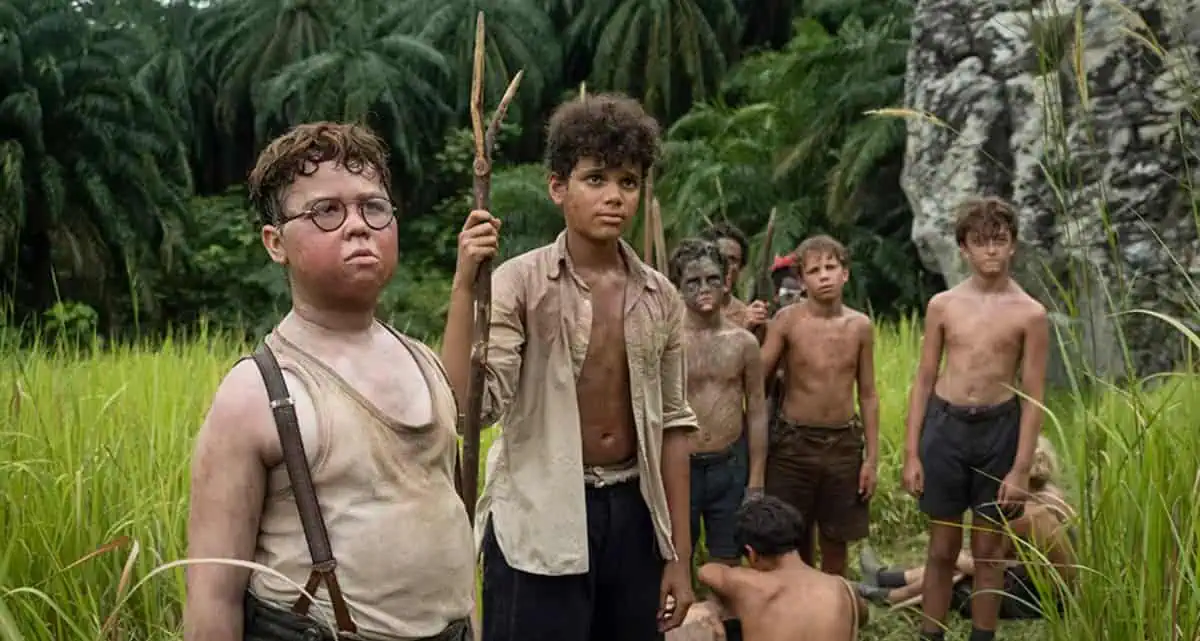
In a slight shift from the novel’s linear narrative, the series focuses each episode on one of the main characters: Piggy, Jack, Simon, and Ralph. Starting with Piggy (David McKenna), the first episode opens with the airplane carrying the children crashing on a remote island. Piggy first encounters Ralph (Winston Sawyers), whom he befriends. Where Ralph is athletic and likeable, Piggy is intelligent and overly talkative. They gather the children on the beach with a conch shell, summoning them, where they encounter Jack (Lox Pratt), the leader of a group of choirboys. Jack instantly mocks Piggy and tries to take command of the survivors. Piggy lobbies for Ralph to be chief, and the divide between the sides begins. At first, the democratic process of meetings and voting seems to work, but Jack and his hunters start to devolve into violence and a single-minded focus on control and trying to kill a pig on the island.
The symbolism from Golding’s novel remains intact, with Ralph representing order, Jack representing violence and power, and Piggy representing rationality. In the book, the characters are not as three-dimensional as they are in this adaptation, which delves further into what makes each boy who they are. Lox Pratt plays Jack as a strong antagonist, and it is apparent why he was cast as Draco Malfoy in the upcoming HBO Harry Potter series, but we also see the side of the character hidden from view, with moments of vulnerability and weakness that eventually lead to the tragic savagery that caps the story. Equally great are David McKenna and Ike Talbut, who act with more depth and subtext than actors three times their ages. Talbut especially gets some added context for his fraught relationship with Jack, as illustrated by the diary Jack steals. Winston Sawyer’s performance as Ralph is also unique in that he is less oppositional to Jack, instead sharing commonalities that pull the adversaries together and apart throughout the series.
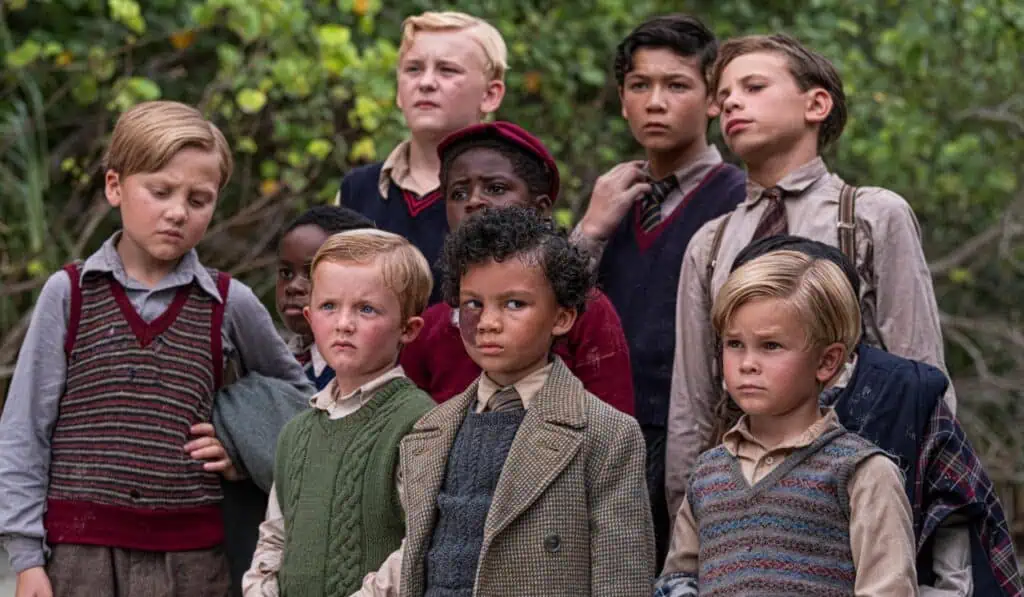
Filmed on location in Malaysia, Lord of the Flies is enhanced by the South Pacific’s physical paradise. The pre-teen cast, especially the youngest members, feels in real danger amid the CGI used to create the pigs on the island and the rare use of special effects to augment the remote locale. The fact that this ensemble of young actors can sustain a four-episode series without it feeling watered down from the written page is impressive, while the adult cast, including Rory Kinnear, Rochelle Neil, Daniel Mays, and Tom Goodman-Hill, is limited to just a few minutes of screen time. The series also does not shy away from the violent aspects of the tale, with the pig hunt bloody and gory, as well as the death scenes of key children. Lord of the Flies was never an easy book to stomach, and this series carries that on in this beautiful but haunting adaptation.
Known for adapting children’s stories with mature themes, including the masterpiece Netflix series Adolescence, the stage play Harry Potter and the Cursed Child, HBO’s His Dark Materials, and the films Wonder, Enola Holmes, and This is England, writer Jack Thorne never treats his adaptation of Lord of the Flies as a television series. Yes, it is broken into four episodes, but collectively this series feels like a faithful recreation of the novel, with additional elements that make it more visual. Director Marc Munden (The Third Day) uses the perfectly cast actors and lush Malaysian locations to create a cinematic achievement that looks as epic as Robert Zemeckis’ Cast Away, but with a lurking sense of folk horror, like The Wicker Man. Composer Cristobal Tapia de Veer lends an eerie, grand score, enhanced by a selection of classical and choral music that combines the children’s civilized past with their new-world dystopia on the isolated island.
If you have read the novel or seen either of the prior adaptations, you are not going to be prepared for how good this interpretation of Lord of the Flies actually is. From the pitch-perfect casting that will surely result in long careers as each of these actors comes of age to the ethereal musical score and the layered visuals and writing, Lord of the Flies is the definitive coming-of-age horror story that would not only make William Golding proud but may possibly improve on his original novel. Lord of the Flies should be required viewing for everyone as a masterclass of visual storytelling, but a truly disturbing look at how easily society could backslide into primitive savagery if you take away law and order. This series is beautiful, tragic, and absolutely mesmerizing to watch.
Lord of the Flies is now streaming on Netflix.






The comment section exists to allow readers to discuss the article constructively and respectfully, focused on the topic at hand.
What’s Not Allowed