


In the history of Hollywood box office disasters, few have been as notorious as Michael Cimino’s Heaven’s Gate, which nearly destroyed a studio and effectively ended the so-called “New Hollywood.” But, contrary to popular opinion, it didn’t end Cimino’s career overnight. Five years later, he returned with a movie that—while not a major financial success—proved to be a remarkable return to form and developed a cult following in the decades that followed: 1985’s Year of the Dragon, starring a young Mickey Rourke at the height of his powers.
How Heaven’s Gate Nearly Ended Michael Cimino’s Career
Flashback to April 9, 1979. Michael Cimino, whose movie The Deer Hunter was only his second film as a director, was anointed as one of the most acclaimed filmmakers of his time when he took home two Academy Awards for his opus: Best Picture and Best Director. Success such as this can wreak havoc on a man’s ego, and only days later, he began filming his follow-up, Heaven’s Gate, an epic Western about the Johnson County War.
Given carte blanche and a then-substantial $17.6 million budget, Cimino apparently ran amok on set, to the point that production dragged on for months, with the budget approaching $44 million. All of this probably wouldn’t have derailed his career had the film been well received.
But when it premiered in November 1980, perhaps partly due to the negative publicity surrounding its troubled production, the film was a disaster. Cimino had delivered a first assembly that ran over five hours but managed to trim it down to three hours and thirty-nine minutes. The initial screening was a nightmare, and its release went so badly that Cimino actually pulled the film from theaters to attempt to salvage it with a shorter cut.
It was all for nothing, as his two-hour-and-twenty-nine-minute cut was also a commercial disaster, with the film grossing just $3.5 million against a budget of $44 million. It brought United Artists to its knees and was such a calamity that studio executive Steven Bach even wrote a tell-all about the production called Final Cut, which became a bestseller.
Year of the Dragon: Michael Cimino’s Comeback Movie

This likely would have ended Cimino’s career, and it did for a time. He was the original director of Footloose but was dismissed, and he was fired from the crime flick The Pope of Greenwich Village. His reputation in tatters, he was approached by mega-producer Dino De Laurentiis with a proposition: he would film an adaptation of Robert Daley’s book, Year of the Dragon. Daley was a former NYPD deputy commissioner and journalist whose exposé, Prince of the City, was turned into an acclaimed film by Sidney Lumet.
Year of the Dragon centered on a New York cop’s experiences amid a power struggle between organized crime factions in Chinatown. Not given his usual freedom to develop the material by De Laurentiis, who imposed a strict timeline and budget, Cimino brought on Oliver Stone to co-write the script.
Still given a sizable budget in the $20 million region, Cimino aimed to make Year of the Dragon an epic. He cast Mickey Rourke, who had a small role in Heaven’s Gate and starred in The Pope of Greenwich Village, as the lead, a Polish-American police captain named Stanley White.
Mickey Rourke at the Height of His Powers
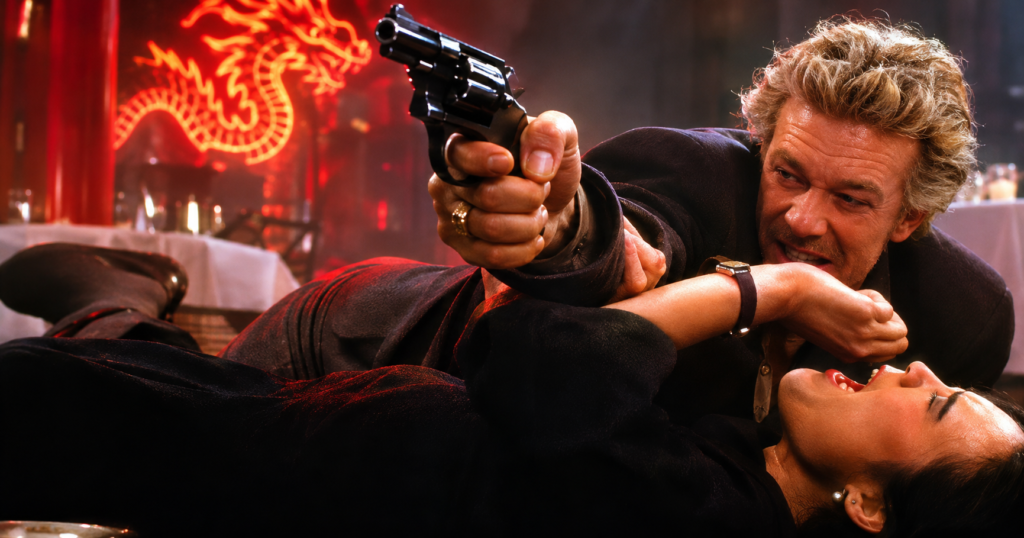
It was unusual casting, as Rourke was only in his early thirties at the time and was widely considered too young for the role. His hair would be dyed gray for the part. Now, one might look back and wonder why he was cast, but the truth is that, at the time, there were few actors in Hollywood who were as hot as Rourke.
He’d burst onto the scene with a showstopping, two-scene role as an arsonist in Body Heat and starred in Barry Levinson’s Diner. While not a box office hit, The Pope of Greenwich Village helped cement his reputation, with many people believing he was the next great American actor in the vein of Robert De Niro and Al Pacino.
Rourke delivers a highly unusual performance as the lead in such an action-driven movie. An openly prejudiced and deeply flawed character, Stanley White is more like Popeye Doyle than the kind of hero you’d typically see in the eighties. Yet Rourke gives the part real nuance, and physically, he’s intimidating, being an experienced boxer and athlete.
He’s extremely well supported by the movie’s other lead, John Lone, who plays Joey Tai, an ambitious Triad member trying to take power. Slick and good-looking, Lone has the vibe of someone like Chow Yun-fat in the part, with Tai calculating and ruthless but also capable of inspiring unexpected sympathy.
The supporting actors are almost all good, including future Big Trouble in Little China star Dennis Dun as a Chinese-American cop White recruits as his primary undercover agent, the great Victor Wong, and Raymond J. Barry (cut to “The wrong kid died” from Walk Hard).
I say “almost” because one of the parts is very poorly cast. Model Ariane Koizumi is cast as a TV reporter who becomes White’s mistress. It’s a huge role that would have benefited from a more experienced actress like Joan Chen, and her performance is one of the movie’s weakest elements. That’s a shame, as it’s a pivotal role and was one of the areas critics, who one could argue were gunning for Cimino at the time, seized on.
One of the Most Impressive Crime Thrillers of the Eighties
Watching Year of the Dragon now, it’s hard not to be struck by how technically proficient it all is. The film is set in New York City, but much of it was shot on elaborate sets in North Carolina. Stanley Kubrick, who was born and raised in New York, was apparently stunned when, after seeing the film, he was told that much of Chinatown had been recreated for the production.
The action is impeccably mounted, with a shootout in a Chinatown restaurant early in the film serving as a masterfully staged sequence that ranks up there with the best action set pieces of the era.
The film ran a lengthy—but not over-the-top—134 minutes when it came out in 1985. Cimino claimed to have final cut, although that assertion was later called into question when he battled for final cut over his next film, The Sicilian, in 1987.
Why Year of the Dragon Was So Controversial
When it came out in 1985, it received mixed-to-negative reviews, including criticism from major critics Pauline Kael, Roger Ebert, and Leonard Maltin. Although, to be sure, they weren’t all outright pans, as critics acknowledged there were good things about it. It was especially well received in Europe, where Cahiers du cinéma chose it as the third-best film of the year.
Yet it was widely criticized by Chinese-American groups in the United States, who objected to the inflammatory dialogue—as well as the cultural stereotypes they felt the movie perpetuated. While White’s prejudices are integral to his characterization, the film’s depiction of Chinatown generated considerable controversy.
Cimino himself strongly defended the film, arguing that it was a movie about prejudice rather than one that endorsed it. However, the controversy became so significant that a disclaimer was added to the film.
Financially, it wasn’t a hit, only grossing $18.7 million in the U.S., but overseas, it enjoyed greater success, potentially offsetting some of its disappointing domestic performance. Ironically, it ended up being distributed by MGM/UA—the very same company Cimino had nearly destroyed a few years earlier.
Why Michael Cimino Never Got the Comeback He Deserved
Despite its international success, Year of the Dragon still had the reputation of being a flop, and Cimino was never able to fully bounce back. His follow-up, The Sicilian, was a disaster, with him again falling prey to poor casting choices that made it hard to sit through despite its technical brilliance.
He’d have an even bigger commercial disappointment with yet another movie for MGM/UA, thanks to their distribution deal with De Laurentiis, who liked Cimino enough to hire him again for his remake of The Desperate Hours. It reteamed him with Rourke but opted for a camp aesthetic that seems unintentional, and it was widely dismissed.
He ended his career with the barely released The Sunchaser and largely withdrew from public life toward the end of his life.
However, there was something of a happy ending for him, with Heaven’s Gate being rediscovered before he passed away. He was able to oversee a restored director’s cut, do away with some of his questionable aesthetic choices (including the movie’s much-criticized hazy look), and re-release it via the Criterion Collection to rave reviews. It’s now widely regarded as a misunderstood film.
Year of the Dragon has also developed a strong reputation among cinephiles, with Quentin Tarantino an outspoken fan of the film. It certainly benefited both Rourke and Lone, who became major stars in the late eighties, although both had rather short reigns as Hollywood leading men.
While an intense, uncompromising film, Year of the Dragon is unique for the era in that it feels like a leftover from the seventies in all the best ways. It’s one of Mickey Rourke’s finest showcases, a reminder of Michael Cimino’s considerable talent, and a crime epic that deserves to be rediscovered.
Have you seen Year of the Dragon? Do you consider it one of the most underrated crime movies of the eighties? Let us know in the comments!
















The comment section exists to allow readers to discuss the article constructively and respectfully, focused on the topic at hand.
What’s Not Allowed