


Recently, we talked about a movie I thought nobody cared about. Turns out… you really do. And that means we get to talk about its sequel. After the “failure” of the first The Guyver, director Steve Wang wanted to right that wrong. Despite the film’s growing cult status, he couldn’t watch it without seeing all of his mistakes. So he set out to make a sequel that fixed everything. There were some problems to overcome: No Mark Hamill, and therefore no star power. And only a fraction of the budget. With roughly a third of the original budget and a desire to go darker, Wang pushed forward. So it’s time to revisit The Guyver 2: Dark Hero.
The Cult Following That Made It Possible
Despite underperforming financially, The Guyver found new life:
- Heavy rotation on HBO
- A strong fanbase in Europe (where it was known as Mutronics)
There was clearly demand for more.
The Budget Disaster
Originally, effects legend Screaming Mad George was offered the sequel. He turned it down. Why? Because the proposed budget was $1.5 million, already half the original. Then came the real shock. The actual budget? $800,000.
The studio’s instructions? “One monster, one cute girl, do whatever you want.”
Keeping the Vision Alive
Despite everything, Wang wanted to deliver a film fans deserved. He even met with original manga creator Yoshiki Takaya, and they agreed:
- The film universe should be separate from the manga
- Continuity would be too difficult on such a small budget
The goal?
- Stay connected to the first film
- Be more faithful to the source material
- Tell a darker, more serious story
A New Shawn Barker
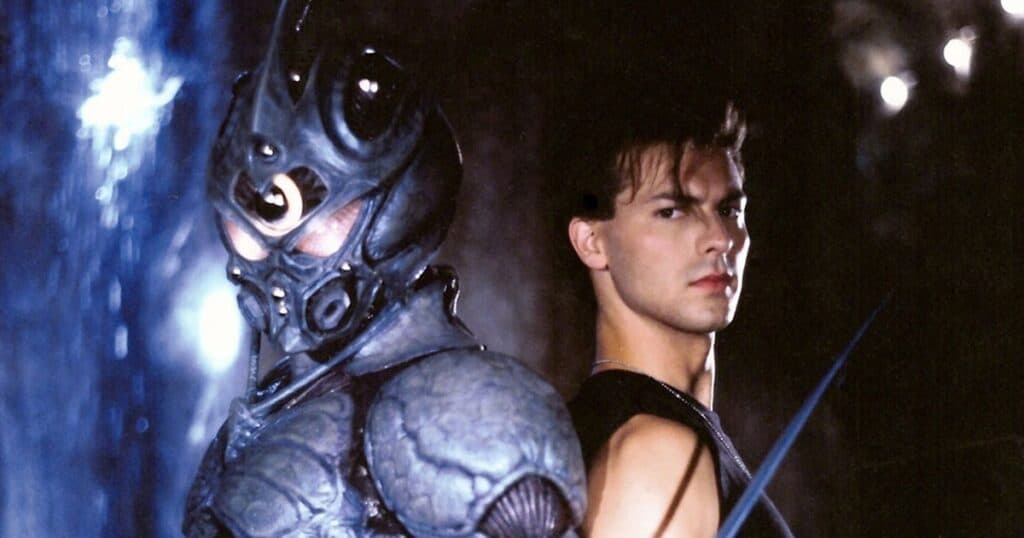
With original actor Jack Armstrong not returning, the role of Sean Barker went to David Hayter. Yes, that voice. Solid Snake himself from Metal Gear Solid. He also wrote X-Men, X2, and Watchmen. Hayter brings a unique delivery; slightly campy, but way more engaging. And this version of Sean is just better.
A Darker, More Serious Story
Unlike the first film, where Sean’s motivation revolves mostly around Mizky, here he’s dealing with something heavier:
- Guilt over the people he’s killed
- Fear of the Guyver’s violence
- A desire to stop the cycle
He’s searching for answers and redemption.
New Characters & Standouts
- Kathy Christopherson plays Corey, a strong and compelling love interest
- Christopher Michael appears as CIA agent Atkins
- Bruno Giannotta plays villain Arlen Crane and absolutely steals the show
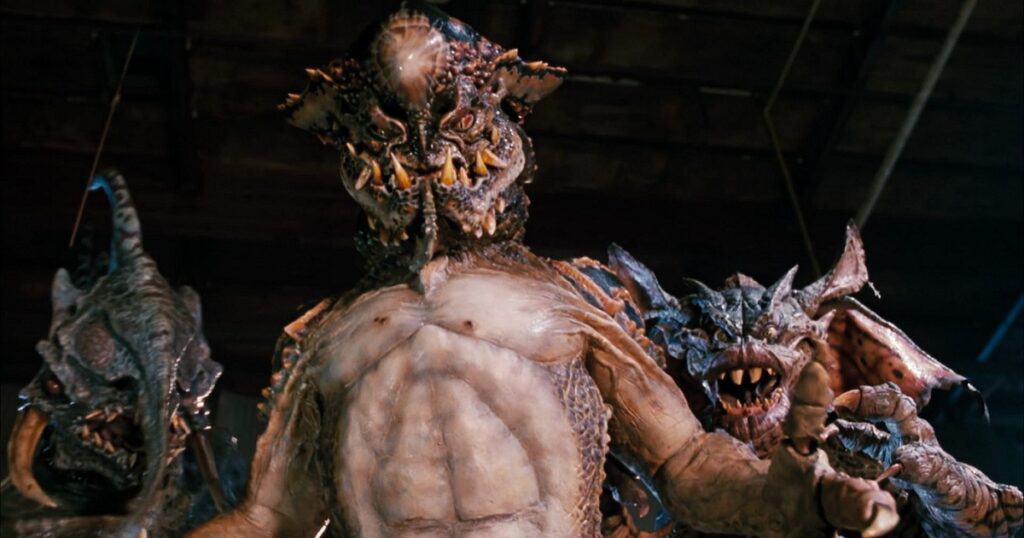
Crane delivers great monologues and has one of the coolest monster designs in the film.
The Guyver Zoanoid Controversy
Interestingly, Yoshiki Takaya initially opposed the inclusion of a Guyver/zoanoid hybrid. He wanted to use the idea himself. Thankfully, he relented. Because it gave us one of the best visuals in the entire movie.
Story Overview (Spoiler-Light)
Sean is drawn to a remote mountain area where an archaeological dig is underway. There, he discovers:
- More about the origins of the Guyver
- Evidence that zoanoids date back to prehistoric times
- A deeper connection to his own purpose
When a zoanoid appears, he knows he’s close to the truth.
Creature Design: Where the Film Shines
Despite the budget, the creature work is fantastic. Highlights include:
- Vulker, a massive rhinoceros-like zoanoid
- Arlen Crane’s Predator-like design with moving jaws
- Returning suits (like Lisker) reused creatively
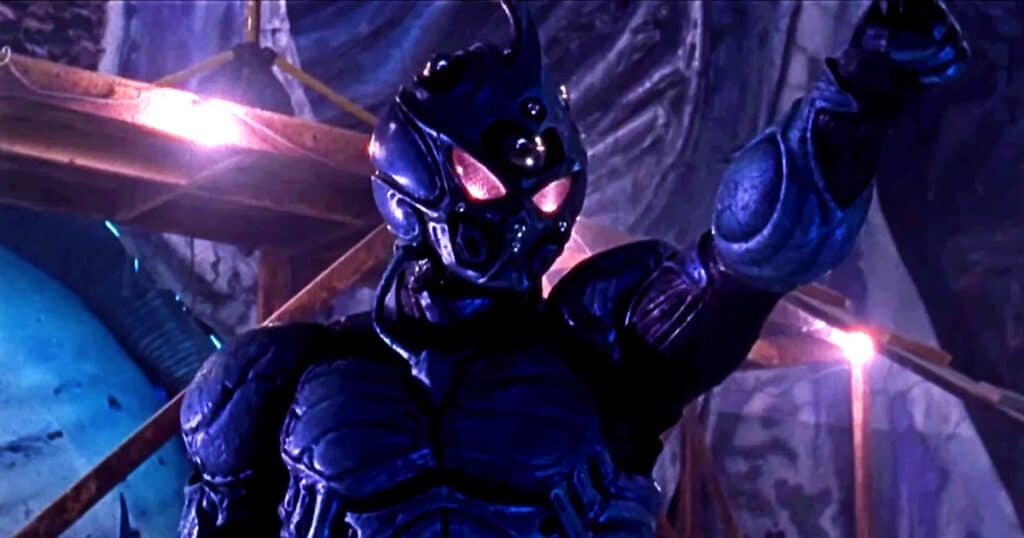
Even the Guyver suit got an upgrade:
- More blue in tone
- Bulkier build
- Closer to the manga design
Less metallic, more rubber, but it works.
Making $800K Look Like a Million
The production team got creative:
- Reused experience from the first film
- Built efficient sets
- Maximized practical effects
The spaceship set alone is impressive, especially considering today’s reliance on CGI.
The Heat Was Real (And Miserable)
Filming took place in the San Fernando Valley… in summer. The spaceship set:
- Made of plaster, foam, and chicken wire
- Fully enclosed
- No air conditioning (too expensive)
So yeah, everyone is sweating for real.
Behind-the-Scenes Chaos & Fun
Because the production was non-union:
- Long hours were the norm
- Cast and crew partied on set
- Some even slept there
The set became known as “Camp Guyver.” And in a twist, David Hayter met his future wife during filming.
Low-Budget Filmmaking at Its Finest
Crew members wore multiple hats. Case in point: Wyatt Weed
- Associate producer
- Second unit director
- Miniature builder
And… the guy who gets brutally killed at the beginning.
The Opening Scene Packs a Punch
Shot in a real steel factory in the City of Industry, the opening:
- Uses real equipment (including an overhead crane)
- Feels bigger than the budget suggests
- Sets a darker tone immediately
More violence. More swearing. This isn’t the first movie anymore.
The Music Shift
Original composer Matthew Morse didn’t return. Instead, Wang brought in his friend: Les Claypool of Primus. He even created music recognizable from South Park. The final fight score? Thrown together quickly, slightly messy, but it works.
Release & Reception
- Premiered at Los Angeles Comic Con (with technical issues)
- Released in Japan: April 20, 1994
- Released on VHS in the U.S.: October 19, 1994
No theatrical run, but it became a video store staple. Reviews were kinder this time. Still not a hit. Still a cult classic.
Why Dark Hero Deserves More Love
New fans are still discovering it today. And it deserves it. If you want to go deeper, check out Biomorphs by Dom O’Brien, a fantastic behind-the-scenes book.
Final Thoughts: Where’s the Comeback?
We live in an era where everything gets rebooted. So why not The Guyver? There’s so much untapped potential:
- Dark sci-fi tone
- Incredible creature designs
- One of the coolest suits in fiction
As flawed as these films are, they still deliver something special. And more people need to know about it.
I’m doing my part. You should too. Spread the word. Because we need more The Guyver.
Two previous episodes of Revisited can be seen below. To see more of our shows, head over to the JoBlo Horror Originals channel – and subscribe while you’re at it!







The comment section exists to allow readers to discuss the article constructively and respectfully, focused on the topic at hand.
What’s Not Allowed