


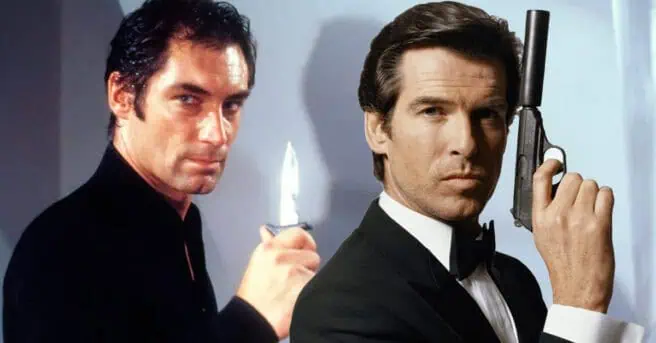
Timothy Dalton and Pierce Brosnan defined James Bond throughout the late eighties and into the nineties. Both had sometimes controversial runs as 007, and both had to arguably hand over the reins to the part before they had truly gotten the chance to shine, but their paths to 007 oddly intersect over and over, with both having long been associated with the role before they ever ended up playing it. How does that happen? Stay with us because we’re going to take a deep dive into how—in the golden age of the series—one became James Bond, but also—on the flip side—lost the role, even if it would forever define both actors’ careers long after they sipped their final Vodka Martinis—SHAKEN, NOT STIRRED, of course.
For a James Bond fan, these are interesting times. A whole new era in the super spy’s history is about to start, with this being the first Bond movie produced since 1983’s renegade Never Say Never Again that didn’t have the fingerprints of Eon Productions all over it. This production company, which stood for Everything or Nothing, was founded by producers Albert R. Broccoli and Harry Saltzman, and with the exception of the 1967 spoof Casino Royale and Never Say Never Again, it produced every James Bond movie. Now run by Albert R. Broccoli’s daughter, Barbara Broccoli, and his stepson, Michael G. Wilson, it kept 007 as a very lucrative family business, and they wielded enormous control over the franchise—until—that is—they were recently bought out by Amazon, who now control the destiny of the silver screen’s most iconic spy.
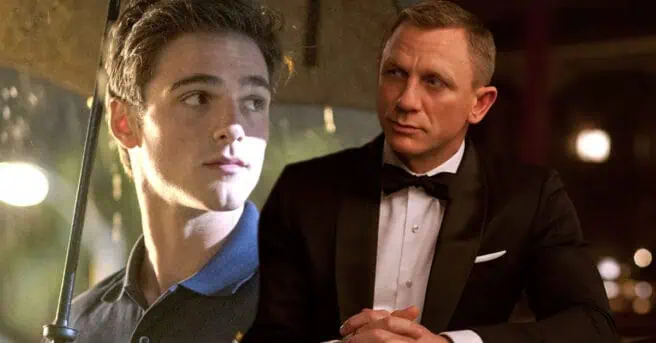
Now, everyone is waiting with bated breath over who will be the next to don 007’s tux, to the point that speculation has run rampant, with presumed frontrunners Jacob Elordi and Callum Turner unable to sit for an interview without someone asking them whether or not they will be the next James Bond. This is how it’s always been, though, and one person who could tell you all about that is Pierce Brosnan, who for about a decade probably never sat for an interview where someone didn’t bring up the part—long before he ever played it. But what made it worse for Pierce is that he’d come tantalizingly close to playing the role, losing it at the eleventh hour to Timothy Dalton for a ridiculous reason we’ll be getting into. Brosnan, once he actually played 007, remembered a low point seeing a billboard of Timothy Dalton as James Bond in his first movie, The Living Daylights, and admits he could never bring himself to watch the films, as he knew that could have been him up there. Yet, even though he replaced Brosnan at the last minute, Dalton was far from an emergency backup, with him having his own intriguing history with the series.
Timothy Dalton’s First Encounter with 007
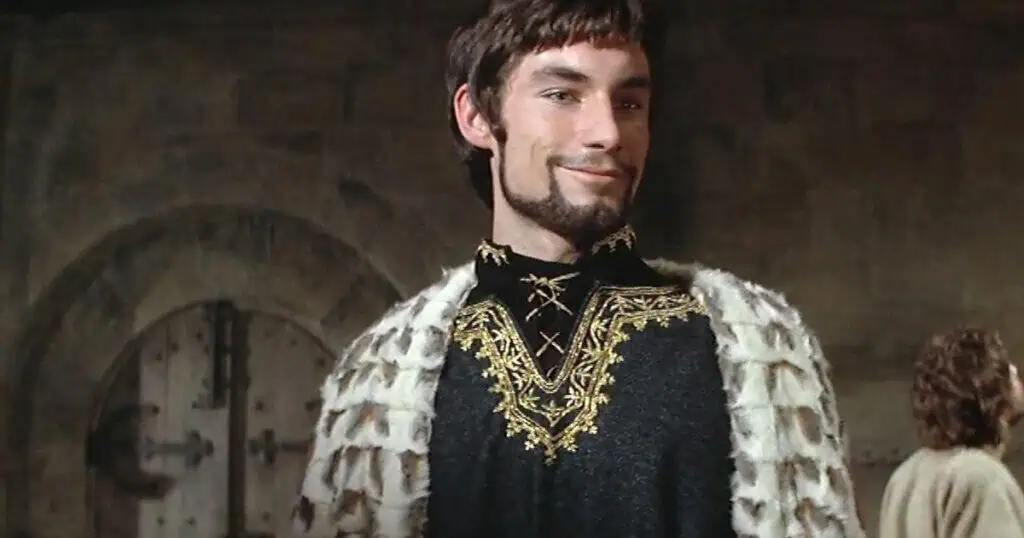
Jump back to the late sixties, when the Welsh-born Dalton was just coming into his own as a young man in the theater, following his Royal Academy of Dramatic Arts training. He got a big break when he was signed to play Philip II of France in one of the most acclaimed movies of the period, The Lion in Winter, opposite Peter O’Toole and Katharine Hepburn. Another actor making his debut in the film was Anthony Hopkins, while another, Nigel Terry, would go on to play King Arthur in Excalibur. Dark and brooding, this was when Dalton first came to the attention of producers Albert R. Broccoli and Harry Saltzman, who were casting a wide net to find a new 007, with Sean Connery having quit the role following You Only Live Twice.
While now any actor would kill to play the part, this was not the case circa 1968. Sean Connery was so closely identified with the role that many thought anyone replacing him was doomed to fall flat on their face. Perhaps this was how Dalton felt, but in interviews he stated it was more his age than anything else, as he was only about twenty-two at the time and felt he was far too young to play the role.
Just as everyone predicted, George Lazenby was presumed to have fallen flat on his face as 007 in On Her Majesty’s Secret Service, with the presumption being that he was fired after one movie. The truth is more complicated, as Lazenby’s ego went into overdrive and, having taken some very poor advice from his agent, he quit the role even though Broccoli and Saltzman wanted him back for Diamonds Are Forever. The head of UA, David Picker, said differently, saying the studio had a mandate to bring Sean Connery back at any cost. Yet sometime in the lead-up to Diamonds Are Forever, it looked like yet another 007 would be launched, with American John Gavin having actually been hired to play the role. Before him, Dalton was apparently approached again, but he once again turned it down, with his career pretty hot at the time, having played Heathcliff in an acclaimed version of Wuthering Heights. And again, there was a certain shadow over the Bond role at the time, as no one actually knew whether it was possible to have someone succeed in the role who wasn’t Sean Connery. That all changed when Roger Moore, at forty-five years old (he was actually three years older than Connery), was hired to play 007 in Live and Let Die. The choice of Moore was interesting because he was distinctly not an unknown, but a virtual household name in the UK thanks to his long-running series The Saint, which in its later years became increasingly Bond-like. Moore ended up being a hit in the role, so much so that he had a stronghold on it for the next twelve years.
By all accounts, the relationship between Moore and EON, which by this point was solely owned by Albert R. Broccoli, was harmonious—but one can never say Broccoli only had eyes for Moore. In fact, Moore almost left the series after Moonraker in 1979, and guess who the producers approached again? Timothy Dalton. By this point, Dalton was in his thirties, and his resemblance to the ideal of James Bond was picking up steam, with him even appearing as a character on the show Charlie’s Angels whom everyone kept saying looked like James Bond. Dalton says he turned down the role, not having liked the direction they were going in, and another actor named Michael Billington was actually enlisted to play the role before Broccoli blinked and agreed to pay Moore the hefty salary he’d been asking for, as under his reign the box office had steadily increased. As much as people don’t like Moonraker now, until GoldenEye came out it was the highest-grossing 007 movie of all time.
Pierce Brosnan shows up on the set of For Your Eyes Only
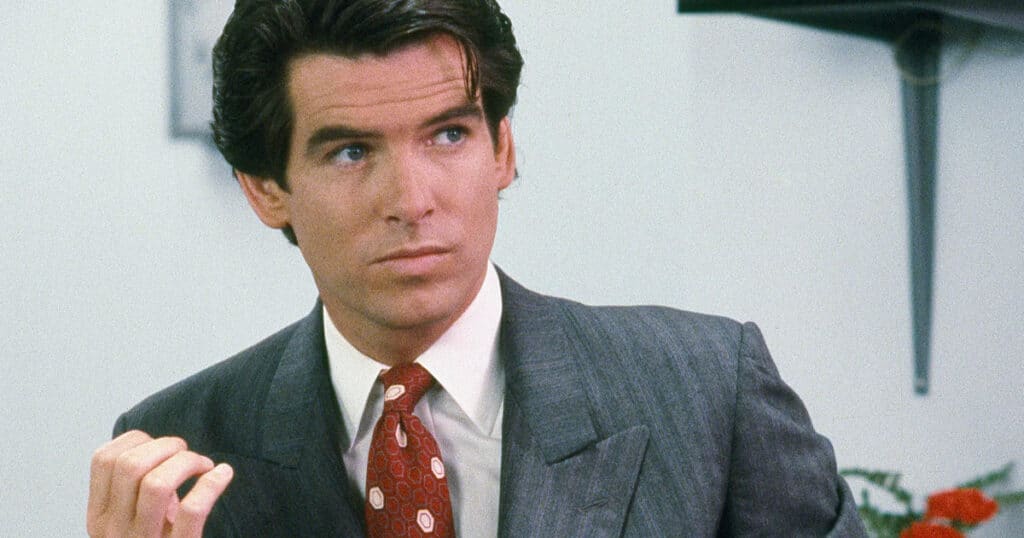
While Broccoli kept returning to Dalton over and over again, it was on the set of For Your Eyes Only that Cubby Broccoli caught a glimpse of another would-be Bond, a handsome young Irishman named Pierce Brosnan. One of 007’s love interests in the film is played by a beautiful actress named Cassandra Harris, and she was married to Brosnan at the time, who hung around on set. Broccoli and director John Glen took note of the darkly handsome Irishman, who’d made an impression the year before in a silent role in the classic British gangster movie The Long Good Friday. Apparently Broccoli even told Harris, “If he can act, he’s my Bond.”
In fact, had Pierce Brosnan not moved to America shortly afterward, it’s possible he might have played 007 in 1983, with Broccoli once again not wanting to pay Moore’s hefty salary. But by this time Pierce was a star on American TV thanks to playing the title role on Remington Steele, a show where over and over people compared him to James Bond, as did the press, who likely had no idea just how close he actually was to the part. Yet had Sean Connery not opted to star in Never Say Never Again, it’s unlikely Brosnan would have ever gotten his next close brush with 007, as Broccoli once again hired someone else to play 007—in this case American actor James Brolin. Alas, all involved felt it was a bad idea to choose that moment to launch a new Bond, as with Connery starring in a competing Bond movie they needed a ringer—and as such Roger Moore once again got a nice paycheck to play 007 in Octopussy, a movie that outgrossed Never Say Never Again at the box office by a wide margin. EON was so happy with the box office they convinced a reluctant Moore to return for A View to a Kill, but Moore apparently had a moment of clarity when he remarked that one of the mothers of the various love interests he had in the movie was younger than him when he began playing Bond, so he decided it was time to step down.
And so the hunt was on….
Brosnan gets hired…then unhired
In 1986, pretty much every young English actor tested to be James Bond. Heck, you didn’t even need to be English, with New Zealander Sam Neill at one point a frontrunner, as was the French actor Lambert Wilson. Mel Gibson was also considered a possibility, but by then he’d already played Mad Max and soon after would be launched to superstardom when he starred in Lethal Weapon. But Albert R. Broccoli already had his eye on who he thought would be the ideal person to take over as 007—none other than Pierce Brosnan.
In the years since he’d shown up with his wife, Cassandra Harris, on the set of For Your Eyes Only, Brosnan had become a TV star in America. On NBC, he starred in the romantic comedy/mystery series Remington Steele, in which he played a con man posing as a sleuth who winds up becoming the real thing. The press at the time couldn’t get enough of his dark Irish looks, with many saying he would absolutely kill it as James Bond.
Yet Brosnan wasn’t the only one Broccoli had his eye on. Timothy Dalton, despite having turned down the role at least twice before, was still seen as a possibility. His career had stalled in recent years, with his most notable roles being the love interest to an eighty-five-year-old Mae West in Sextette. He had starred in the Mel Brooks–produced horror film The Doctor and the Devils, which earned excellent reviews but whiffed at the box office. He was now doing TV miniseries, starring opposite Joan Collins in the soapy melodrama Sins. Clearly, he could use the boost, and at about thirty-nine he was just about the right age to play Bond and undoubtedly would have nabbed the part—if only he hadn’t signed on to play the love interest in a big-screen version of the hit comic strip Brenda Starr, opposite Brooke Shields. If you haven’t heard of that movie—well—there’s good reason for that.
So with Dalton out of the picture, probably for the last time, attention was turned once again to Pierce Brosnan, who had also recently made a feature called Nomads that, while not a huge hit, did get noticed around town, with its director, John McTiernan, earmarked for Predator. While on the young side for Bond, being only about thirty-three years old at the time, Brosnan was called into EON for what would be an extensive screen test lasting three days. He was outfitted in a classic Bond tux and acted out a series of classic scenes from the franchise, including the classic Tatiana Romanova seduction scene from From Russia with Love. It was agreed that Brosnan had all the elements to play Bond. He was handsome but could also be tough when the need arose—so Pierce Brosnan was publicly offered the role, and he happily accepted.
Yet there was a big fly in the ointment—NBC. Even though Remington Steele was expected to be canceled, he was still under contract, and when Brosnan was hired to play 007, TV execs figured they could cash in on his notoriety by greenlighting another season of Remington Steele, which in turn would be reconfigured into more of a James Bond–like international series. Basically, they were going to rip off James Bond, and Albert R. Broccoli wasn’t having it, famously proclaiming, “James Bond is not Remington Steele, and Remington Steele is not James Bond.” Brosnan, in turn, had no choice but to honor his contract, and so the role slipped through his fingers.
Dalton finally signs the dotted line

And so the producers were once again left without a 007, but the timing would turn out to be fortuitous for Dalton. By the time he was approached again, Brenda Starr had finished filming, and the movie—simply put—was a catastrophe. It would take years for it to come out—ironically it wouldn’t surface in North America until three years after Dalton’s last James Bond movie. Despite all of this, Dalton still wasn’t sure if he wanted to be Bond. While he had been approached and considered for the part many times, he still struggled with whether or not he’d actually suit the role, having never really done anything like it in his career. He knew that once he signed on to play the role it would forever define him, and he had also been publicly critical of the increasingly silly direction the franchise had taken in the Roger Moore years. Dalton himself said that he finally made up his mind at an airport in Miami, when he picked up the phone, called the producers, and said he was on board.
Now, it’s hard to say how Brosnan’s 007 would have fared compared to Dalton’s, as many say the pivot into darker territory was at the urging of the new 007 himself, who wanted to go back to the darkness of Fleming’s original novels. Yet The Living Daylights, which is really an underrated Bond film, does play like it was written more for someone like Brosnan than Dalton, with it heavy on romance and more derring-do–style action, which actually had to be toned down in the editing room. There was a scene where 007, in a moment that could have been ripped out of a Roger Moore movie, escapes bad guys in Tangier by riding a carpet over some phone lines, making it seem like a “magic carpet.” Moore—or heck, maybe even Brosnan—could have sold that, but Dalton looked embarrassed. Notable was Dalton’s discomfort in other Bond-like scenes, with him awkwardly holding a cigarette in the smoking scenes. His tailoring is also strange when he’s wearing a suit, with him the only James Bond to sport a “wash-and-wear” suit, which was a cheap kind of suit made in the eighties that you could wash at home in a washing machine and dryer without needing to press it. Yet he did look cool in a tuxedo, and the action must have been reconfigured at some point during the production, with Dalton far more vigorous than the older Moore, which is why the movie has a lot more brawling for Bond, including a killer fight in an Afghan jail and another great one at the climax with the movie’s henchman, Necros, as they hang from a cargo net out of an airplane where, in a taste of things to come, Dalton’s 007 coldly executes the bad guy by cutting the shoelaces from the boot he’s holding onto as he begs for his life. There’s also a lot more gunplay, which is something Moore never liked doing, and in this way The Living Daylights feels more modern as an action film than anything we’d seen in the James Bond series up to that point.
Were Dalton’s 007 movies successful?
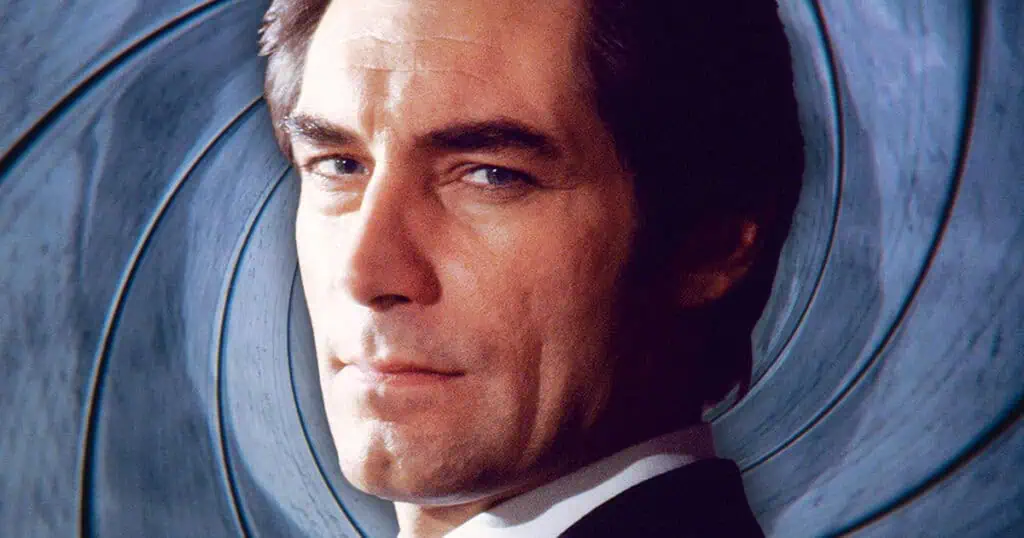
While many assume both of Dalton’s James Bond movies flopped, that’s not true. The Living Daylights was actually a significant box office success. It did fairly well in North America, with about $51 million, which was on par with A View to a Kill, but less than Moonraker, For Your Eyes Only, and Octopussy. Yet internationally it outgrossed both Octopussy and A View to a Kill, so EON and MGM/UA were pretty thrilled with Dalton’s debut, with him also earning strong reviews.
In fact, everything seemed to be pointing at a long run for Dalton as 007, and when a second James Bond film featuring him in the role was greenlit, everyone assumed it would be a hit. More so than The Living Daylights, this movie would be crafted with Dalton’s darker approach to 007 in mind. It would also be—ironically enough—the most American-skewed Bond movie since Bond went to Vegas in Diamonds Are Forever, with Michael G. Wilson the creative steward now. The film would feature villains ripped from the headlines, with Robert Davi’s Franz Sanchez a cartel leader very much in the mode of Escobar, with much of the action set in the fictional Republic of Isthmus, which was a stand-in for Panama and Manuel Noriega. It would be much more violent than your usual Bond film, taking a page from American action movies of the era—with a heavy dose of TV’s Miami Vice worked in—as Bond goes undercover in Sanchez’s cartel as a rogue agent (who actually has his license to kill revoked), hellbent on avenging the brutal maiming of his best friend, CIA Agent Felix Leiter, and the murder of Leiter’s bride—no doubt reminiscent of Bond’s own wife Tracy, who was killed in On Her Majesty’s Secret Service, with this only the third time her death was mentioned in the entire series.
Watching Licence to Kill now, it’s easy to make a case for it being the most underrated Bond movie ever made. Dalton’s performance as 007 is one of the best in the history of the franchise, with him bringing an edge to the part that harkened back to the Connery days. It’s the only time in the franchise up to that point, since perhaps Connery in his heyday, where Bond felt legitimately dangerous. It has a great villain in Davi’s Sanchez, while Benicio del Toro kills it in his henchman role as the young, impetuous Dario, while Carey Lowell’s Pam Bouvier remains one of my all-time favorite Bond girls. But audiences in 1989 weren’t ready for it. It was the first Bond movie to nab a PG-13, and only after being trimmed at the last minute. I think American audiences rejected it because—perhaps—it seemed to them to be too familiar to American action films and not Bond-like enough. It also came out at the worst possible time, being released in the summer of 1989, which was one of the most jam-packed in Hollywood history. This was the summer of Indiana Jones and the Last Crusade, Batman, and Lethal Weapon 2. It opened disastrously in fourth place at the box office, behind Lethal Weapon 2, Batman, and Honey, I Shrunk the Kids, and never rebounded, only making $34 million domestically. Overseas, however, it was still a pretty big hit, earning another $121 million. No one really saw it as a flop per se, but it was considered a major disappointment.
Even still, that wasn’t supposed to be the end of Dalton as James Bond. A third film called The Property of a Lady was planned for 1991 or 1992 and would have taken James Bond to China, and multiple scripts were written. Yet it was caught up in a legal battle between EON and MGM which lasted four years, and by the time they were ready to make a new Bond movie, many believed Dalton’s time had passed. Broccoli was bent on honoring the agreement, but the consensus seems to be that Dalton, knowing how much the studio was pressing Broccoli to recast, ended up taking the high road and leaving—especially considering that Broccoli was in ill health at the time and that the creative baton of the series was being passed, making it logical that the franchise would get a fresh start.
Pierce Brosnan finally gets his shot

Enter Pierce Brosnan. The years following his initial signing as 007 hadn’t been the best. Not only did he have to deal with the indignity of the press always portraying him as the man who lost out on 007, but NBC actually canceled the season of Remington Steele they ordered after only five episodes. It was off the air months before The Living Daylights hit theaters. Brosnan tried movies, with him having a good role as the villain in the Michael Caine spy flick The Fourth Protocol, as well as the lead in an old-fashioned adventure movie called The Deceivers. He even tried action with the Irish flick Taffin, but the roles dried up fast, and toward the end of the decade and into the nineties, he was mostly doing B-movies and cable films. Tragically, his beautiful wife, Cassandra Harris, to whom he was devoted, died around this time, leaving him a single father. Yet it was around this time that his career actually started to pick up a bit of steam. He played the second lead in the successful sci-fi flick The Lawnmower Man, and New Line Cinema actually planned to launch him as an action hero with their movie Live Wire, in which he’d sport an American accent, with him reworked into a Bruce Willis–style action star. Sadly, they dumped the pretty good flick onto cable, but then he got a great role in Mrs. Doubtfire as the very James Bond–looking love interest for Sally Field. Importantly, that film’s director, Chris Columbus, was one of the most powerful directors in town and was actually approached to direct what would become GoldenEye. He passed but told EON they needed to consider hiring Brosnan for the role.
So as you see, Dalton was still attached pretty late in the game, but when he bowed out, the logical choice—of course—was Brosnan. Ironically, at around forty years old, he had aged into a more appropriate choice for the role, and when he signed on to star in GoldenEye, the press worldwide—and fans as well—celebrated the choice. To many, he was long overdue his shot at 007. His film, GoldenEye, was a box office smash, with it the most successful since Moonraker, and Brosnan’s three subsequent Bond films all became bigger and bigger hits, with Die Another Day setting new franchise records.
Brosnan’s mixed run comes to an anticlimactic end
Ironically, despite being such an amazing choice for 007, Brosnan got the worst material of any of the Bond actors, with none of his follow-up films living up to GoldenEye. He pushed EON to give him darker material, but they wanted to keep things light. When they finally decided to make a dark James Bond film, they opted to do it without Brosnan, unceremoniously dumping him from the role.
What’s interesting to note is how, in the years since their respective 007 eras, Dalton and Brosnan’s careers seemed to echo each other. Of the two, Dalton by far had a harder time escaping the role, with him reduced to B-movies by the end of the nineties. Brosnan, having earned raves for his performance in The Matador, was able to segue into more character-driven roles, but he also struggled with typecasting. What would break the cycle for both men—interestingly enough—was TV. Dalton ended up playing one of the leads on the long-running Showtime series Penny Dreadful, which came from two James Bond veterans, Sam Mendes and writer John Logan. He then moved right into DC’s Doom Patrol and very recently earned excellent reviews for playing the villain on Taylor Sheridan’s 1923, with him having finally escaped the shadow of 007. The same thing recently happened for Pierce Brosnan, with him earning the best reviews of his career for playing his first true villain, the psychotic head of a British crime empire in MobLand, a role which oddly echoes his breakout role in The Long Good Friday. However, unlike Dalton, Brosnan, who’s still a pretty strapping figure into his seventies, still gets associated with the part, with many saying the new rights holders, Amazon, should consider doing an old man Bond movie in the vein of Logan, with him in the lead. It’s unlikely to happen, but Brosnan, God bless him, could still nail the part.








The comment section exists to allow readers to discuss the article constructively and respectfully, focused on the topic at hand.
What’s Not Allowed