


True crime stories have always held a special place in the public consciousness. It’s why even films that feature very little truth are still labeled as “true stories,” and audiences eat it up. There’s something more visceral about watching a story that actually happened. But audiences also crave a satisfying conclusion and the honest truth is that real life doesn’t always tie things up in a nice bow. Loose ends remain. Questions linger.
If you were in the Bay Area in the late ’60s and early ’70s, there are few mysteries more haunting than the Zodiac Killer, a man who murdered multiple people and taunted police with cryptic ciphers. There’s just one problem: they never found him.
So the question becomes, would audiences accept a serial killer story where the killer is never caught? Let’s dig into what happened to David Fincher’s Zodiac.
The Long Road to the Screen
Robert Graysmith wrote his true crime book Zodiac in 1986, selling over 4 million copies. The film rights initially went to producer Shane Salerno, who set the project up at Touchstone Pictures. However, that version would have been fictional, following a modern-day Zodiac copycat in Los Angeles. Thankfully, it never got made.
Writer James Vanderbilt, who had been obsessed with the book since high school, saw its true cinematic potential. Producer Brad Fischer reached out to Graysmith just as Disney lost the rights, and the timing couldn’t have been better. Graysmith chose Vanderbilt and Fischer to bring the real story to life.
David Fincher Joins the Project
Vanderbilt’s first choice for director was always David Fincher, inspired by Se7en. At the time, Fincher was preparing The Black Dahlia but eventually dropped out (it would later be directed by Brian De Palma). That opened the door for him to take on Zodiac.
Fincher had been fascinated by the Zodiac case since childhood, making this a deeply personal project. He, Vanderbilt, and Fischer spent three years researching; interviewing witnesses, victims, and investigators to ensure the most accurate version possible.
Deep Research and Real Testimony
One of the surviving victims, Michael Mageau, had disappeared from public view. The filmmakers hired a private investigator to track him down. His testimony became crucial in recreating his near-fatal encounter with the Zodiac Killer.
Studio Concerns vs. Creative Freedom
Paramount and Warner Bros. co-financed the film after MGM dropped out due to concerns over runtime and the dialogue-heavy script. Despite worries about the inconclusive ending, the studios ultimately gave Fincher the freedom to make the film his way.
Casting the Key Players
Fincher assembled a standout cast:
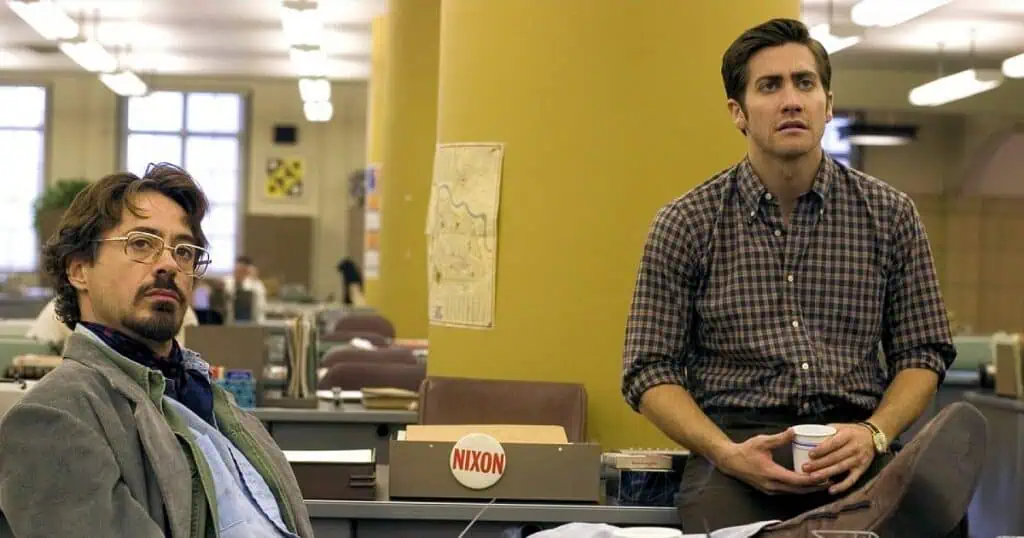
- Jake Gyllenhaal as Robert Graysmith
- Mark Ruffalo as Inspector Dave Toschi
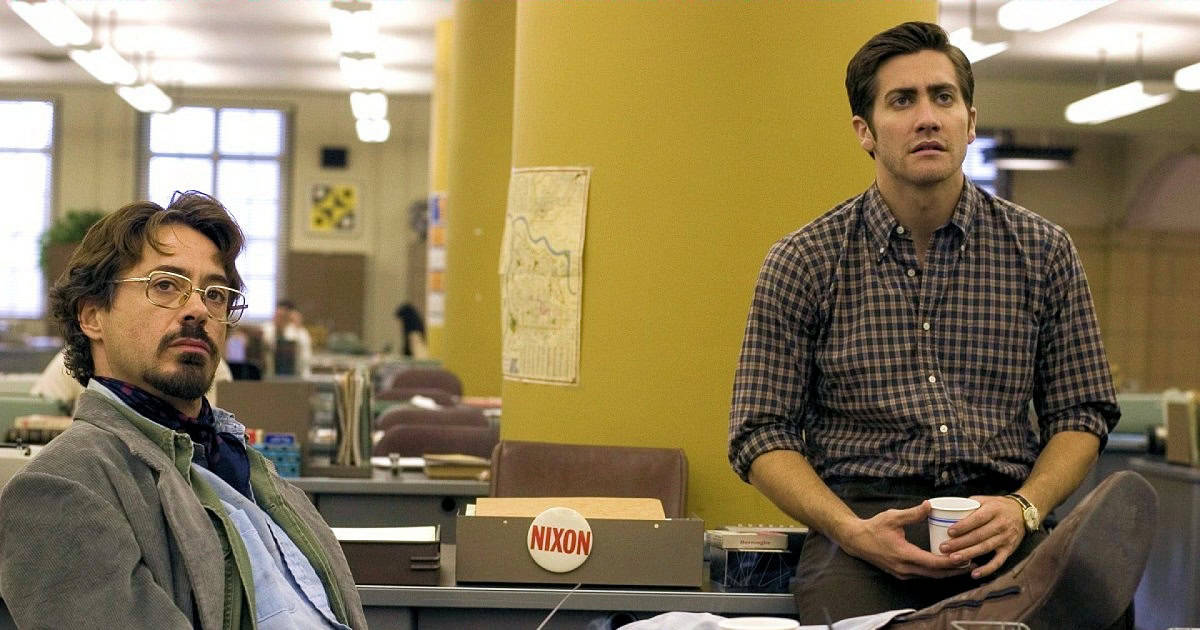
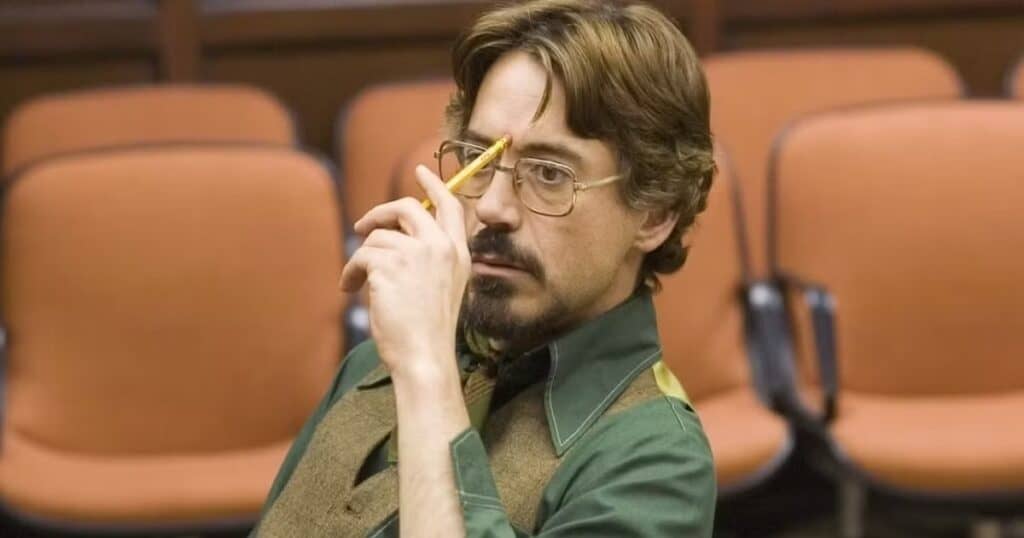
- Robert Downey Jr. as journalist Paul Avery
- Anthony Edwards as Bill Armstrong
- Chloë Sevigny as Melanie Graysmith
Gyllenhaal was chosen for his ability to portray both naivety and obsession. Ruffalo initially wasn’t interested, but Fincher convinced him.
The actors met their real-life counterparts, shaping their performances around those interactions. Robert Downey Jr., cast before his major comeback, brought charisma and unpredictability to Paul Avery.
The Arthur Leigh Allen Question
The role of Arthur Leigh Allen, the film’s primary suspect, was crucial. John Carroll Lynch plays him with deliberate ambiguity, never confirming guilt or innocence. Even within the film’s narrative, doubt remains.
A Different Kind of True Crime Story
Zodiac avoids the typical structure of a crime thriller. There’s no final capture. No definitive resolution. Instead, the film focuses on:
- The psychological toll on investigators and journalists
- The paranoia of a killer still at large
- The obsession that consumes those chasing the truth
The murder scenes are based strictly on witness testimony. If there were no witnesses, the film doesn’t depict the crime. Multiple actors portray the Zodiac Killer to match varying descriptions, adding to the unease.
Commitment to Accuracy
The production went to extreme lengths for authenticity:
- Costumes were exact recreations of what victims wore
- Real locations were digitally rebuilt
- Events were reconstructed from documented accounts
Some liberties were taken. For example, Graysmith and Toschi weren’t close in real life, but these choices helped unify the narrative.
Fincher’s Technical Approach
Unlike Se7en, Fincher wanted Zodiac to feel grounded and mundane. The film was shot on Thomson Viper digital cameras, with certain sequences, like slow-motion murders, captured on film.
What appears to be a simple opening tracking shot actually required 450 feet of dolly track to eliminate camera shake.
Recreating 1970s San Francisco
Much of the film’s environment was digitally enhanced. Fincher used CGI to reconstruct period-accurate San Francisco, including a stunning push-in shot of the city, one of his personal favorites. Matte paintings and practical effects were also used extensively to maintain texture and realism.
The Many Takes of David Fincher
Fincher’s reputation for excessive takes is well-earned. Jake Gyllenhaal reportedly grew frustrated, with some scenes requiring dozens, sometimes nearly 90, takes.
Even simple actions, like tossing a book, could take 30+ attempts.
Robert Downey Jr. also contributed to the challenge, insisting on including a straw trick in a bar scene, only to regret it after countless retakes for continuity.
Practical Effects vs. Digital Choices
While Fincher embraced digital filmmaking, he also valued practical techniques.
- Newspaper headlines and text were filmed physically for added realism
- Blue screens were used for car interiors
- Bullet hits were done digitally for efficiency
The film was edited using Final Cut Pro; unusual for a major studio production at the time.

Release and Box Office Performance
Zodiac was released on March 2, 2007, opening to $13.3 million. It ultimately grossed around $81 million worldwide against a budget of $65–85 million, making it a box office disappointment.
Critical Reception
Despite its financial performance, the film was highly praised:
- 90% critics score
- 70% audience score
Critics highlighted its tension, realism, and character-driven storytelling.
Rather than focusing on violence, Fincher emphasized atmosphere and psychological depth.
Home Release and Technical Limitations
Zodiac has received several strong home releases. However, it was originally mastered in 1080i, meaning even the 4K version is an upscale. not a true native 4K transfer. Fincher’s director commentary is particularly notable, as he meticulously points out details, inaccuracies, and production insights.
An Ending Without Answers
In the end, Zodiac stands apart from most true crime films. There’s no definitive answer. No arrest. No closure. Even Arthur Leigh Allen, the film’s primary suspect, was reportedly considered innocent by investigator Dave Toschi.
The mystery remains unsolved. And that’s the point. Instead of resolution, the film leaves us with a question: will we ever truly know what happened?
Or does this story, like many in real life, simply… end?
A couple of the previous episodes of the show can be seen below. To see more, head over to our JoBlo Horror Originals YouTube channel – and subscribe while you’re there!




The comment section exists to allow readers to discuss the article constructively and respectfully, focused on the topic at hand.
What’s Not Allowed