
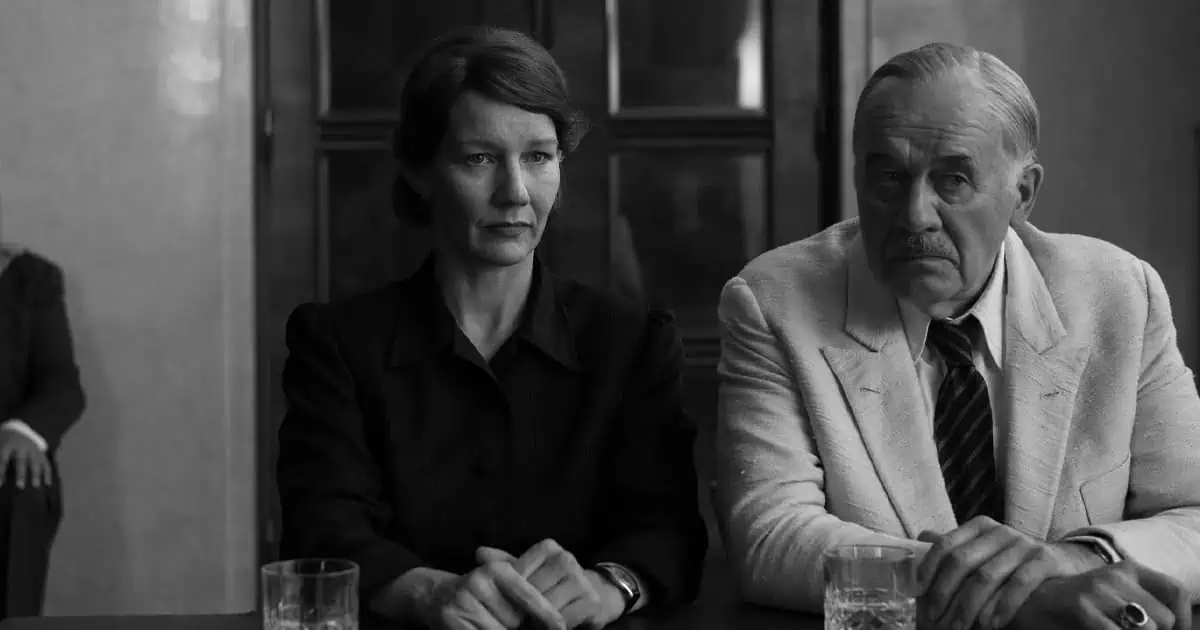

PLOT: In 1949, Nobel Prize-winning author Thomas Mann (Hanns Zischler) returns to Germany with his daughter, Erika (Sandra Hüller), to accept two prestigious tributes — one in West Berlin, and the other behind the Iron Curtain in the East.
REVIEW: Paweł Pawlikowski is among the biggest names in international arthouse cinema. His last movie, Cold War, not only nabbed the director a Best Foreign Film Oscar nomination, but also a nod for Best Director, which is rare for non-English-language films. That film was a nimble, brilliantly done love story between a Polish composer and a young singer whose relationship is ravaged by the Cold War. His follow-up, Fatherland, is thematically similar in that it once again focuses intensely on the tortured relationship between two people, in this case a father and daughter.
Thomas Mann is among the most compelling literary figures of the 20th century. The writer of — among other things — Doctor Faustus and Death in Venice, he, along with his family, left Germany on the eve of WWII, becoming prominent German anti-fascists. Yet, their relationship with their adopted home, the United States, became troubled throughout the Cold War and Red Scare, in some ways due to the events depicted in this film.
In Fatherland, Mann agrees to return to Germany to be honoured, but refuses to only offer his support to the West, visiting old friends and participating in a state dinner in the East, where he’s wanted for a key position — one he refuses over and over. Yet, as much as the film could have focused on the political tension of Mann’s trip, it instead opts to focus on the tension within his own family, particularly with his daughter Erika.
As played by Hüller, Erika is a brilliant woman in her own right, having served as a war correspondent and rally car driver, in addition to her skills as a polyglot, with her switching from German to French to English with ease — similar to Hüller herself. The two have a troubled relationship, with the brilliant but cold Thomas estranged from most of his family — particularly his son Klaus (August Diehl), a gifted writer in his own right. In fact, as the film shows, his most celebrated work, Mephisto, was a thinly veiled takedown of Erika’s own former husband, a German actor who became a star thanks to his close ties to the Nazis and Joseph Goebbels.
As Fatherland begins, Klaus has seemingly taken his own life, but rather than call off his trip, Thomas decides to plow ahead, with Erika in tow. While Cold War was defined by the passion between its two leads — which was scalding (Joanna Kulig briefly reprises her role here in a cameo) — Thomas and Erika are incessantly cold to each other, with much left unsaid. The film never goes the easy route of having them verbalize their resentments; rather, it’s told through the way they interact when alone, with little to no warmth.
Hüller and Hanns Zischler are superb in the leading roles, with the latter well conveying a brilliant man who, as commendable as he is as an artist and anti-fascist, is a failure as a father. Likewise, Hüller plays Erika as a woman who — when away from her father — can be explosive and full of life, but reverts to being basically his assistant and handler when he’s being fawned over in both the East and West.
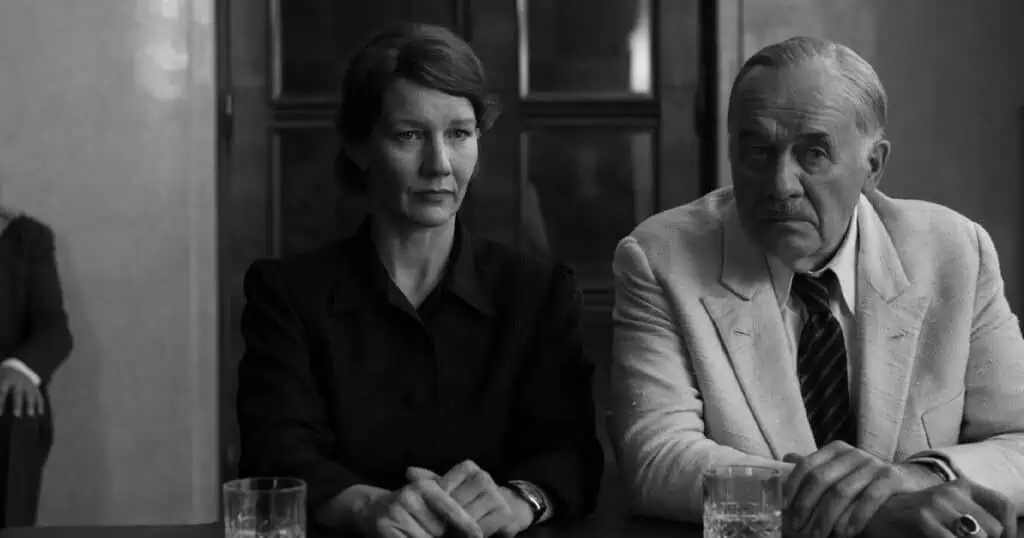
One thing that’s defined Pawlikowski’s recent work is his use of black and white, the 1.33:1 aspect ratio, as well as his brief running times. Running eighty-two minutes, Fatherland is disciplined, never becoming bogged down by extraneous footage or subplots, instead zeroing in on exactly what’s important, which is a huge difference from many of the other films in competition here at Cannes, with the majority clocking in at well over two hours (some over three). The cinematography, by Łukasz Żal, who nabbed two Oscar nominations in recent years for his other two films with Pawlikowski (and deserved on for Jonathan Glazer’s Zone of Interest), seems likely for a three-peat. Post-war Germany, with its wrecked buildings, is well recreated, with the lack of colour and aspect ratio making it feel like a movie that could have been made in the era it depicts.
While I get that Fatherland may not be an easy pick for the average audience here on JoBlo, I think a lot of you reading this might actually enjoy it. In an era where a lot of studio fare feels stagnant, many of you have expanded your horizons to international cinema, and this is a solid — if somewhat austere — film. Even if you don’t know much about Thomas Mann and his children, it’s worth checking out when it makes the rounds this fall, with it a likely Best Foreign Film player at the Oscars.











The comment section exists to allow readers to discuss the article constructively and respectfully, focused on the topic at hand.
What’s Not Allowed