
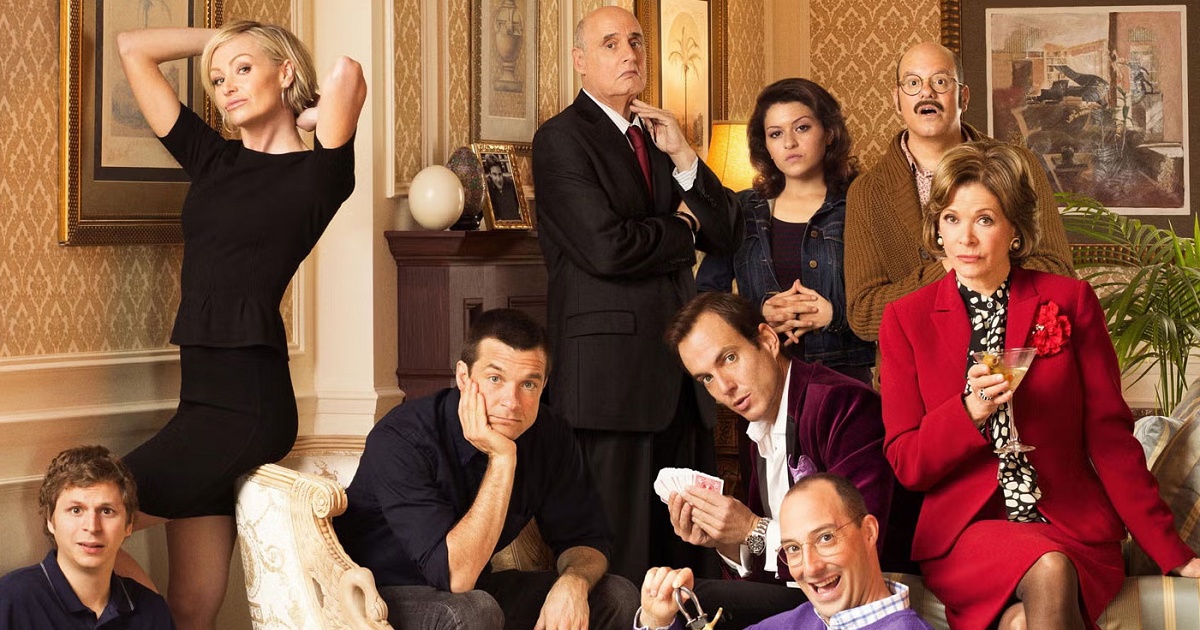
The story of Arrested Development begins with one of Hollywood’s most recognizable filmmakers: Ron Howard. Howard wanted to create a comedy that looked and felt different from anything else on television. Having worked on both traditional multi-camera sitcoms and single-camera productions, he was fascinated by a new technology that most television creators hadn’t embraced yet: HD videotape.
Unlike film, HD video was faster to shoot and required significantly less lighting and setup time. Howard believed the savings could be used to rehearse scripts extensively and perfect every joke. But when he brought writer Mitch Hurwitz into the project, Hurwitz had a different idea. Hurwitz had been developing a comedy about a wealthy family’s spectacular fall from grace. Inspired in part by corporate scandals like Enron, he believed audiences would find endless comedy in watching privileged people struggle after losing everything. Rather than spending the budget on rehearsals, he argued that shooting in a documentary-style format would allow multiple jokes, reactions, and storylines to unfold simultaneously.
The approach resembled The Simpsons, where jokes are layered throughout every scene. Hurwitz didn’t want simple sitcom archetypes. He wanted deeply flawed characters whose personalities would generate comedy naturally.
Another key ingredient was a narrator. Hurwitz felt the show’s complicated family history needed explanation, but he also realized narration could become a source of jokes itself. Ron Howard recorded the narration for the pilot as a temporary placeholder. His dry, snarky delivery worked so well that he became a permanent part of the series. Howard later said he based the style partly on nature documentaries, adding a sarcastic edge that perfectly complemented the show’s humor.
While the Bluth family was inspired by corporate scandals, Hurwitz has also admitted they were loosely influenced by powerful American political dynasties. That influence would become the source of numerous jokes throughout the series.

Casting Michael Bluth
The show’s emotional center was Michael Bluth, the supposedly responsible son trying to keep his family from imploding. Initially, Michael was written as a fairly straightforward “good guy.” That changed when Jason Bateman auditioned.
Bateman had once been a television star thanks to shows like Silver Spoons and The Hogan Family. By the early 2000s, however, his career had stalled. A string of failed projects and personal struggles had given him a reputation as damaged goods. Hurwitz was reportedly hesitant to cast him. Some accounts suggest other actors, including Jeremy Piven, were strongly considered.
Two people helped change his mind: Joe and Anthony Russo. The Russo brothers had been brought in by Ron Howard to direct the show’s unique documentary-style format. When Hurwitz expressed concerns about Bateman’s reputation, the Russos argued that his career struggles actually made him perfect for Michael Bluth. Michael was exhausted from constantly cleaning up other people’s messes. Bateman understood that feeling.
During auditions, Bateman added a dry, deadpan arrogance that transformed the character. Instead of being a traditional sitcom hero, Michael became a well-intentioned narcissist who often created problems while believing he was solving them. That complexity became one of the foundations of the series.
George Michael and the Banana Stand
One of the most autobiographical relationships Hurwitz ever wrote was the bond between Michael and his son George Michael. Hurwitz has said their dynamic was heavily inspired by his own relationship with his father. Even the famous Banana Stand was rooted in reality. As a child, Hurwitz and his brother started a cookie business. Their father eventually rented them an abandoned snack stand at California’s Balboa Fun Zone, where they reportedly sold thousands of cookies a day. The experience inspired the family business that would become one of the show’s most famous recurring jokes.
George Michael himself was intentionally designed as the family’s moral compass. His name reflected his role within the family: part George, part Michael, but struggling to become his own person.
The character truly came to life when Michael Cera was cast. After growing frustrated with overly polished child actors, Hurwitz wanted someone completely different. He discovered Cera in a failed television pilot and was fascinated by what he described as a “nothing performance.” Cera managed to be compelling while appearing to do almost nothing at all. His awkward energy became the defining trait of George Michael and helped establish the show’s unique comedic rhythm.
The Rest of the Bluth Family
Casting GOB proved particularly challenging. The character needed to be arrogant, pathetic, and somehow lovable all at once. Rainn Wilson came close to landing the role, but Will Arnett ultimately changed everything.
Interestingly, Arnett was initially rejected. Hurwitz reportedly felt he wasn’t funny enough. Jason Bateman pushed for another audition, and Arnett returned with a completely different interpretation.
Instead of playing GOB as a slick operator, Arnett portrayed him as a man who genuinely believed he was a genius despite overwhelming evidence to the contrary. That choice secured the role.
GOB’s obsession with “illusions” also carried symbolic weight. While the rest of the family hid their crimes through deception, GOB openly admitted he was trying to fool people. In a strange way, he may have been the most honest liar in the family. Real magicians were even brought in to help make the tricks look authentic before inevitably falling apart.

Lindsay, Maeby, and Tobias
Lindsay Bluth underwent one of the most dramatic transformations during casting. Originally envisioned as a disheveled hippie obsessed with alternative lifestyles, the character changed completely after Portia de Rossi auditioned. Rather than playing Lindsay as eccentric, de Rossi portrayed her as breathtakingly self-absorbed. Hurwitz loved the interpretation so much that he rewrote the character around it.
That decision also changed Lindsay’s daughter, Maeby. Originally, Maeby was supposed to rebel against her hippie mother by becoming an ultra-conservative pageant contestant. Once Lindsay became a vapid socialite, Maeby evolved into the manipulative young con artist audiences came to love. Alia Shawkat was actually the first actor cast in the series. Her chemistry with Michael Cera was immediately obvious, and the pair remain close friends today.
Then there was Tobias Fünke. The character was inspired partly by a real doctor Hurwitz knew who allegedly lost his medical license after performing unnecessary CPR on a sleeping person. David Cross auditioned for several different roles before landing Tobias. Once offered the part, he immediately understood how to play him, creating one of television’s most unforgettable comedic characters.
Buster, Lucille, and George Sr.
Tony Hale secured the role of Buster Bluth through one of the strangest auditions in television history. While most actors played Buster as an eccentric oddball, Hale submitted a tape in which he simply stared at a milk carton in terror before quietly delivering the line: “Hey brother.” Hurwitz instantly understood that Buster’s comedy came from vulnerability rather than weirdness.
Jessica Walter’s casting as Lucille Bluth was considerably simpler. Already a television legend, Walter impressed producers so thoroughly that they essentially cast her on the spot. Her ability to make cruel, selfish behavior hilarious elevated the entire series. Lucille became one of television’s greatest sitcom characters, influencing countless similar characters in later shows.
George Bluth Sr. wasn’t originally supposed to stick around either. Jeffrey Tambor was initially brought in for what was expected to be a brief appearance. However, once producers saw his performance, they realized the family dynamic worked far better if George remained an active manipulator lurking behind the scenes.
The Mustache War
Before the show even premiered, it found itself in conflict with Fox. Network executive Gail Berman reportedly enforced a strange rule: male comedy characters should avoid mustaches, hats, and flamboyant shirts because they supposedly limited audience appeal. David Cross strongly disagreed. He argued that Tobias absolutely needed his mustache. After a heated dispute, the network eventually relented. As a small act of rebellion, Tobias also appeared wearing a puffy shirt in the pilot. It was an early sign of the creative battles the show would face throughout its run.

Why Critics Loved the Show
From the beginning, critics recognized that Arrested Development was special. Its rapid-fire joke structure, layered storytelling, and documentary-style presentation felt revolutionary in 2003. Many of its greatest jokes rewarded repeat viewings, something that was relatively uncommon in network sitcoms at the time.
The guest stars only strengthened the show’s world. Liza Minnelli joined the cast as Lucille 2, a role inspired partly by the amusing idea of casting a legendary dancer as someone constantly falling down due to vertigo.
Carl Weathers memorably played a fictionalized version of himself. Originally, the writers planned to parody his Rocky fame, but Weathers suggested making himself absurdly cheap instead. The result became one of the show’s funniest recurring jokes.
Henry Winkler’s incompetent attorney Barry Zuckerkorn was originally intended as a one-off appearance. His performance proved so popular that he became a recurring fixture throughout the series.
Other memorable guest stars included Judy Greer as the unhinged Kitty Sanchez and Mae Whitman as Ann Veal, whose forgettable personality became one of the show’s most enduring running jokes.
The Genius of the Running Gags
Few sitcoms have ever matched Arrested Development‘s mastery of recurring jokes. Tobias being a “never-nude” emerged from Hurwitz’s observation of flesh-colored garments actors wear during filming.
The famous chicken dances originated when Will Arnett asked if GOB could perform a hilariously inaccurate rooster impression. Hurwitz loved the idea and encouraged the entire cast to invent their own terrible versions.
Then there was the infamous “Mr. F” storyline. The Season 3 arc followed Michael’s romance with Rita Leeds, played by Charlize Theron. Hurwitz challenged himself to create a storyline that worked simultaneously as a romance, a mystery, a misdirection, and a long-form joke. Theron had recently won an Academy Award when she approached the show about appearing. According to Hurwitz, she joked that she needed a “lifeboat” after filming Aeon Flux, immediately convincing him she had the comedic instincts needed for the role. The result remains one of the most debated and memorable storylines in sitcom history.
Why Fox Canceled Arrested Development
Despite universal critical acclaim, ratings remained disappointing. Part of the problem was timing. Modern audiences are accustomed to binge-watching serialized comedies, but in 2003 many viewers expected sitcoms to be self-contained. Arrested Development rewarded consistent viewing and careful attention, making it a difficult fit for traditional network scheduling.
Fox didn’t help matters. Episodes frequently aired out of order, timeslots shifted constantly, and the series often competed against far more popular programs. Marketing campaigns frequently presented the show as a conventional sitcom rather than the unique series it actually was.
The network also failed to capitalize on growing internet communities, strong DVD sales, and the show’s popularity on DVRs and TiVo.
By the time Fox moved the series to the dreaded Friday night death slot opposite the Winter Olympics, its fate was largely sealed. The cancellation announcement in 2005 triggered immediate backlash. Critics and fans struggled to understand why a show winning Emmys, Golden Globes, and widespread praise was being removed from the schedule. Ironically, the controversy only increased interest in the series.

The Netflix Revival
Seven years later, Netflix revived Arrested Development. On paper, it sounded perfect. In reality, it never recaptured the magic.
Many cast members had become major stars, making it difficult to get everyone together. As a result, Season 4 split its focus among individual characters rather than showcasing the ensemble chemistry that made the original series great. The writing also felt different. Some jokes landed, but much of the sharpness was gone. Storylines often felt more interested in being outrageous than clever.
Even cast members later described the production as chaotic, with scripts frequently rewritten at the last minute and extensive reshoots complicating the process. While some fans enjoyed the revival, many felt it lacked the precision and energy of the original run.
Final Thoughts
For all its flaws, Arrested Development remains one of the most influential sitcoms ever made. Its documentary-style filmmaking, layered storytelling, and relentless joke density helped shape modern television comedy. Shows that embraced serialized humor and binge-worthy storytelling owe a debt to what Mitch Hurwitz, Ron Howard, and an extraordinary cast created in 2003. The Netflix revival may have stumbled, but it doesn’t diminish what came before.
If you’ve never watched Arrested Development, you’re in for something special. And if you have, there’s always an excuse to revisit television’s most dysfunctional family. After all, there’s always money in the Banana Stand.
Frequently Asked Questions About Arrested Development
Who created Arrested Development?
Arrested Development was created by Mitch Hurwitz. The series was produced by Ron Howard and Imagine Entertainment, with Howard also serving as the show’s narrator.
What inspired Arrested Development?
Mitch Hurwitz has said the series was inspired in part by corporate scandals such as Enron and the idea of a wealthy family suddenly losing everything. Elements of the Bluth family were also loosely inspired by powerful political dynasties and Hurwitz’s own family experiences.
Why was Arrested Development different from other sitcoms?
The series used a documentary-style filming approach, rapid-fire jokes, layered callbacks, and long-running storylines that rewarded attentive viewers. Many critics consider it one of the first modern binge-worthy sitcoms.
Who played Michael Bluth?
Michael Bluth was played by Jason Bateman. His performance helped transform the character from a traditional sitcom hero into a flawed but well-meaning protagonist struggling to manage his dysfunctional family.
Was the Banana Stand based on a real story?
Yes. Mitch Hurwitz has said the Banana Stand was inspired by a childhood business venture he operated with his brother. Their father helped them run a snack stand in California, which became the inspiration for one of the show’s most famous recurring jokes.
Why was Arrested Development canceled?
Despite widespread critical acclaim and numerous awards, the series struggled with ratings on Fox. Frequent schedule changes, inconsistent promotion, and the show’s serialized storytelling made it difficult to attract a large network television audience during its original run.
Did Arrested Development win any awards?
Yes. The series won multiple Emmy Awards, including Outstanding Comedy Series, and earned a Golden Globe for Jason Bateman’s performance as Michael Bluth.
Why did Netflix revive Arrested Development?
Netflix revived the show in 2013 after years of fan demand and strong DVD sales. The streaming format seemed ideal for a series known for its interconnected storylines and recurring jokes.
Why was the Netflix revival controversial?
Many fans felt the revival lacked the chemistry of the original series because scheduling conflicts prevented much of the cast from appearing together. Critics were also divided on the new storytelling structure and writing style.
Is Arrested Development still worth watching?
Absolutely. The original three seasons are widely considered among the greatest sitcoms ever made. While opinions on the revival vary, the original run remains a landmark achievement in television comedy.














The comment section exists to allow readers to discuss the article constructively and respectfully, focused on the topic at hand.
What’s Not Allowed