


A promising star, a harrowing tragedy, a deep obsession, and a bloody road to revenge. Batman fans rejoice, because we may be in for a horrific treat. The DCU’s Clayface movie is headed to theaters just in time for the spookiest day of the year, and I could see no better time to dive deep into the muddy whirlpool of DC Comics and bring you the full origin of Clayface. Or at least, all the details that seem relevant to the upcoming film. What you may not know is that the history of this monster may be even muddier than you initially thought. Is this a character that deserves his own movie? Do audiences WANT to explore a villain in Gotham BEFORE we’ve even met the hero? Does this seemingly off-universe film have a greater connection to James Gunn’s upcoming DCU slate? Well, in order to answer any of those questions, we need to first learn about exactly who and what we’re dealing with here. Let’s grab a stack of comics and talk about Clayface.
The Golden Age: Basil Karlo’s Tragic & Superpower-Free Origin
Okay, so, firstly, it’s important to note—like many comic book characters that have been around this long—there have been multiple versions of Clayface over the years. From the looks of it, the new film will be combining certain aspects of each to create its own take on just one of them.
The thing is, Clayface is one of those Batman villains where the version most people picture isn’t actually anything like the original. The first Clayface was Basil Karlo, who debuted all the way back in Detective Comics #40 in June 1940, only about a year after Batman himself first appeared. The story was written by Bill Finger, with artwork by Bob Kane and Jerry Robinson, and introduced Karlo as a washed-up horror movie actor rather than the giant shapeshifting mud monster we know today. Karlo discovers that one of his old horror movies is being remade with another actor in his former role, and he doesn’t exactly take the news well. He puts on the creepy mask and costume of “Clayface,” a villain he had played onscreen, and starts murdering members of the new production. Batman and Robin eventually uncover Karlo as the killer and bring his extremely dramatic comeback tour to an end.
The surprising thing about the original Clayface is that he had absolutely no superpowers. No stretching, no turning his hands into giant hammers, no impersonating people by reshaping his face—he was basically a horror-themed serial killer in a mask. Basil Karlo’s whole movie-star gimmick also seems to have been heavily influenced by classic Hollywood horror. Bob Kane later said Clayface was partially inspired by Lon Chaney’s appearance in the 1925 version of The Phantom of the Opera, and even the name “Basil Karlo” is generally understood as a mash-up of horror-era actors Basil Rathbone and Boris Karloff. That’s honestly a pretty perfect name for a Batman villain created in 1940.

Basil didn’t immediately become one of Batman’s major recurring villains, either. His original Golden Age version only made a handful of appearances, including a return in Detective Comics #49 in 1941. Eventually, DC started introducing entirely different people using the Clayface name, beginning with Matt Hagen, and those later versions brought in the shapeshifting powers. Years later, DC circled back around to Basil and essentially merged the concepts, eventually turning the original Clayface into a genuine superpowered Clayface himself. That’s why modern Basil Karlo can be confusing if you go back and read his first appearance: the guy who eventually becomes a huge walking pile of clay started out as nothing more than an angry actor with a costume and a serious grudge.
Adaptations have mixed and matched these different Clayfaces almost from the beginning. One of the most famous is Batman: The Animated Series, where the classic two-part episode “Feat of Clay” uses the name Matt Hagen, but gives him the profession of an actor—a major element borrowed from Basil Karlo. Basil himself has shown up more directly in other adaptations, including The Batman, where he becomes a Clayface after ingesting a substance that gives him shapeshifting abilities, and the live-action series Gotham, where Brian McManamon played a version of Basil Karlo created through Hugo Strange’s experiments. More recently, Harley Quinn has featured a very different and much more comedic Basil Karlo, voiced by Alan Tudyk, leaning heavily into the idea that underneath all that clay, he’s still an incredibly theatrical actor. So even though the powers and personality have changed dramatically over the decades, that original 1940 idea—an actor who takes his performance way, way too far—has managed to stick around.
The Silver Age: Matt Hagen and the Birth of the Mud Monster
The second character to take up the Clayface name was Matt Hagen, and he’s arguably the guy responsible for turning Clayface into the villain we actually recognize today. Hagen debuted in Detective Comics #298 in December 1961, in a story called “The Challenge of Clay-Face,” created by writer Bill Finger and artist Sheldon Moldoff. Unlike Basil Karlo, who was basically a disgruntled horror actor wearing a creepy costume, Hagen was a treasure hunter who stumbled across a strange underground pool of radioactive protoplasm. After being exposed to the stuff, his entire body transformed into a clay-like substance that he could reshape at will. Suddenly, Clayface wasn’t just a guy with a mask anymore; he could change his face, impersonate other people, alter his body, and basically become whatever shape the story needed him to be.
There was one pretty big catch, though. Hagen’s powers were originally temporary, lasting only about 48 hours before he needed to expose himself to the protoplasm again. That limitation became a major part of his early stories, with Hagen repeatedly trying to find ways of extending or restoring his abilities while Batman and Robin figured out how to exploit his weaknesses. It’s also worth remembering that this was 1961, right in the middle of Batman’s wonderfully bizarre Silver Age period, so the idea of a criminal accidentally discovering a magical-looking radioactive puddle in a cave wasn’t even particularly strange by Batman standards. Still, the concept worked. Matt Hagen established the basic visual and power set: a shapeshifting human made out of living clay that almost every famous version of Clayface has borrowed from ever since.
Hagen continued popping up throughout the Silver and Bronze Ages and even crossed over into the wider DC Universe, including joining Queen Bee’s Anti-Justice League. His original story eventually came to a fairly definitive end during Crisis on Infinite Earths, when Hagen was killed by one of the Anti-Monitor’s Shadow Demons. DC being DC, that didn’t keep him gone forever, and later continuity has brought Matt Hagen back into the picture. His original origin was also revisited in the 1990s in Batman: Legends of the Dark Knight #89–90, which essentially retold and modernized the basic premise of his 1961 debut.
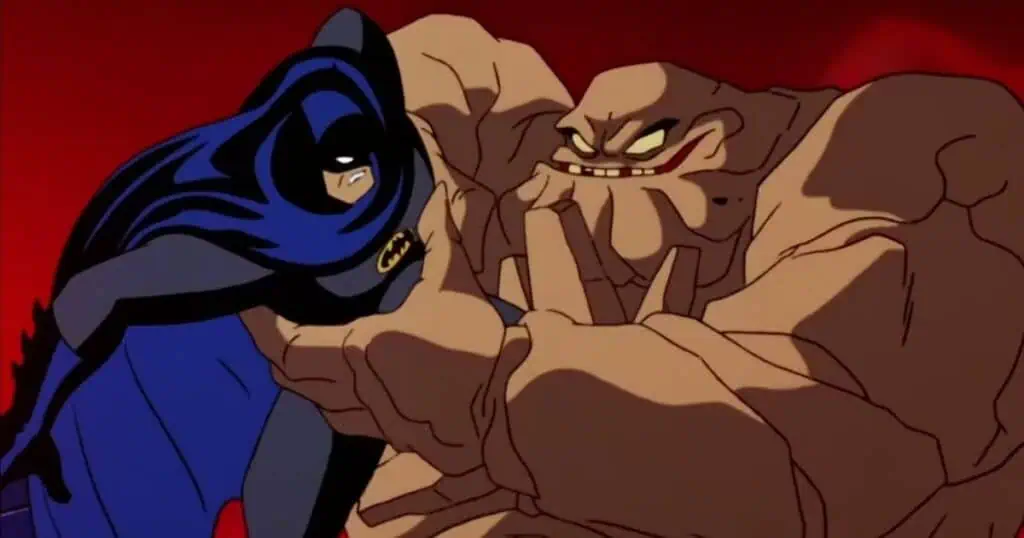
But Matt Hagen’s biggest contribution outside the comics is probably the Clayface from Batman: The Animated Series. Voiced by Ron Perlman, that version is named Matt Hagen and has the shapeshifting powers associated with the comic character, but his backstory is actually a mash-up of multiple Clayfaces. The animated Hagen is an actor whose career is threatened after his face is badly disfigured, borrowing the Hollywood/actor angle much more heavily associated with Basil Karlo. The result is basically an amalgamation of the first two Clayfaces, and the two-part “Feat of Clay” became one of the show’s most memorable villain stories.
And Matt Hagen is about to become considerably more important to the general public. The upcoming live-action DC Studios Clayface movie centers on Matt Hagen, played by Tom Rhys Harries. This version again mixes elements from the character’s history: Hagen is an actor who becomes disfigured and ultimately undergoes a procedure that transforms his body into clay. So there’s something kind of fitting about Matt being at the center of the movie. Basil Karlo may have been the first Clayface, but Matt Hagen was the character who introduced the powers that made Clayface such a unique Batman villain in the first place.
Over the years, you’ve also seen other wacky interpretations of the character like Preston Payne and Sondra Fuller, who both became Clayface at different points. Somewhere in between, they met and had a baby named “Clay,” who also became Clayface for a while. It… I don’t know… It taps into some Seed of Chucky type shit and gets a little too weird for me. I don’t think the movie will have any of those elements, but I thought it was worth mentioning for the like 12 people out there who consider Cassius “Clay” Payne to be the definitive take on Clayface…
What We Know About the Upcoming Live-Action Movie

Now, with the idea of merging Basil and Matt into one character, keeping the most interesting aspects of each, I think the Clayface movie has some serious potential. We already know a few important things, like we WILL be getting some kind of mud-monster transformation where Matt uses his mutation to take someone out. We know that he’s an up-and-coming actor from Gotham who has something vague yet sinister done to him after getting mixed up with the wrong people. And we know that according to James Gunn and director James Watkins, this movie will take place BEFORE the events of the current DCU timeline. So, anything we see in Superman, Supergirl, Peacemaker, or the present-day timeline in Lanternshas not happened yet.
So, why are they making THIS movie? Well, simply, acclaimed writer and director Mike Flanagan wrote what he saw as a twisted adaptation of “Feat of Clay” after remarking that he’d always loved Batman: The Animated Series as a kid. A writer of this caliber with THIS many good movies under his belt is nothing to shrug at, so James Gunn and Peter Safran bought the script and offered Flanagan a seat as the director of the film. Unfortunately, Flanagan was busy working on his Carrie TV series and couldn’t commit to the gig. So, it went to James Watkins (another talented filmmaker), and now who knows what still remains of Flanagan’s original script.
I think what we’re looking at is a film that was originally written as an unconnected Elseworlds story in the tradition of Matt Reeves’ The Batman and Todd Phillips’ Joker, but Gunn enjoyed it so much, and saw an angle to make it fit into his world, that he opted to make it a prequel film set in the DCU so that it could maintain having little connection to his previously established continuity. Basically, I don’t expect this movie to push the DCU forward, but rather help fill it in with stories that help make it all feel lived-in.
Why DC Fans Should Be Excited for Clayface
So, why should we care? In my opinion, James Gunn’s DCU is off to an interesting start. Superman made its debut and seems to be favorable among most fans (definitely not ALL fans), plus we had Peacemaker Season 2 which I enjoyed a lot, Supergirl which (I think) everyone hated (I thought it was fine), and the recent Lanterns on HBO Max which I’m currently loving and seems like pretty much everyone else is too.
But there has been no shortage of strange upcoming movie and TV announcements for the studio. At one point there was an announcement for a Bane and Deathstroke movie, there’s a puppet movie with Dick Grayson and Jason Todd as the Robins, there was at one point a Sergeant Rock film coming up, and a whole catalogue of seemingly random characters getting a new movie or series. Nothing could be AS random as when DC made a show called Pennyworth: The Origin of Batman’s Butler, but Gunn seems to be a bit all over the place with his upcoming slate.
I’m saying this because Clayface may FEEL like one of those projects. It’s a DCU canon movie set in Gotham that probably doesn’t have Batman in it, and we’re getting it BEFORE we’ve even seen the DCU Batman in live action (I know his shadow was in Creature Commandos, but that does NOT count). But if we look closer at this upcoming movie, I think the reason it DOES matter is because it was written to be its own thing, and it now happens to exist in-universe for the DCU. Had that decision been different, this movie would just be a Flanagan and Watkins horror film with a dark take on a familiar character. THAT is cool. So, don’t throw the movie out with the rest of the DCU if you’re not a fan. This movie could be just the thing to change your mind.
















The comment section exists to allow readers to discuss the article constructively and respectfully, focused on the topic at hand.
What’s Not Allowed