



Anyone who visits this site – hell, anyone who visits ANY site – is probably keenly aware of a certain movie about mutated, viciously violent sheep that go bonkers on the New Zealand countryside (their transformations aided by a certain Oscar-winning New Zealand-based effects house). In these days of grisly torture movies and almost-cuddly PG-13 ghosts, it’s nice to see a horror movie that is dead-set on not being taken seriously – one that prompts knee-slaps along with queasy gasps (there ARE some pretty bloody goings-on).
You would imagine that someone on the last leg of an immense press tour would be exhausted; at the very least – weary of hearing and answering what are most likely the same questions for the 4,075th time. But Jonathan King’s voice sparked with enthusiasm throughout my entire one-on-one interview with him – it was as if he had just finished the film in question, BLACK SHEEP, and was eager to immediately start talking about it. By the end of our long chat, I think I was the one who was worn-out – King was most likely just getting started.
I saw a midnight screening of BLACK SHEEP at the Tribeca Film Festival with an enthusiastic, vocal crowd, and it made for a very enjoyable experience. Did you set out to make a movie that was meant to be seen with an audience that would respond to it in a big way?
I guess I probably did.. I’ve always seen it as a fun ride for the audience, and it’s basically one of those films that I think you enjoy more with an audience around you, you know, getting into it. And certainly film festival audiences have been beyond my wildest dreams for that. I think film festival audiences, and midnight audiences come along to have a good time, it’s not like, you know (puts on a serious voice) “Okay, let’s see how good this is.” A friend of mine went to a screening here in the afternoon and there weren’t many people there, and he said people weren’t really sure if they were supposed to laugh or not. But I think if you come along ready to laugh, you’ll have a great time.
As the film starts, you get some of that tentative laughter, people aren’t sure maybe what the tone is supposed to be. It’s the kind of movie where once a few people start laughing, getting into it, then other people start to get into it. It’s infectious that way.
Exactly. Because the premise is so kinda goofy, the film actually starts kinda seriously, taking place in the real world, we set up these real people – and THEN this goofy premise comes in – and by the end there are people with no pants on-(laughs)
Well yeah, there’s a pretty gruesome effect later on in the movie that must have been pretty horrifying for everybody on set to deal with…[SLIGHT SPOILER WARNING]
Yeah, it was pretty funny, because obviously someone has to sculpt the rubber penis, and then you look at it and say “Well lookit that! Is that long enough? Should it be a bit longer?” Then you have a ton of people in the crew standing around SHOOTING the rubber penis…and then you spend a day in the editing room, thinking about how long the shot it should be “Would it be funnier if we held on it longer? Or would it be not so funny?”
You found yourself looking at it for way too long, I’m sure.
I know – I feel dirty, I need to go have a drink now! [END SPOILER]
Was there a traumatic sheep attack in your youth that was responsible for BLACK SHEEP?
I wish I could tell you that there was, but there wasn’t, unfortunately. Sheep are one of those things that everybody talks to New Zealanders about, they go “Oh there are lots of sheep there, you must run in with sheep a lot” but most of us don’t. I didn’t grow up on a farm or anything, but I certainly visited farms – and I don’t like animals very much. I was just thinking about what if IT happened, and then kinda following through with it almost seriously – but I thought it was a funny idea – what WOULD happen?
I’m sure you’re doing dozens of interviews a day – over the phone and in person – and you’re talking about your killer sheep movie. After all this time, is it a surreal experience for you at this point?
It really is, it’s certainly gone wider, and been received better, than I could’ve hoped for it, so yeah its been amazing. The idea just kinda popped into my head and it made me laugh, and I thought I could have a lot of fun with it. And we gathered some people together, and they kinda understood it and it made them laugh, and we got to make a movie of it…
How long have you been making movies for?
This is my first feature film – but for about ten years I’ve been making music videos and commercials and a couple of shorts, but I’ve been writing scripts the whole time as well. Learning how to make stuff, really. This wasn’t the first script I wrote, but this is the first one that I really had a lot of fun with – a strong, simple idea- with goodies and baddies, and monsters…
What was the most difficult part of making the film? Was it actually getting things started, getting funding? Or was it once you were actually in production, being on set, dealing with all the complicated effects and everything else?
At the end of the day, getting the film financed took like 3 years, I think – it took like 3 years from starting the script to starting to shoot – which seemed like a long time at the time. Some people say it’s reasonably quick for a film, feels like a long time. But it kept moving forward, people were always saying “Hey this could really work.” We just had to find someone who would hand over the check to make the film. And then once you have someone say “Here’s your money, go make your film!” it’s like “Oh my God, how are we going to do this?!” And then Weta workshop became involved which was sort of a huge boon for us, they brought so much knowledge and experience to the effects and things.
How was it dealing with the live sheep?
It was (pauses to laugh) frustration? We had amazing animal trainers that did BABE in Australia, and these sheep were incredible, you could call them and they’d stop where you wanted them to, they’d stop on a mark, and they’d look where you wanted them to. BUT having said that, it might take a few goes – one might change its mind and see a nice bit of grass to eat, or one of them goes where you want but the other three go in the wrong direction…
I’m sure it burns up quite a bit of film…
Exactly, it wasn’t a big budget film. It wasn’t like “Well that didn’t work lets try again tomorrow.” Things had to work that day. So I learned a lot about working with animals and effects. I would love to work more with effects and I hope to never work with animals again (laughs)
How early on did Weta become attached to the project?
They came onboard really quite early. Richard Taylor, who runs Weta, read the script and said “I love it, we’d love to be a part of it,” which was amazing for us, because they were in the middle of doing KING KONG at the time. Which was cool, because when we went to talk to people, internationally, they’d say “Well good script, but how on Earth are you going to do it?” we’d say “Well, Weta’s going to help us do it!”
Did you meet Peter Jackson?
He wasn’t involved, I only met him after I shot the film. But we shot in his studios and did the post-production in Jackson’s new post-production facility – so he wasn’t directly involved, but the film was effected by this amazing infrastructure he’s built. And I showed him the film right before Christmas, which was really exciting.
Was he a big influence? Because there are certainly similarities between BLACK SHEEP and his early, comedic horror films.
Absolutely, those early films I really loved – I think I was at the 2nd-ever screening of BAD TASTE –
Wow, that’s pretty cool.
Yeah it was really exciting. I loved the spirit of those films, and it was incredibly inspiring how he made those films – and the fact that a guy that lived in the same town as me made those films, and now he’s making these amazing, huge movies. It’s a good thing to keep you going, it’s like “Oh I want to make a movie but no one will give me money!” Well, no one gave Peter Jackson money, and he found a way to do it, and look where he is now. It’s also like Sam Raimi making THE EVIL DEAD, and he’s one of the biggest filmmakers around.
It’s got to be inspiring – those guys made these low-budget, but very influential, horror movies and now they’re incredibly popular directors. Do you see yourself eventually doing the kind of things they’re doing now? Or are you not interested in the whole “blockbuster” angle?
Well, I guess I do dream of it. I mean, those guys – it didn’t happen overnight for those guys, it was a long road, and I would like to travel the same road. But yeah, I’ve got some big ideas that I would love to make big movies out of.
Do you see yourself remaining in the horror genre for the time being?
I pretty much see myself as always making “fantastic” movies, you know? But I wouldn’t want to stay with just horror, I would love to make sci-fi movies, I’d love to make fantasy films. I’d love to make a period movie, which again is the kind of film that takes you out of the real world. I don’t want to make a gritty kitchen-sink drama about the human condition, you know? I love movies that transport you somewhere else and show you a world you haven’t seen.
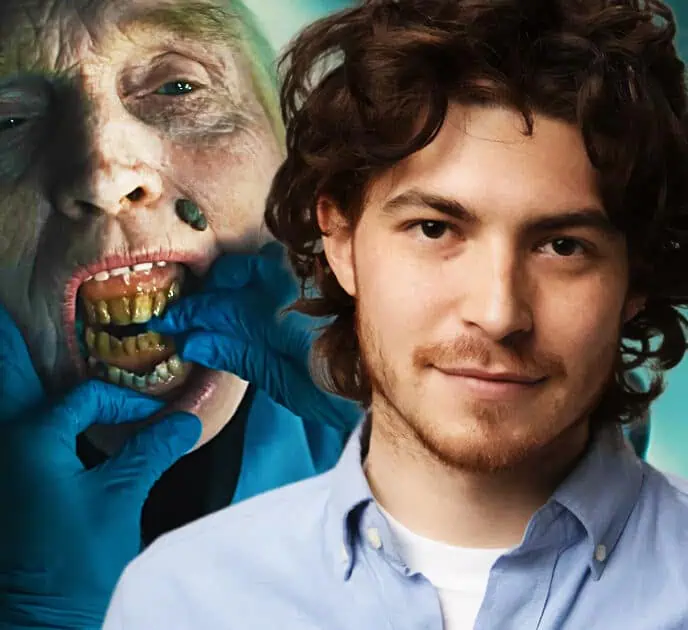
What can you tell me about THE TATTOOIST? It’s in a different horror-genre as BLACK SHEEP – it looks much more serious. Can you tell me the origin of that movie?
I only co-wrote THE TATTOOIST – I’m actually about to see it for the first time at 2pm this afternoon – I haven’t seen it yet!
That must be a bit nerve-racking!
Yeah, I’ve only seen bits and pieces. It’s funny, the same year I wrote and directed my own film, I wrote a film someone else directed. So on one hand you’re in total control over everything, and on the other you’re working for someone else and you hand it over and trust them to do what they have to do. So it isn’t my baby anymore. So I wrote it with Matthew Grainger, it was for some people who had an idea – they had a treatment that wasn’t really working, we threw everything out except we kept “Samoan tattooing horror movie.” Traditional Samoan tattooing is done with a hammer and chisel. So it’s about an American tattooist, played by Jason Behr, who comes to New Zealand to learn about that, and he unleashes this vengeful ghost who tattoos everyone he’s tattooed to death. I’ll find out this afternoon how it turned out!
Did that start at the same time as BLACK SHEEP? Or was it after?
It came together very quickly, that film – it started while I was doing BLACK SHEEP. The script for BLACK SHEEP had gotten quite a bit of attention, so someone came to me and asked if I was interested in writing this script –
So you already had a bit of clout based on the BLACK SHEEP script?
Yeah, but I was quite busy, so I said I would if I could co-write it with my colleague, with whom I had worked with before. So it took about a year and a half I think from starting the script to when it got made.
What is your next project?
I’ve got a film I’m developing, again with Matt Grainger, a thing called UNDER THE MOUNTAIN, which is kind of a scary sci-fi adventure, not for kids really, but for teens – very much influenced by THE THING and INVASION OF THE BODY SNATCHERS. Just trying to finance that at the moment.
We want to shoot it in New Zealand. Otherwise I’m looking at some books that I’d love to do, and trying to write some original things.
Is the festival circuit winding down for you now?
Winding down a little, I’m going to Melvin, Australia at the end of July, then London for FrightFest in August.
You’ve probably seen it about 2000 times!
Yeah I have! I try to watch it with audiences as much as I can, but when I just saw it three times in one weekend, now it’s like “Enough!”
Is there anything about it you pick apart even now, or are you completely satisfied?
I’m really satisfied, it was a really challenging film to make and I think we achieved what we set out to. The things that I really see are like “Oh it was really windy that day!” There are a couple bits I would maybe have done differently now, but you know it was my first movie so I learned a lot – I’m pleased really.
Anything special planned for the DVD?
We’re working on DVD stuff at the moment. There isn’t going to be a longer version, we cut the best version of the film I think, but there’s some deleted scenes, quite a bit of stuff at the front of the film which kinda slowed down the film – you wouldn’t want them back in the film, really. (Laughs) We’ll have a really good making-of, which has the behind-the-scenes effects, and great Weta concept art and that kind of thing.
Jonathan I’ve got to thank you for all of your time, I wish we had more, but I’m sure you’ll be doing this all day.
(Laughs) Yeah, I’ve got a few. Thanks!
Thank you again to Jonathan King for his time – and don’t forget to see BLACK SHEEP, opening JUNE 22!




The comment section exists to allow readers to discuss the article constructively and respectfully, focused on the topic at hand.
What’s Not Allowed