
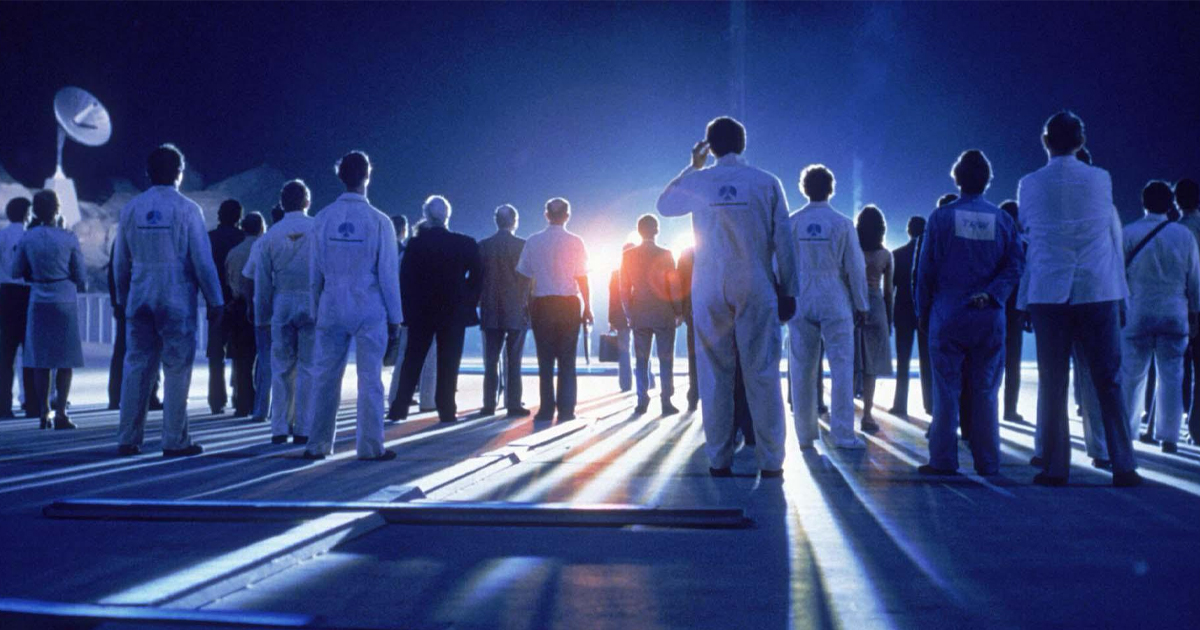
Long before he brought dinosaurs back from extinction or won Oscars for his portrayals of WWII, Steven Spielberg was just a child who was awestruck by a meteor shower he watched with his father in New Jersey. That experience stuck with him, and at only seventeen years old he made a 135-minute film called Firelight in 1964.
Made for only $500 using friends and family as the cast, the film revolved around UFOs and alien encounters. Spielberg has called it one of the five worst films ever made, but it planted the seeds for what would eventually become Close Encounters of the Third Kind. In fact, some shots and ideas from Firelight would make their way into the finished film nearly shot-for-shot. Even the runtime was identical: 135 minutes.
After directing television episodes of Columbo and Night Gallery, Spielberg broke through with Duel, then The Sugarland Express, before exploding into superstardom with Jaws. With the biggest blockbuster of all time under his belt, Spielberg suddenly had the freedom to pursue his dream UFO project.
From “Watch the Skies” to Close Encounters
Following The Sugarland Express, Spielberg struck a deal with Columbia Pictures to make a science-fiction film. Initially titled Watch the Skies, the project focused on UFO investigations and Project Blue Book.
The script went through numerous incarnations. Paul Schrader wrote a version called Kingdom Come centered on an Air Force officer, but Spielberg hated it, feeling it stripped away the wonder and mystery of UFO mythology. John Hill’s rewrite made the protagonist a police officer, but Spielberg felt it was turning into a James Bond movie.
Eventually, contributions from David Giler, Hal Barwood, and Matthew Robbins were folded into the screenplay, including the idea of a child being abducted by extraterrestrials. Ultimately, Spielberg refined the material himself and earned the screenplay credit.
The title was finalized as Close Encounters of the Third Kind, based on the UFO classification system created by astronomer J. Allen Hynek, who also served as a consultant on the film.
Casting the Film
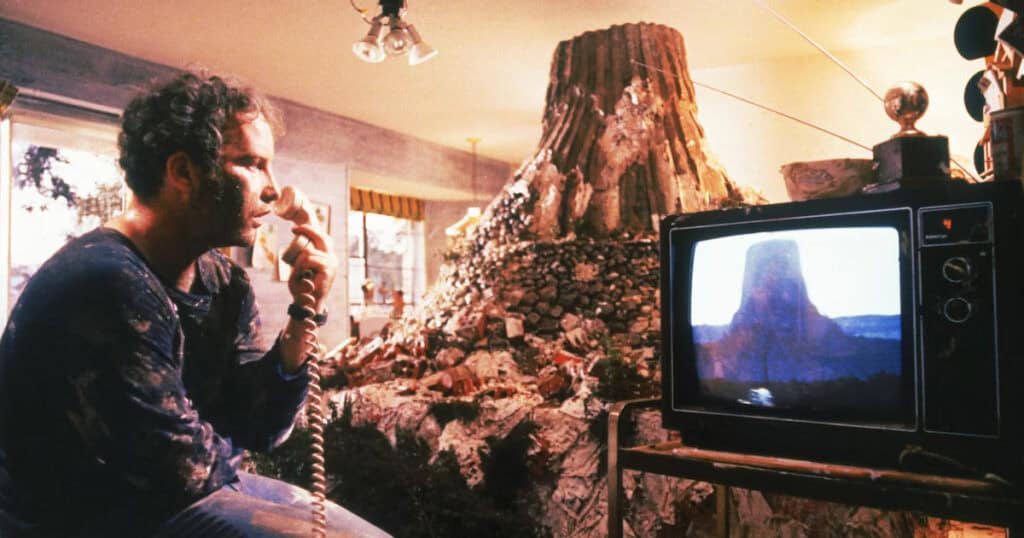
Finding the right Roy Neary proved difficult.
Steve McQueen was Spielberg’s first choice, but he turned the role down because he felt he couldn’t cry on command. Richard Dreyfuss, fresh off Jaws, desperately wanted the role and became his own biggest advocate. He constantly discussed UFOs with Spielberg during the filming of Jaws and believed he understood exactly what the director was trying to achieve.
The studio wasn’t convinced. After McQueen passed, Columbia pursued Gene Hackman, Al Pacino, Jack Nicholson, Dustin Hoffman, Robert De Niro, and James Caan. Pacino wasn’t interested, Nicholson had scheduling conflicts, and Hackman was trying to save his marriage.
Eventually Spielberg got his way, and Dreyfuss landed the role.
For French scientist Claude Lacombe, Spielberg cast one of his cinematic heroes, legendary French filmmaker François Truffaut. It would be the only acting role in a film he didn’t direct and his only English-language movie. Truffaut struggled with the language barrier and often attached cue cards to fellow actors so he could remember his lines.
Terri Garr won the role of Roy’s wife Ronnie after Spielberg noticed her in a thirty-second coffee commercial. Melinda Dillon, cast only three days before filming began, landed the role of Jillian Guiler and would eventually earn an Academy Award nomination.
Bob Balaban rounded out the cast as the project’s interpreter, while four-year-old Cary Guffey became one of the film’s breakout performers as Barry.
Building the World
Spielberg reunited with composer John Williams and cinematographer Vilmos Zsigmond, both of whom played critical roles in creating the film’s unique atmosphere.
Williams and Spielberg developed the iconic five-note musical phrase used to communicate with the aliens after experimenting with hundreds of combinations. The tune became one of the most recognizable pieces of movie music ever created.
Zsigmond faced constant battles with producers over how the film should look. He intentionally overexposed many of the alien sequences to create a mysterious, dreamlike quality. Producer Julia Phillips frequently clashed with him and even attempted to replace him, but Spielberg and the crew stood firmly behind their cinematographer.
Production designer Joe Alves originally wanted Monument Valley for the climactic landing site but eventually settled on Devils Tower in Wyoming. The location became one of the most iconic landmarks in movie history, with tourism surging after the film’s release.
The Massive Challenge of Production
Filming began on May 16, 1976.
The production was extraordinarily ambitious for its time, especially regarding special effects. The effects budget alone exceeded the original budget proposed for the entire project.
Douglas Trumbull, who had previously worked on 2001: A Space Odyssey, oversaw the groundbreaking visual effects. Miniatures, matte paintings, motion-control photography, and practical effects were used extensively throughout production.
Some early concepts for the aliens included mimes and even orangutans on roller skates. Thankfully, saner heads prevailed.
The towering mothership was inspired by an oil rig Spielberg saw while traveling in India. The small aliens featured at the end of the film were portrayed by local six-year-old girls from Mobile, Alabama, whom Spielberg felt moved more gracefully than boys.
Other practical effects included elaborate cloud formations created by layering fresh water over salt water in tanks and injecting paint into the mixture. Roy Neary’s levitating truck was achieved through mechanical rigs and clever camera work.
Perhaps the greatest challenge was that neither the actors nor Spielberg fully knew what the finished visual effects would look like. Much of the cast had to react to things that simply weren’t there.
Dreyfuss later admitted he would have performed some scenes differently had he known exactly what the finished aliens and spacecraft would look like.
A Risk That Saved a Studio

The movie represented an enormous gamble for Columbia Pictures, which was struggling financially at the time.
Production was conducted under intense secrecy. Spielberg originally hoped for a 1978 release, but Columbia pushed for Christmas 1977. The director later described the editing process as one of the most difficult experiences of his career.
The effort paid off.
Released on November 16, 1977, Close Encounters of the Third Kind became a phenomenon. It grossed nearly $290 million worldwide and ranked among the highest-grossing films of all time.
Critics embraced it as well. The film earned eight Academy Award nominations and won for Best Cinematography. Science-fiction legend Ray Bradbury famously called it the greatest science-fiction film ever made.
More importantly for Columbia, it became the studio’s biggest hit and helped pull the company back from the brink.
The Special Editions
After release, Spielberg remained unsatisfied with certain aspects of the film.
Because Columbia had given him final-cut privileges, the studio agreed to finance a revised version in 1980. Spielberg added several minutes of new footage while trimming other scenes. The revision also included a brief glimpse inside the mothership, something Spielberg later regretted.
Nearly two decades later he revisited the film again, creating what became known as the Collector’s Edition, which effectively served as his preferred director’s cut.
The film has since been added to the National Film Registry and consistently appears on lists of the greatest science-fiction movies ever made.
Does It Still Hold Up?
Absolutely.
Even if modern 4K presentations reveal some of the limitations of the practical effects, they remain remarkably charming and convincing. The movie captures the mystery and fascination surrounding UFO culture in a way few films have ever matched.
Richard Dreyfuss delivers what may be the best performance of his career. Melinda Dillon is outstanding, and Cary Guffey gives one of the most natural child performances of the era.
The film also balances multiple genres effortlessly. It contains Spielberg’s trademark sense of wonder while also delivering genuinely frightening moments, particularly Barry’s abduction sequence.
What makes the film especially powerful today is how personal it feels. Beneath the science-fiction spectacle lies a story about obsession, family, purpose, and sacrifice. Roy Neary’s journey isn’t just about discovering extraterrestrial life—it’s about being drawn toward something larger than himself, even at tremendous personal cost.
That emotional complexity only grows stronger with age. As a child, the movie is an adventure. As an adult, it’s also a surprisingly melancholy story about a man abandoning one life in pursuit of another.
Nearly fifty years later, Close Encounters of the Third Kind remains one of Spielberg’s most personal films, one of the defining science-fiction movies of the 1970s, and a landmark achievement in cinematic storytelling. Its influence can still be felt across the genre today, with Spielberg revisiting many of the same themes with his upcoming Disclosure Day. Its legacy will likely endure long after everyone involved in making it is gone.










The comment section exists to allow readers to discuss the article constructively and respectfully, focused on the topic at hand.
What’s Not Allowed