
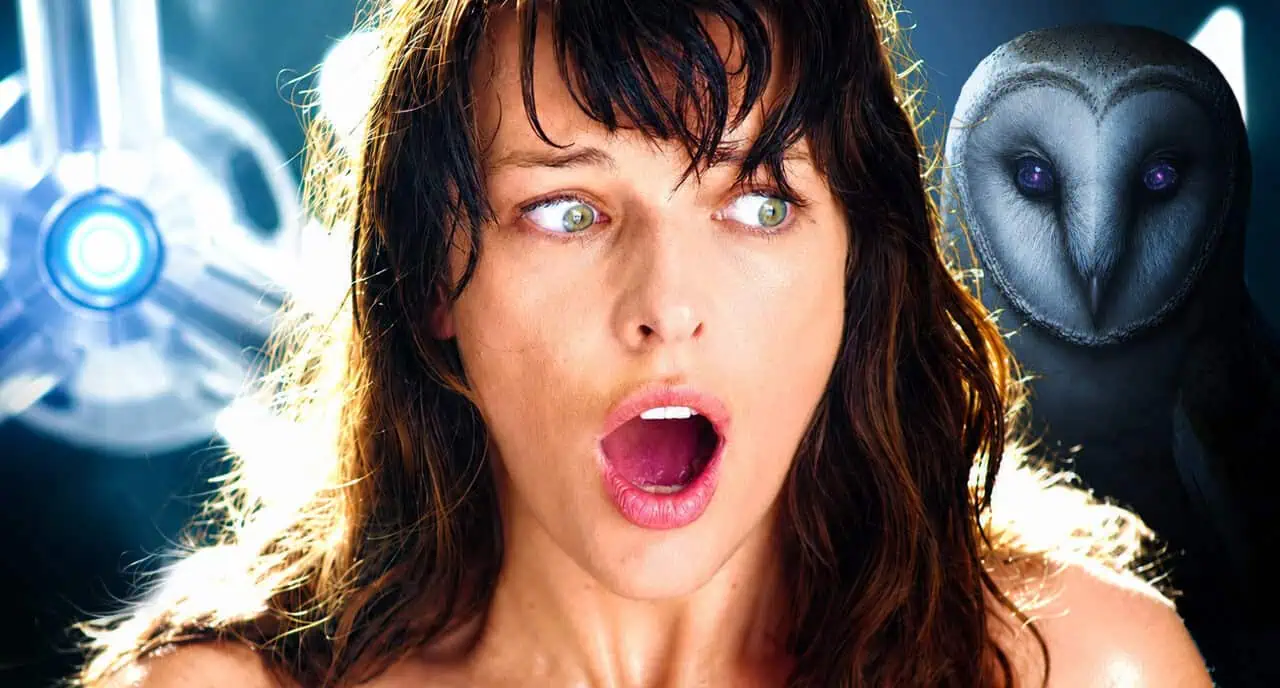

What happens when a truly frightening new horror movie promises to be based on a true story, only to end up upsetting the community it’s supposedly based on? What happens when a movie studio goes so far in its attempt to recreate the phenomenon of The Blair Witch Project or Paranormal Activity that it creates a website with fake news clippings using real-life publications and the names of writers from that same community? What happens when the director and star actress literally walk into the frame of that same film to promise that these are dramatizations of real-life events, backed by evidence that you’ll see and hear in the film? Well, a lawsuit, obviously.
But there’s a whole lot more behind The Fourth Kind. In this video, we’ll talk about the making of the movie, fact-check some of its biggest claims, and break down the real tragedies of Nome, Alaska, that likely helped inspire the story in the first place. This is what happened to The Fourth Kind.
The Making of The Fourth Kind
Writer, director, and awkward on-screen interviewer in The Fourth Kind, Olatunde Osunsanmi, is said to be a protégé of Smokin’ Aces director Joe Carnahan, with whom he worked as an assistant. Carnahan would later produce The Fourth Kind. With the help of producer Terry Robbins, Osunsanmi wrote the screenplay and came up with this bizarre gambit of a movie, which was picked up by Universal for distribution.
Just before the film was released, Brad Brevet of ComingSoon.net reached out to Universal for information about how much of the film’s marketing was based on real events. He was only able to produce a press sheet that revealed the following information about its conception. In October of 2004, Osunsanmi was wrapping up another film and traveled to North Carolina for post-production. There, allegedly, a colleague told him about a psychologist who had moved there from a remote town in Alaska.
Osunsanmi supposedly contacted this psychologist and convinced her to tell him her story, which they said included a terrifying and “heavily documented” sleep study that concluded with terrifying results about extraterrestrials. This psychologist has never, nor has anyone else involved, come forward since. The film says the names have all been changed to protect the people behind these stories. And then the movie begins.
Milla Jovovich Says This Is a Dramatization of Real Events
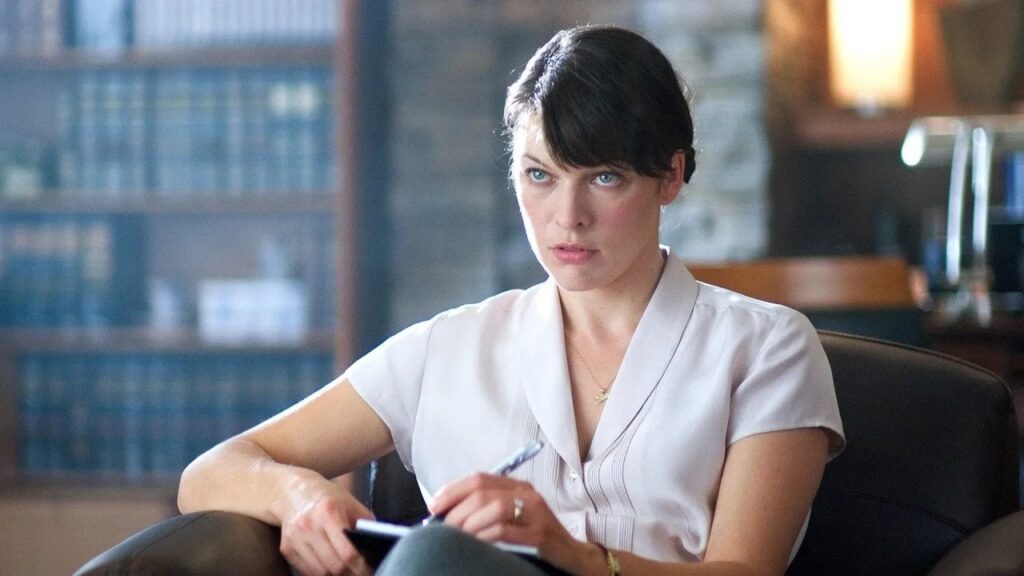
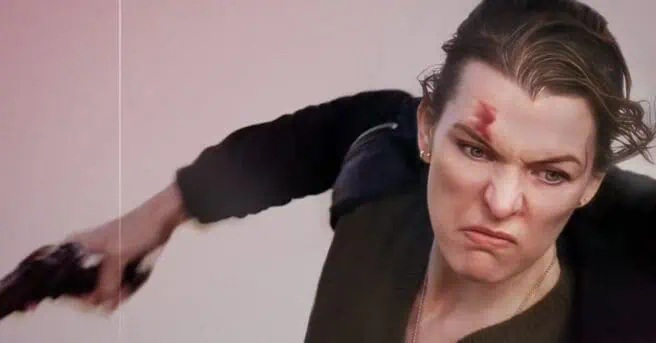
The gorgeous Milla Jovovich walks out of the forest like some sort of majestic creature to inform us that… well, she’s actress Milla Jovovich. And she’s here to portray Dr. Abigail Tyler in a dramatization of events that occurred on October 1, 2000. They even give us a specific date. No “inspired by a true story.” No “based on a true story.” This is a “dramatization” of events that allegedly took place on this night and in the days that followed. And, oh man, Milla looks serious. So serious. The ethics of all this aside, this is indeed a multi-layered and ambitious idea in meta filmmaking.
Jovovich informs us that the director has also chosen to include archive footage from the psychologist’s personal collection so the audience can better understand the events that took place. The footage supposedly comes from 65 hours of videotape that Dr. Abigail recorded during her studies. But again, they changed everyone’s names and professions. So you can’t find them to ask about it.
Jovovich tells us that everything we see in this film is backed up by Dr. Abbey’s video, audio, or just some stuff Abbey told the director during filming. Finally, Milla asks us to be advised that some of what we’re about to see may be disturbing. And you know it’s serious because the camera is spinning around her like she’s Martin Lawrence and Will Smith at the end of Bad Boys.
Now, despite the possibility that this is some of the most egregiously blown hot smoke up our asses in cinema history, you have to love the showmanship here. I feel like I’m about to go on a Universal Studios ride. It’s exciting.
Dr. Abigail Tyler and the “Real” Footage
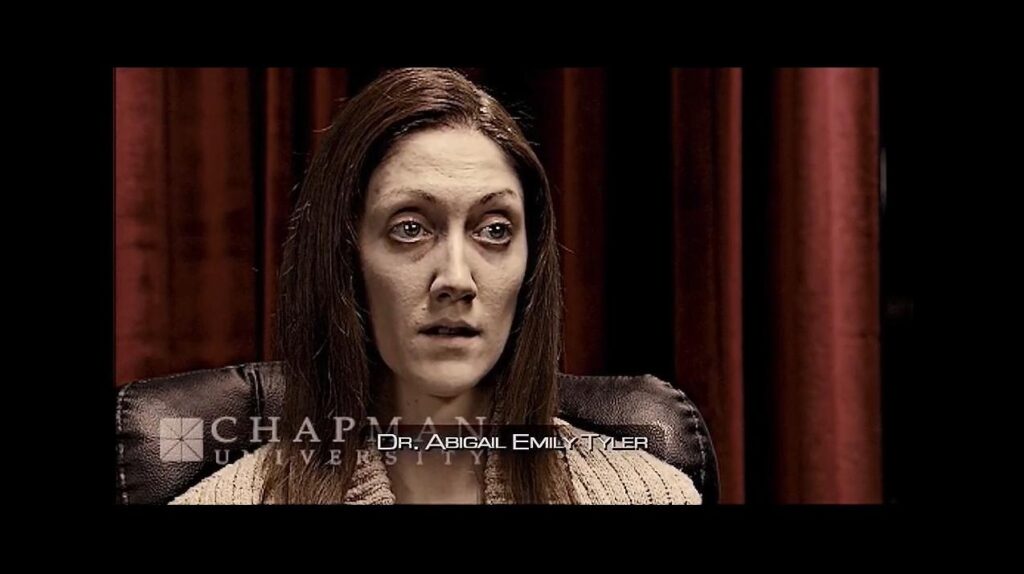
We then pan to a Chapman University interview with Abigail, who looks like she needs a shot of B12 and a pool day, as the actual director of the film interviews her. Despite desperately needing to blink, she bravely tells her story, which then pans to “actual audio” of her speaking, which then turns into Milla Jovovich acting. And we’re off.
She’s now speaking to her friend and fellow doctor, Elias Koteas, who plays Dr. Abel Campos… which is, of course, an alias. Duh. I don’t know why he’d try to hide it. If Casey Jones was going to play me in a movie, I’d like people to know it.
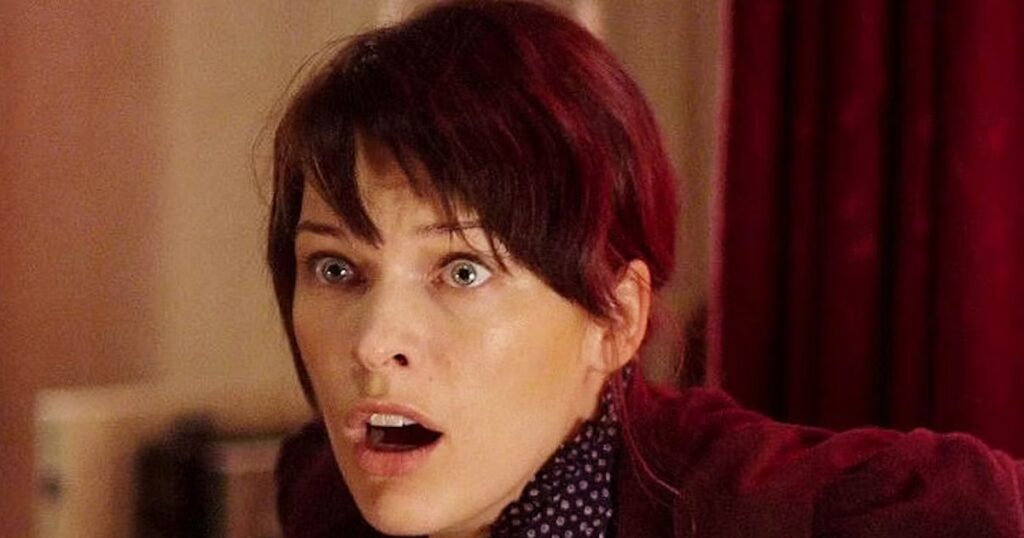
The movie continuously cuts to footage of the “real” Abigail during some of these scenes. And man, they did an amazing job of making this totally normal-looking British actress, Charlotte Milchard, look freaky as hell. I’m more scared of her than I am the aliens. If Mom and Dad left for a Christmas party and this was my babysitter, I’m hiding in the closet. She might seem frail and nice, but it’s that kind of “Kevin Spacey trapped a bomb to me with duct tape in Se7en, and I’m trying to play it cool” nervous nice that I simply can’t trust.
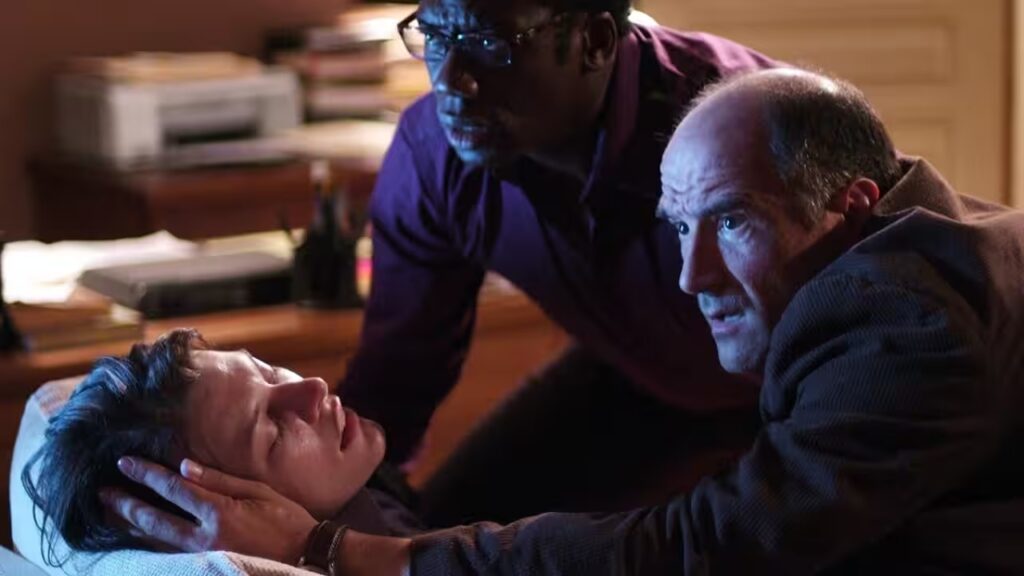
Abel hypnotizes Abbey on camera in an effort to help her remember the face of the attacker who had snuck into their bedroom in the middle of the night and murdered her husband. One must admit that the editing in this movie is top-notch. They move seamlessly from “real” footage to acting footage to the hypnotic state. It’s impressive.
Welcome to Nome, Alaska
We then learn that Nome, Alaska, where all these freaky events take place, is unreachable by road. You have to fly there. So here we have our first of many fact checks in this film. And it appears that this statement is… true. Because it is off the main road system, this remote city is accessible only by air or water. The city is the landing spot for the end of the famed Iditarod Dog Sled Race and has a population of less than 4,000 people. They also host the world’s largest gold pan. But they aren’t known for aliens. More on that later.
They aren’t known for white owls stalking people like Batman from their window sills, either. But that’s what Abigail’s patients are telling her. Each one of them wakes up in the middle of the night to a white owl staring at them. And Jesus, that thing is frightening.
We learn during the exposition that this phenomenon has been going on for some time and that more than 300 people have reported waking up around 3 a.m. in a panic for no apparent reason.
When the tale of the tape shows Abbey hypnotizing one of her patients, Tommy, to recall one of his 3 a.m. episodes, things become unsettling. The way he responds, screaming “No!” over and over again while crawling all over the couch like Tom Cruise, is way too on the nose for real-life sleep terrors. The movie will obviously go on to claim that these terrors aren’t just medical phenomena. They’re alien abductions that we don’t remember.
On behalf of everyone who has experienced sleep terrors… Great. Grand. Wonderful.
The First Tragedy
Tommy doesn’t want to tell her what he saw. But that night, we make a hard cut to real footage of a 911 call where his wife is screaming at him to put the gun down and let their children go. Meanwhile, the sheriff arrives, played by none other than Halloween 2018’s finest, Will Patton. The man simply plays a good small-town sheriff.
Tommy says that he “has no choice” before reciting some gobbledygook that his vision told him and promising that he or his family will never have to see what he saw again. He then tragically kills his family and himself. It’s a shockingly dark moment that heightens the sense of danger and dread in the film. And it’s the kind of thing that makes you glad this probably isn’t a true story.
When Abbie talks to the sheriff and he starts to blame her for what happened, we get a big exposition dump and find out that apparently the town of Nome, Alaska, has more unsolved murders and missing people than any other town in Alaska. And it’s time for a fact check.
Does Nome Really Have an Abnormally High Number of Disappearances?
The answer is surprisingly yes and no. While Nome does not, in fact, lead the state in disappearances or murders, nor did it at the time, its per capita numbers can be extremely high because of its low population. In a historic review of Alaska’s missing people and crime rates that covered 1960 through 2004, Nome had 24 disappearances on record. That’s about one disappearance every 1.8 years.
The state of Alaska overall had approximately 1,240 disappearances during that period. That means Nome’s 24 cases accounted for roughly 2% of the entire state’s disappearances during the study. What makes Nome stand out, however, is its population of less than 4,000 people. So, in summation, the movie’s claim isn’t particularly true. But the town does have a surprisingly high rate of disappearances per capita.
There have also been some higher-profile cases in the years since The Fourth Kind was released, including the disappearances of Joseph Balderas and Florence Okpealuk, which both remained unsolved. It’s worth noting that one involved a missing outdoorsman in an area heavily populated by bears, while the other was last seen leaving a bar with an unknown gold miner. Neither had any strange science-fiction circumstances surrounding them, as far as we know.
Back to the movie.
The Aliens Make Their Presence Known
Dr. Abigail is now hypnotizing another Nome resident in an attempt to find out what in the unholy hell is going on with that owl. This is the first time the terrors are referred to as “they,” likely meaning little green or gray guys, before Scott starts making sounds that sound a whole lot like someone who is being experimented on by aliens. You know: the clicking and the metallic tearing. Scott says that the aliens, though he can’t remember what they look like, smell like putrid cinnamon and can communicate with him telepathically.
Afterward, we pop the top off this bottle of scary as Abbie hears a recording she gave to her assistant to transcribe. She apparently fell asleep while recording, and during playback you can hear some of the most frightening nails-on-a-chalkboard sounds possibly ever recorded, with her screaming while an electronic voice of hate barks things at her. It’s genuinely unsettling.
Abbie goes home and breaks down the language on the tape as best she can. That leads her to reach out to a language expert, who concludes that it sounds Sumerian. Sumerian is considered one of the oldest known written languages in human history. The specialist breaks down the tape and claims that it seems to say something like, “Our creation. Examine. Ruin” or “destroy.” He then claims that you can go to any Sumerian exhibit and see drawings of rockets that look like Apollo launching into the sky, along with etchings and sculptures of men in spacesuits that resemble oxygen masks. All supposedly made 4,000 years before Christ.
Ladies and gentlemen, it’s time for another fact check.
Does Ancient Sumerian Art Depict Aliens?
It’s actually not total bullshit. The audio here is obviously most likely fictional, but it’s a pretty cool movie tie-in to some semi-real-life stuff. Sumerian is one of the oldest known written languages, and scholars have been able to translate portions of it over time. Real Mesopotamian art discovered over the years does include unusual winged discs, stylized gods, and elongated figures with reptilian features. Many archaeologists, though, reject the notion that these pieces of art resemble rockets or oxygen masks. They argue that they are religious or symbolic works of art.
The artwork also isn’t restricted to Sumerian culture. Similar imagery can be found across several different Mesopotamian cultures and time periods. So, in movie terms, it’s close enough to at least have some fun with. But it’s not supported by most mainstream archaeology.
The Hypnosis Gets Worse
Next, the phone rings. Surprise! Scott is freaking out at home after going under hypnosis earlier and needs help. I’m starting to agree with Will Patton here that we should just pretend none of this is happening. Hypnosis only seems to make things worse.
But they go to his house, and we’re off again into one of the freakiest scenes in the movie. They hypnotize Scott again, and he gives us the holy-shit package of sleep abduction. He screams and levitates above the bed as his mouth opens way wider than any mouth should ever open. The voices say something about there being no need to pray and demand that they end the study.
I feel like we’re all in agreement now. It’s time to end the study. Dear God, end the study. And the police agree.
Will Patton shows up at Abbie’s house pissed off and looking like Ric Flair about to go up against Macho Man Randy Savage for the world championship belt. He informs her that Scott is paralyzed from the neck down after their hypnosis session. He tells Abigail that he’ll arrest her if she leaves her home again until he has the situation sorted out.
What Does “The Fourth Kind” Mean?
We then return to our interview with the director, in which the “real-life” Abigail explains the different kinds of encounters. The first kind is when you see a UFO. The second kind is when you see evidence of a UFO, such as crop circles. The third kind is contact. And the fourth kind is abduction. These classifications come from astronomer and ufologist Josef Allen Hynek’s classification system for alleged alien encounters.
She also drops the haunting thought that people all over the world are being abducted just like the people in her studies, only we’re forced to forget it. Don’t go too deep into that thought unless you want to have trouble going to sleep tonight. Yes, I’m talking to myself. But it sets the table for the craziest moment of the film.
The Abduction
The officer tasked with supervising the house gets out of his car, and his dashcam records a giant black shape hovering above the home before the camera spazzes out. We can’t see anything, but we hear the officer radio in and say that it is taking someone out of the house and into the air. At this point, we feel like Helen Hunt in Twister, screaming “I WANNA SEE IT!” while Bill Paxton tries to console us. As it turns out, Ashley was the only one taken out of the house.
Will Patton delivers an Oscar-worthy performance (yes, I said it, and I don’t care who heard it) when he finally loses his shit on Abigail and takes her son from her custody. Her only course of action now is to have Abel put her under hypnosis so she can try to get answers.
We witness her abduction, which includes a very intimidating metal-prong situation that first appears to brand her shoulder, and then… God, I don’t want to know. It causes her to convulse and do the freaky mouth-opening-way-too-much thing on the couch while unleashing a satanic scream. The Sumerian voice says, “I enforce my will,” refuses to return her child, and then proclaims, “I am God.”
What’s even more messed up is that when she is sat back on the couch, her jaw still looks dislocated as her mouth hangs open. Then there’s more screaming and Jason Bourne fight-scene-style camera work. She tells us that the aliens abducted all three of them that night and that they don’t remember where they were taken or what was done to them. We then learn that her husband had chosen to end his own life, and Abbey had created the story in her own head that he was murdered to help her deal with his death. This is supposedly why nobody believes her about the studies, despite the videos apparently showing that she isn’t lying. Which is a weird plot hole.
The camera pans back to reveal that she’s in a wheelchair from injuries sustained during the abduction. Captions then explain that she was cleared of foul play in her missing daughter’s disappearance, although her daughter was never found. Her son remains estranged from her and believes she had something to do with his sister’s disappearance.
Another Wild FBI Claim
The Fourth Kind, and specifically the director himself, then really tries to hammer home the point that this is somehow real. Osunsanmi walks into the magical forest set from the beginning of the film and claims that since the 1960s, there have been more than 2,000 FBI visits to Nome. The highest number in Alaska. In comparison, Anchorage, with more than 76 times the population, supposedly had only 353 visits over the same period. Which would be pretty goddamn astounding if true.
So, one more fact check. How the hell do you fact-check FBI visits? Exactly. And it’s especially fishy considering that the FBI literally has a home base in Anchorage, Alaska. Would the things they investigate there even count as “visits”? If so, that would greatly fudge those numbers.
With some digging, you can find that the FBI has, in fact, sent teams to investigate the troubling number of disappearances and deaths in the Nome area. But those investigations were focused on the possibility of a serial killer, not aliens. Not that they would tell us that’s what they were there for.
Still, the investigation found that even a serial killer was an unlikely explanation because the timeline did not support a serial killer operating for such a long period. More importantly, it was considered far more likely that the region’s alcoholism problems combined with its harsh climate were responsible for many of the disappearances and deaths. Supporting that theory, many of the bodies that were found showed no signs of trauma, which supported hypothermia as a cause of death more than murder.
Some will argue that these findings could simply be part of an FBI cover-up. But the story doesn’t end there.
The Real Nome Controversy
When marketing The Fourth Kind, Universal dug into the Blair Witch Project bag of tricks and built a website for the movie that housed a collection of creepy news stories from Nome, Alaska, about mysterious events. The only problem is that many of them were fake.
Actually, the real problem was that Universal decided to use the names of real Alaskan publications and news outlets to create those fake documents. They even used the names of actual Alaska-based journalists in the articles.
The Anchorage Daily News went scorched earth when it reported on a settlement that required NBC Universal to offer The Press Club $20,000, with another $2,500 going toward a scholarship fund, over the website’s promotional tactics and what the article described as a “half-assed Hollywood alien abduction movie” that had irritated the people of Nome. The article also noted that even after local outlets objected, the website owners initially ignored them until they were sued.
It also pointed out something else that makes the movie’s supposed authenticity even more questionable. The film was shot in the Balkan Mountains of Bulgaria. That’s about as far as you can get from Nome’s actual aesthetic and geography. And it’s true. For all the wooded landscapes and atmospheric settings in The Fourth Kind, actual Nome, Alaska, is a very different place. Trees struggle to grow past eight feet tall because of the harsh conditions.
The Anchorage Daily News noted that the primary things the two locations share are cold weather and problems with alcoholism. Again, those are two of the likelier explanations for the disturbingly high per-capita numbers of missing people in the region.
The Real Tragedies of Nome
There still remains an eeriness about the situations in Nome. And, in part, dramatizing those situations in Hollywood fashion is exactly why The Fourth Kind pissed off so many people in the community.
In November 2018, according to Kawerak.org, Nome and Kawerak jointly requested an FBI investigation because of “turmoil and concern rising with public safety.” The request asked the FBI to examine the Nome Police Department over civil rights violations. The goals included taking a more proactive approach to preventing violence and sexual assault in an area where a shocking 51% of women in the Bering Strait Region had reported physical or sexual abuse.
There was also a 2005 FBI investigation into Nome that followed a string of incidents in which Native villagers went missing or died while visiting the area. These victims were not psychologists or patients seeing white owls at night. They were often Native men from nearby villages who went missing or died under suspicious circumstances.
Locals’ concerns were more about hostility toward Natives and police misconduct than anything involving alien abductions.
And that is where the real story behind The Fourth Kind becomes considerably more complicated. The film took genuine concerns about disappearances, deaths, violence, alcoholism, and public safety in a remote Alaskan community and transformed them into an elaborate alien-abduction story. Then Universal marketed that fictional story as though it were backed by real evidence from the same community. That is a pretty uncomfortable thing to do.
The Release and Legacy of The Fourth Kind
Despite the settlements and the probably unethical promotion, The Fourth Kind received a wide theatrical release in November 2009. The film had a reported budget of $10 million and managed to top that figure on its opening weekend, bringing in more than $12 million, including my fifteen bucks or whatever it cost at the time to have an excuse to wear my brown pants to the theater. Despite pretty bad reviews, the film ended up with a reasonably impressive worldwide gross of almost $50 million.
Critics largely dismissed the movie as hogwash, but much of the vitriol seemed to stem from the filmmakers’ attempts to trick audiences into believing that the events were real rather than from the movie’s effectiveness as a horror film. And that distinction matters. Because despite the ethically questionable marketing, The Fourth Kind has developed a more favorable reputation among horror fans who approach it simply as a piece of entertainment.
For me, someone who is deathly afraid of aliens and wouldn’t take out the trash alone at night for years after watching Fire in the Sky on HBO as a kid, it’s one of the scariest movies of my lifetime. Despite the filmmakers apparently thinking we’re all gigantic idiots who would just swallow all of this as fact, The Fourth Kind still manages to be scary as hell as a horror film. The fake documentaries. The creepy “archival” footage. The unsettling performances. The hypnotism sequences. The suggestion that people can be abducted without remembering it. The bizarre Sumerian connection. The footage of something hovering over a house. It all adds up to a movie that knows exactly how to get under your skin.
The problem is that the filmmakers didn’t just create a fictional town and invent a fictional history. They used the name of a real community that had experienced very real tragedies, then built a marketing campaign designed to make audiences believe those fictional events had actually happened there. That is the part of The Fourth Kind that hasn’t aged quite as well.
But as a horror movie? It still works.
And that, my friends, is the truth of what happened to The Fourth Kind.
A couple of previous episodes of this show can be seen below. For more, check out the JoBlo Horror Originals YouTube channel—and don’t forget to subscribe!



The comment section exists to allow readers to discuss the article constructively and respectfully, focused on the topic at hand.
What’s Not Allowed