

Alien abductions are everywhere in cheesy UFO documentaries, reality TV, and science fiction shows. Strangely, they’re much rarer in movies than you’d expect. Modern films like The Fourth Kind and Phoenix Forgotten tried to reinvent the concept through found footage or “based on a true story” storytelling, but neither has managed to top what Fire in the Sky accomplished back in 1993.
Released during the height of The X-Files craze and inspired by one of America’s most famous alleged UFO encounters, Fire in the Sky delivered an alien abduction sequence that still hasn’t been surpassed. So why is that scene still so terrifying? How much of Travis Walton’s story do people actually believe? And which cast member discovered he was related to the real person he was playing?
Let’s take another look at Fire in the Sky, still the greatest alien abduction movie ever made.
Behind the movie
Fire in the Sky was adapted by Tracy Tormé and directed by Robert Lieberman. Tormé, who sadly passed away in 2024, was also the creator of the cult sci-fi series Sliders. He also wrote the 1988 supernatural thriller Spellbinder, starring Wings’ Tim Daly. Again, when Tim Daly comes up, you have to mention Wings. Those are apparently the rules too. Lieberman spent most of his career directing television, but Fire in the Sky remains his best-known feature film.
The cast is stacked:
- D.B. Sweeney
- Robert Patrick
- James Garner
- Peter Berg
- Craig Sheffer
- Henry Thomas
Despite all that talent, the movie underperformed when Paramount released it on March 12, 1993. Made for around $15 million, it earned just under $20 million worldwide. Box office aside, the film gradually became a cult classic thanks to one unforgettable sequence that still overshadows the controversy surrounding its supposedly true story.
What happens in Fire in the Sky?
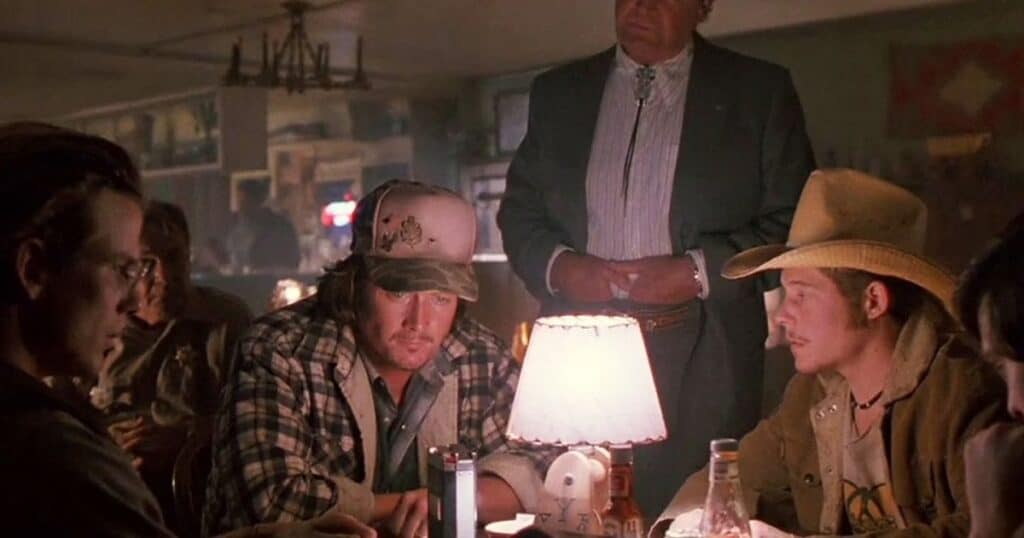
The film tells the story of Arizona logger Travis Walton, played by D.B. Sweeney. Rather than opening with the alleged UFO encounter, the movie immediately throws us into the aftermath. Walton has disappeared, and his coworkers are being questioned by Lieutenant Frank Watters, played by James Garner.
The crew tells conflicting versions of what happened. One member has a criminal record. Another fails a polygraph. Suspicion quickly shifts from a mysterious disappearance to possible murder.
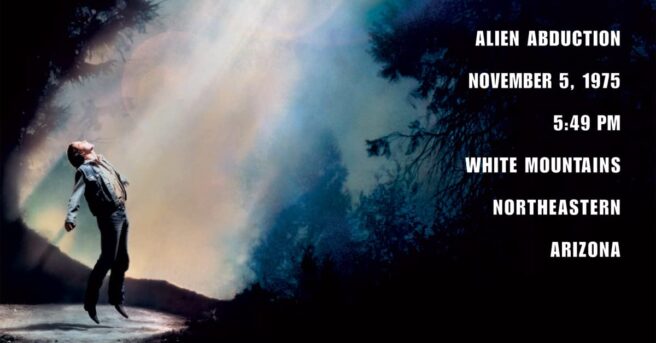
Only then does the film flash back. Walton is portrayed as an optimistic dreamer, especially through his friendship with crew chief Mike Rogers. About 25 minutes into the film, the crew notices strange red and green lights in the sky. Walton steps out of the truck to investigate and is blasted by a powerful beam of light.
Panicking, the crew flees before turning around moments later. Walton is gone.
What follows is less science fiction than small-town procedural drama. Search parties comb the forest. Rumors spread. The media descends on the community. The crew turns on one another while the town quietly assumes one of them must have killed Walton.
Five days later, Rogers receives a phone call. Walton has reappeared. He’s found naked, dehydrated, and deeply traumatized at a gas station.
The true story behind Fire in the Sky
Unlike most alien invasion movies, Fire in the Sky was based on an alleged real event. According to Travis Walton, he disappeared for five days in Arizona after encountering a UFO while working with a logging crew in 1975. The story became known as the Travis Walton Incident.
Walton later sold his account to the National Enquirer, won the publication’s $5,000 “Best UFO Case of the Year” award, and eventually wrote The Walton Experience, the book that inspired the film.
Although Walton is credited as the author, many researchers believe writer John G. Fuller heavily assisted with the book.
The case has remained controversial for decades. Skeptics like Philip J. Klass and Michael Shermer argued the entire event was staged. One popular theory suggested the crew fabricated the disappearance to avoid financial penalties after falling behind schedule on a forestry contract.
The debate has never really gone away. In 2021, Mike Rogers briefly posted on Facebook that he was renouncing his status as a witness to Walton’s “supposed abduction,” only to apologize to Walton a couple of months later. Other researchers have suggested that a nearby fire tower could have been used to fake the mysterious lights while Walton hid elsewhere during his disappearance.
Walton, however, has remained consistent. As recently as late 2025, he continued to insist the abduction happened, claiming the aliens were attempting to heal injuries he suffered during the encounter.
The scene that changed alien horror forever
After Walton returns home, he’s physically alive but emotionally shattered. His friends argue over what happened that night in the forest. The town remains divided. Even a welcome-home party can’t shake the feeling that something is deeply wrong.
Then Walton suffers what appears to be a PTSD episode. And that’s when Fire in the Sky stops being a mystery drama and transforms into outright horror.
At around 1 hour and 23 minutes, we finally see what Walton claims happened during those missing five days. More than three decades later, it’s still one of the most disturbing scenes ever put on film.
Inside the alien ship
Walton wakes inside a cocoon covered in a slimy membrane that… honestly looks a bit like sautéed onions. Judging by his reaction, it definitely doesn’t taste like sautéed onions.
He tears through the skin-like cocoon, which lets out a horrible ripping sound, and discovers he’s surrounded by dozens of others hanging inside a vast metallic chamber. Everything about the environment feels wrong. The walls are dark. The lighting constantly shifts. Gravity barely behaves the way it should. The ship doesn’t resemble the sleek silver flying saucers audiences were used to seeing. Instead, it’s industrial, dirty, mechanical, and strangely organic all at once.
Walton desperately searches for a way out. Eventually he finds what looks like a storage area filled with spacesuits… and, more importantly, car keys. For one hopeful moment, it seems like escape might actually be possible.
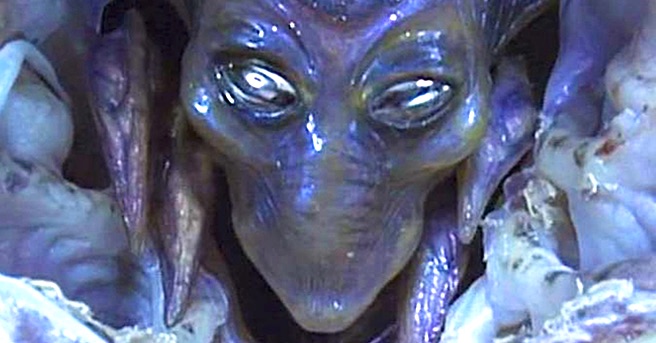
Then one of the “spacesuits” moves. Walton kicks the helmet off, revealing one of the film’s unforgettable Grey aliens. Even today, the practical makeup holds up remarkably well.
The alien barely reacts. Instead, Walton runs.

Terror without a single jump scare
The chase through the narrow corridors is terrifying not because it’s fast, but because it’s inevitable. The aliens don’t panic. They don’t rush. They’re simply stronger than he is. When they finally catch him, they drag him down the hallway with the effortless force of Jason Voorhees hauling another unfortunate Camp Crystal Lake counselor.
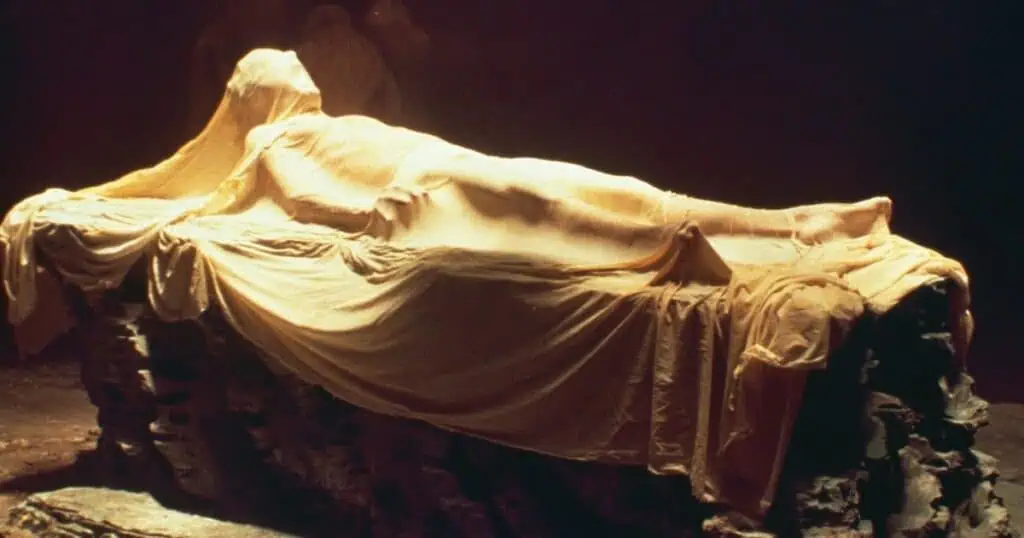
Then comes the operating table. The aliens strip Walton and cover him with what appears to be an ordinary brown sheet. A mist falls over it. Instantly, the material shrinks into an airtight membrane that wraps around his entire body.
The sound design is almost worse than the visuals. The crackling plastic. The tightening fabric. Walton’s increasingly desperate screams. It’s pure sensory horror.
Then things somehow become even worse. The aliens place another membrane over his head. It seals tightly across his face. For a moment, it looks as though they’re simply going to suffocate him. Instead, they slice openings over one eye and his mouth. The relief lasts only seconds.
Why the eye scene still traumatizes audiences
The aliens produce a tray of bizarre surgical instruments, each one looking more threatening than the last.
First comes a strange gel forced into Walton’s mouth. Then an unsettling device clamps between his teeth, opening his jaw wider and wider with slow mechanical precision.
His hands strain against the membrane while his eyes begin to roll back in panic.
Another alien inserts a long instrument near his neck before positioning a circular metal device over his exposed eye. If you’re expecting eye trauma, so is everyone else. Whether you’ve seen Dead Space 2 or not, our brains instinctively imagine the absolute worst.
Instead of immediate violence, the aliens fill the opening around his eye with a milky liquid while another enormous instrument slowly descends toward him. The anticipation is almost unbearable. Before we ever find out what comes next, Walton jolts awake in a hospital bed.
The sequence lasts roughly 12 minutes. It remains, in my opinion, the greatest alien abduction sequence ever filmed.
Why the scene still works today
The horror isn’t just what happens. It’s when it happens. For over an hour, Fire in the Sky plays like a grounded mystery. It’s about missing persons, police investigations, media attention, and a town tearing itself apart. Then, with almost no warning, it becomes body horror.
That sudden shift catches audiences completely off guard.
Just as important is the production design. Previous alien movies often featured brightly lit spaceships filled with humanoid Martians or clean, futuristic interiors. This ship feels abandoned. Rusty. Wet. Claustrophobic. Every surface looks contaminated. Every tool appears improvised. Nothing feels advanced in the comforting science-fiction sense. It feels ancient, biological, and completely indifferent to human life.
Even the aliens themselves move differently than we expect. They’re small, but unnaturally strong. They don’t act out of anger or curiosity. They behave like surgeons performing a routine procedure. That emotional detachment makes everything even more disturbing.
D.B. Sweeney sells every second
None of this works without D.B. Sweeney. He’s essentially carrying the entire sequence alone. There isn’t much dialogue. Instead, everything depends on physical acting. The panic in his breathing. The frantic eye movements. The exhausted screams. The desperate attempts to escape.
Sweeney convinces you that every terrifying second is real. Considering his career, which includes Eight Men Out, Lonesome Dove, Spawn, and Taken 2, it’s one of his strongest performances, even if it’s rarely mentioned alongside his better-known roles.
A cast that grounded the unbelievable
The rest of the cast deserves plenty of credit too. James Garner provides exactly the skeptical authority figure the story needs, never overplaying the mystery. Robert Patrick gives Mike Rogers a quiet guilt that makes the emotional conflict believable. Peter Berg and Craig Sheffer round out the logging crew with grounded performances that make them feel like real coworkers instead of movie characters. Henry Thomas, despite limited screen time, continues the streak of dependable performances that began with E.T. and would eventually lead to his collaborations with Mike Flanagan.
There’s also a fascinating piece of behind-the-scenes trivia. While filming, Robert Patrick discovered he was actually related by marriage to the real Mike Rogers. He contacted Rogers directly to better understand the man he was portraying, hoping to make his performance as authentic as possible.
Did the movie believe Travis Walton?
One interesting wrinkle is that Fire in the Sky seems completely committed to Walton’s version of events. The flashback isn’t presented like an unreliable memory. It’s filmed as though we’re witnessing exactly what happened.
Ironically, director Robert Lieberman later admitted he wasn’t convinced by Walton’s story. He once suggested Walton may have drugged his coworkers and staged the entire event.
Whether you believe Walton or not almost becomes irrelevant. The movie works because it fully commits to his perspective. For those twelve minutes, you’re trapped on that ship with him.
Final thoughts
Fire in the Sky doesn’t get discussed nearly as often as it should. People rarely talk about Robert Lieberman’s career. Tracy Tormé is better remembered for Sliders. Even James Garner’s involvement surprises people when they revisit the film.
It’s also easy to forget that most of the movie is a slow-burning procedural drama rather than wall-to-wall science fiction.
But then that scene arrives. The one everyone remembers. The one that has appeared on countless “scariest movie moments” lists for decades. The one that still makes people uncomfortable even after multiple viewings.
Whether Travis Walton’s story is true will probably be debated forever. Whether Fire in the Sky contains the greatest alien abduction sequence ever put on film? For my money, that’s a debate that’s already been settled.









The comment section exists to allow readers to discuss the article constructively and respectfully, focused on the topic at hand.
What’s Not Allowed