


The What Happened to This Horror Movie episode on Mimic was written by Jaime Vasquez:
Guillermo del Toro was told that his monsters in Mimic looked too much like bugs. The problem? The studio had insisted they be cockroaches in the first place. And that was only the beginning of the nightmare behind his first Hollywood film. During production of the 1997 creature feature, del Toro repeatedly clashed with Bob and Harvey Weinstein, eventually coming dangerously close to losing his job.
But what was the darker, more disturbing version of Mimic that del Toro originally envisioned? Why did the studio reject some of its most unsettling sequences and continually demand changes to the creatures themselves? How did Mira Sorvino and Quentin Tarantino help save the production, and why did James Cameron later confront Harvey Weinstein over the ordeal?
Fourteen years later, del Toro finally released a Director’s Cut, but even that couldn’t restore everything he had lost. Grab a flashlight and some weaponry, because we’re heading into the underground tunnels of New York City to find out what happened to Mimic.
The Origins of Mimic
In late 1942, the original inspiration for Mimic was published as a short story. Written by Donald Wollheim, the science fiction tale follows an eccentric man who is found dead in his apartment. It is later revealed that the man isn’t a man at all, but a giant insect that has disguised itself as a human being. Fast-forward more than 50 years, and the story was set to be included in a science fiction anthology film titled Light Years, produced by Miramax. It would feature half-hour segments directed by filmmakers Bryan Singer, Gary Fleder, and Danny Boyle. Guillermo del Toro was chosen to direct the Mimic segment. At the time, he had only released his debut feature, Cronos, a well-received film exploring vampire mythology. It made a strong impression on Bob Weinstein, and eventually, so did the initial scripts del Toro had written. Weinstein was particularly impressed by a sequence in which a giant insect flies away with the film’s lead character. He was so enthusiastic about the material that he decided to relaunch the project as a feature-length film.
Del Toro felt the original story was too short to sustain an entire movie, so he expanded upon its central concept. He envisioned a kind of fable exploring themes of religion and evolution through the terrifying possibility of insects taking humanity’s place at the top of the food chain. To turn the concept into a longer screenplay, del Toro collaborated with science fiction and dark fantasy writer Matthew Robbins.
But early in the production, del Toro began noticing that he and the studio had very different ideas about what the film should be. In the first draft of the screenplay, the mimics were an advanced species of bark beetles living in New York City. Nesting in Central Park, the subspecies carried a deadly virus, creating the need to exterminate them. During a studio meeting, producer Michael Phillips suggested that the creatures should instead be cockroaches. Del Toro said he felt a rush of panic and protested the idea, arguing that people would never take the film seriously and would simply think of it as “the giant cockroach movie.”
The filmmaker eventually relented because, in the minds of the executives, combining New York City and cockroaches was a perfect idea.

The Story and Cast of Mimic
The story focuses on Dr. Susan Tyler, an entomologist who creates a genetically engineered insect called the Judas breed. The name references Judas Iscariot, the apostle known for betraying Jesus Christ. The subspecies is half-mantis and half-termite, and it is created as a cure for a deadly illness known as Strickler’s disease, which has afflicted children across New York City. The experiment proves successful, saving several lives.
Designed to have a short lifespan and die out within six months, the Judas breed’s continued survival comes as a shock to Tyler and her husband, CDC director Peter Mann, when they discover that the insects are still multiplying three years later.
Playing Dr. Susan Tyler is Mira Sorvino. The actress admitted to putting herself in a dark frame of mind so she could remain believably frightened on camera. In some cases, though, this method wasn’t necessary. Despite taking entomology classes to prepare for the role, she still had an extreme distaste for maggots, and the autopsy scene didn’t require much acting on her part. Sorvino manages to look credibly scared and disgusted whenever necessary without coming across as a damsel in distress.
Jeremy Northam plays her husband, Peter Mann. Although del Toro recalled tension between Sorvino and Northam, behind-the-scenes footage shows the two actors laughing and joking around together. It’s possible the issue was more about the pressure of playing an intensely in-love couple when they had very little romantic chemistry. It was rumored that Northam was hired by the Weinsteins without del Toro’s knowledge, likely limiting the director’s opportunity to determine whether the actors could convincingly play a young married couple. Del Toro wanted Andre Braugher to play Susan’s husband, but the Weinsteins rejected the idea, reportedly stating that mainstream audiences weren’t ready for an interracial relationship on-screen.
Josh Brolin almost stepped into the role of Peter Mann but ended up playing Peter’s assistant, Josh Maslow. Brolin later said it was probably for the best that he didn’t take on the demands of the lead role, as this was a particularly difficult time for him personally. Despite the challenges, he could still recognize that del Toro was a great filmmaker, describing him as detail-oriented and passionate on set.
Del Toro wrote the role of Manny specifically for Federico Luppi, the lead actor from Cronos. Manny is a subway shoe shiner whose son, Chuy, goes missing. Unfortunately, Luppi’s English wasn’t strong enough for the role, so the director cast Giancarlo Giannini instead. The actor gives an engaging performance as a dedicated father to an autistic son, making his eventual demise particularly upsetting. Alexander Goodwin plays Chuy. The actor was only eight years old when filming began, but age doesn’t matter here. Goodwin is terrific as the quirky yet serious boy who mimics the sounds of people’s shoes and can easily identify details about footwear, right down to the brand name.
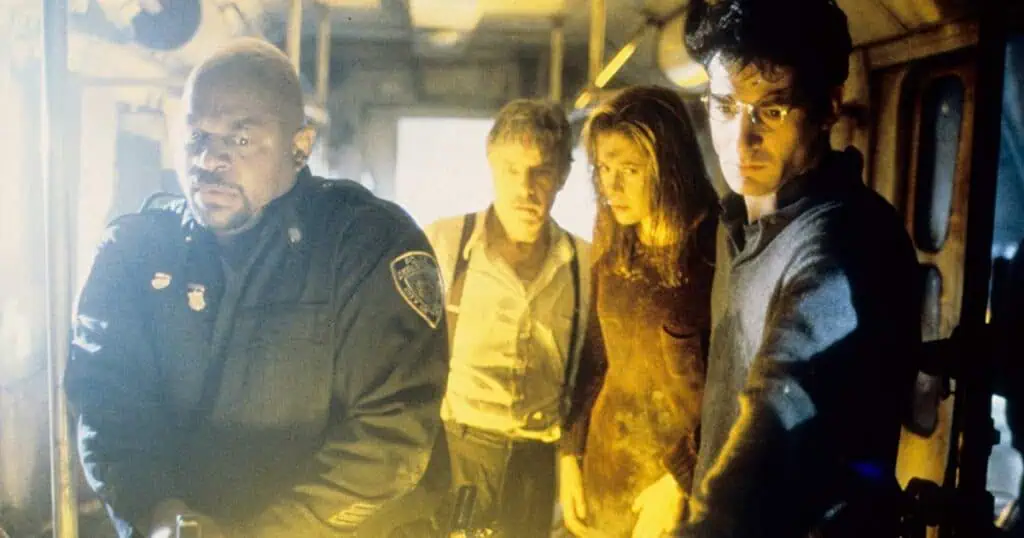
Charles S. Dutton plays MTA Officer Leonard Norton, a no-nonsense warrior who injects some much-needed humor into an otherwise serious film. The role feels like a spiritual successor to Dutton’s performance as Leonard Dillon in Alien 3, right down to sharing the same first name. Dutton is excellent in both films, so consider this our official seal of approval.
The awesome F. Murray Abraham doesn’t get nearly enough screen time as Dr. Tyler’s mentor, Dr. Walter Gates.
In one of his earliest roles, Norman Reedus pops up as Jeremy, a bass-playing sewer worker who mistakes a giant insect for a lobster. Reedus doesn’t get much screen time either, but he makes the most of every minute, bringing an offbeat charm to the role.
A Nightmare Behind the Scenes
Filming began in September 1996 and wrapped in January 1997. Although Mimic is set in New York City, most of the production took place in Ontario, with establishing shots filmed in Manhattan.
The production was notoriously toxic, something del Toro has been very vocal about. Harvey Weinstein reportedly felt the film wasn’t scary enough, and tensions allegedly boiled over when, frustrated with the dailies, Bob Weinstein asked del Toro if he even knew how to direct. Nothing like a little encouragement to keep the creative juices flowing. The studio brought in additional directors to shoot second-unit footage, hoping to speed up the pacing and add a few more scares. There was even talk of bringing in successful directors to throw their weight around.
Del Toro insisted on being present for the additional filming, working to ensure that the new footage remained consistent with his vision, down to the color palette and camera angles. Despite his presence, he felt the second-unit shots didn’t align well with what he’d already filmed. Most of the new material never made it into the Director’s Cut, but more on that later.
Ole Bornedal, a Danish filmmaker and producer on the movie, shot the early sequence where Dr. Tyler and her husband walk past sick children in a hospital ward. There was talk of Bornedal taking over the director’s position for the remainder of the shoot. Reportedly, Bob Weinstein took del Toro aside, fired him, and advised the filmmaker to tell lead actress Mira Sorvino that leaving the project had been his own decision. Allegedly, Sorvino wasn’t buying it. She and her boyfriend at the time, Quentin Tarantino, defended del Toro. The actress made it clear that she had only signed on to the project because of the director and that if he was removed, she would follow. Sorvino was a recent Oscar winner and had considerable credibility, sure. But I’m guessing the Weinsteins mostly didn’t want to piss off Tarantino, who was already a major Hollywood name.
Changes to the screenplay were also being made, with rewrites contributed by other screenwriters, including John Sayles and Steven Soderbergh.

The Darker Version of Mimic We Never Got to See
Del Toro was against explaining exactly what the creatures were, lamenting that the studio wanted him to spell everything out for the audience. He believes that a film should be experienced rather than necessarily broken down for viewers to understand. But he eventually complied with the request, and the mimics were explained primarily through dialogue between Susan, Peter, and Dr. Gates.
Although this kind of exposition can sometimes feel clunky, Mimic handles it well. Susan and Peter are married and well-versed in the Judas breed and entomology in general, so it makes sense that they would discuss the subject in depth. And F. Murray Abraham is a pro at delivering information that lands like a gut punch.
Del Toro and co-writer Matthew Robbins had written several scenes showing interactions among the Judas breed living in a large nest. Several females would surround the king of the colony, which, as the film explains, is the one and only male in the hive. The final chase scene was originally written as a series of shocking moments involving the king. We would see a terrifying number of insects gathered on the wall. Then the male Judas would chase Susan while mating with one of the hive’s females. It would have shown two mimics unnervingly attached to one another as the king pursued its prey. Del Toro described it as a brilliant concept, but the studio rejected it for being too grotesque. It also would have been an expensive sequence to shoot, so it was ultimately never filmed.
Another climactic sequence would have taken place after the subway train hits the male Judas. The creature would walk toward Dr. Tyler as an insect before unexpectedly taking on the shape of a human being. It would then point its finger at Susan and say, “leave.” Del Toro felt the scene would have been eerie because it demonstrated that the mimics had evolved into intelligent creatures capable of communicating like human beings. The studio, however, reportedly didn’t find the sequence scary at all, and it was discarded.
One sequence that was actually filmed but didn’t make the theatrical cut was an alternate ending in which Susan, Peter, and Chuy each escaped the underground hive separately before reuniting inside Grand Central Terminal. An ominous moment occurs when Chuy begins imitating the familiar clicking sound associated with the mimics. Without a giant cockroach lugging around, the implication would be that mimics were now walking among the human race. This particular finale didn’t make the film because the Weinsteins insisted on a happy ending.
Redesigning the Judas Breed
Another major change involved the appearance of the Judas breed itself. The mimics originally had a set of antennae, but this changed after del Toro received an angry phone call from the studio complaining that the creatures looked too much like bugs. The director responded that the studio had been familiar with the intended design throughout the year-and-a-half spent developing the insects. Executives had already seen the sketches and clay models. Besides, the creatures were, in fact, bugs. And at their request, no less! But the studio wanted the mimics to look more like aliens, despite the fact that various special effects teams were already deep into the design process.
Producer and visual effects artist TyRuben Ellingson designed the mimic’s human disguise around an unsettling visual trick. The original concept was much closer to the 1942 short story, with a creature whose anatomy seemed to shift depending on the viewer’s perspective, allowing it to pass for either a human or an insect. That approach changed after the early meeting in which executives agreed that the creature should be a cockroach. The simpler design led Ellingson to envision a vaguely human silhouette that appeared to be wearing a long coat. But the coat was an illusion. What looked like clothing was actually the creature’s wings, draped over its body to conceal its true nature.
A later design introduced false face mandibles that covered the creature’s head rather than jutting out in front of it. Dubbed “peek-a-boo mandibles,” the disguise would open like hands playing peek-a-boo, exposing the insect’s real, biting jaws when it attacked its prey.
Early designs featured two symmetrical halves that met when the mandibles closed over the creature’s head. The concept eventually evolved into a more irregular, asymmetrical design that looked more natural and made the reveal of the insect’s true head all the more frightening. Del Toro also wanted the creature’s head to spring forward when it attacked.
To bring the artwork to life, Rick Lazzarini’s team at The Character Shop was brought in, based on their work on the Dustin Hoffman film Outbreak. Del Toro praised Lazzarini’s approach, saying his puppets were some of the most realistic he had ever seen. As the team worked on the full-sized sculpture, Ellingson showed them reference drawings they could use to get the right shapes and textures for each individual body part. His influences included real-life insects like the praying mantis, the leafcutter ant, and, of course, the common cockroach.
Another change made during the sculpting process involved the mimic’s chest. Initially, it had a flat, firm surface, but del Toro felt that look was a little dull and not scary enough. Lazzarini suggested giving the chest a more jagged-edged appearance, resembling the pupa stage of an insect’s development. The change also fit a plot point involving the Judas breed growing lungs instead of spiracles or tracheae, like a normal insect. Having lungs is what allows the creatures to grow to human size and imitate human behavior.
Another feature inspired by the praying mantis was the creature’s folding, blade-like limbs. The outer sections of its legs could snap into its arms like switchblades, tucked beneath bulges formed by its shinbones. When deployed, these built-in weapons could turn the creature into a walking arsenal, allowing it to stab, slash, and carve into its victims like Michael Myers in bug form.
Special effects makeup creator Rob Bottin was hired to polish the overall design and make it look more predatory. Bottin’s work can be seen in all-time classics like Total Recall and John Carpenter’s The Thing. Bottin gave the creature a more menacing profile. Up to that point, the teams had been so focused on realism that the features ended up looking a little soft. He added a sharper appearance to the antennae and mandibles, perfecting the deadly look the studio had been pushing.
Further requests to turn the creature into a Xenomorph—I mean, to make it scarier—included bigger teeth, visible gums, and crazy hair. Del Toro rejected those ideas. The disputes reportedly lasted two months, but the teams eventually settled on a design they called “The Long John,” a compromise that both the studio and the director could accept.
Del Toro called the final version of the creature “beautiful, aerodynamic,” and “sharp,” while still looking like an actual insect. He was very adamant about maintaining that quality because he believed the appearance of insects was almost mythological in itself, making them all the more frightening.
The visual effects ultimately included approximately 85 digital shots, full-scale puppets standing about seven feet tall, and small-scale rod puppets used mostly for the film’s final scenes. Del Toro noted that there were fourteen puppets in total, each operated by around twenty people at the same time.
The Release and Director’s Cut
When Mimic arrived in theaters in August 1997, it wasn’t a hit with moviegoers. Against a $30 million budget, the film earned only $25.5 million worldwide. The numbers were somewhat surprising given its decent critical reception. It currently holds a 68% approval rating on Rotten Tomatoes, compared with a much lower 37% audience score. Critics generally felt that while the movie wasn’t particularly original, del Toro’s visuals were beautifully executed and easily its standout feature.
In 2011, a Director’s Cut was released. Although del Toro maintained that it still wasn’t the film he had originally envisioned, it was much closer to his liking. The new version mostly trimmed the second-unit material and added approximately six minutes of character development, including an expansion of Susan’s pregnancy subplot. It also restores the themes of human exploitation and religion, introducing a sweatshop operating within the sewer system beneath a church. Another restored moment features a Chinese underground worker hysterically warning that dark angels are coming for her.
Artwork scrawled across the walls by the subway’s underground dwellers further reinforces the film’s ideas about evolution and the mimics’ potential to take humanity’s place in the food chain.
One scene particularly praised by del Toro is a darker underground sequence toward the end of the film. Susan, Peter, and Leonard attempt to hide from the creatures inside a broken-down, abandoned subway car. The director noted that the combination of saturated embers, blue lighting, and rich, rotting textures finally captured the movie he had wanted to make visually.

James Cameron Comes to Del Toro’s Defense
While the Weinsteins may not have been supportive, another Hollywood giant reportedly came through for del Toro. James Cameron claimed that during the 1998 Academy Awards ceremony, he confronted Harvey Weinstein about his behavior toward the filmmaker. The interaction allegedly came close to turning physical, with Cameron claiming he nearly hit Weinstein with his Best Director Oscar statue before the two were ushered back to their seats. Whether or not you believe that account is up to you, but it’s still a pretty amazing thought. And if Cameron had actually hit Weinstein with an Oscar, I’d watch that over Avatar any day. And that’s no shade to Avatar.
Cameron also showed up for del Toro with a genuinely heartwarming gesture. The director’s father had been kidnapped in Mexico and held for 72 days while his captors demanded a $1 million ransom, money del Toro didn’t have at the time. Cameron not only hired a hostage negotiator but also paid the ransom, helping ensure del Toro’s father was safely returned.
Del Toro later commented on the experience, saying, “Two horrible things happened (to me) in the late nineties: my father was kidnapped and I worked with the Weinsteins. I know which one was worse. The kidnapping made more sense, I knew what they wanted.”
Was Mimic Worth the Trouble?
Overall, Mimic is a strong film that simultaneously gives the impression it could have turned out much stronger. And as expected, the Director’s Cut surpasses the theatrical version. There are certain sequences where Marco Beltrami’s score sounds identical or very similar to the intense music from Scream, which doesn’t quite work. To be fair, del Toro builds plenty of tension throughout the movie, but the bombastic cues don’t exactly align with its dreary, muted atmosphere.
The acting is solid across the board, particularly Charles S. Dutton, who commits to his role at full capacity. But something still feels like it’s missing, which is usually the case with movies that have reportedly endured such difficult productions.
Despite showing all the promise of a young filmmaker, I imagine that being constantly shut down on your first Hollywood production would be soul-crushing. Fortunately, del Toro’s next film, Blade II, was an entirely different experience, proving that not every film set had to be a nightmare. And during the filming of Mimic, he found some solace in reading Hellboy comics. Funnily enough, he would go on to create two very successful Hellboy films. Proof that there’s light at the end of even the darkest tunnels. And if there’s a mimic waiting in that tunnel, let’s hope it gets trampled into smithereens by an oncoming train.
And that, my friends, is what happened to Mimic.
A couple of previous episodes of this show can be seen below. For more, check out the JoBlo Horror Originals YouTube channel—and don’t forget to subscribe!












The comment section exists to allow readers to discuss the article constructively and respectfully, focused on the topic at hand.
What’s Not Allowed