
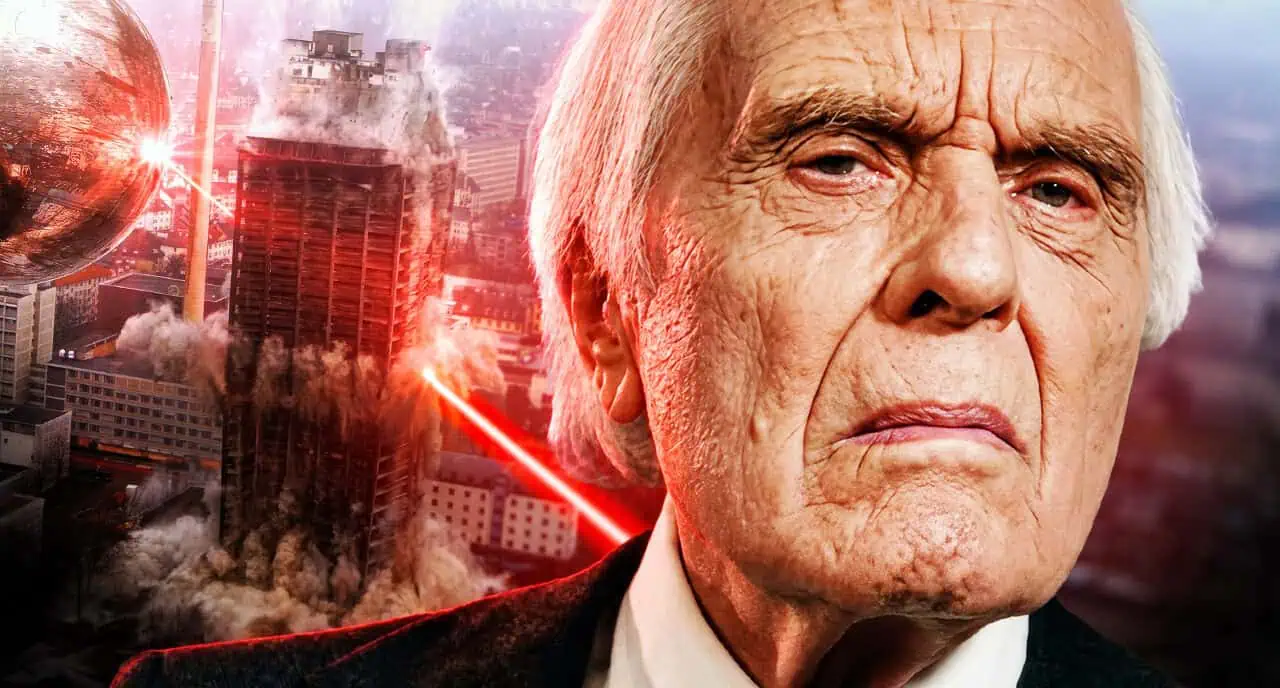
How often do horror franchises actually end? I mean the important ones. Plenty of series have petered out, but the big ones with more than a couple of movies always seem to get resurrected somehow. Jason, Freddy, Michael, Leatherface, Pinhead, Chucky…the list goes on. But what happens when a series definitively ends?
Phantasm started in 1979, and its fifth entry, Phantasm: Ravager, finally arrived in 2016. Thirty-seven years and five movies later, the franchise was supposedly over for real. Unfortunately, Ravager isn’t exactly the best way to put this series to bed.
What happened, though? Which characters returned for a movie that asked more questions than it answered? What controversial behind-the-scenes decision left fans wondering what happened? And which two series veterans got into a heated debate over one of their scenes together? Look out for unusually tall men in mortuaries and duck any silver spheres as we take a look at the final entry in the Phantasm series.
Phantasm: Ravager is a flawed, messy, visually uneven finale that never quite delivers the definitive ending this beloved horror franchise deserved. But thanks to Don Coscarelli’s understanding of these characters and heartfelt performances from Reggie Bannister, Angus Scrimm, and A. Michael Baldwin, it still works as a bittersweet farewell to a series that spent nearly four decades haunting our nightmares.
Is Phantasm: Ravager Really the End?
I don’t mean the end for now, either. As of 2026, Phantasm: Ravager arrived a decade ago, and there has been no sixth movie. Don Coscarelli, the primary creative force behind the series, wrote Ravager but didn’t direct it. His previous directorial effort was 2012’s John Dies at the End, and his involvement here felt like a final trip back to a world he had spent decades building.
The franchise has also lost its two most recognizable stars. Angus Scrimm, the towering terror known as the Tall Man, passed away in 2016 at the age of 89. Reggie Bannister, who appeared in all five movies, passed away in 2026. That makes Ravager‘s story about memory, identity, and losing oneself all the more haunting.
Sadly, the movie doesn’t end with a sense of solidarity or definitive closure. Instead, we get loose ends, interesting cameos, and a handful of genuinely moving exchanges between the actors. In theory, there’s a pretty cool central story here, too, even if the movie looks nothing like the low budget original.
That said, it’s funny to complain about Phantasm not feeling like Phantasm. This is a franchise that has always struggled with conformity, consistency, and even continuity. Why should the fifth movie suddenly make everything make sense?

Reggie Bannister, Dementia, and the Story of Ravager
The movie opens with Reggie wandering a desert road in his familiar, tattered ice cream man suit, carrying his trusty quad shotgun. A car that looks suspiciously like his own stops, and Reggie offers the driver $50 for a ride. He soon realizes the car is actually his, kicks the guy out, and watches as the poor sap is promptly killed by one of the Tall Man’s floating death spheres.
Another sphere comes after Reggie, but he destroys it before suddenly and jarringly waking up in a wheelchair. He’s being pushed through a peaceful hospital park by his old buddy Mike, played once again by A. Michael Baldwin. Mike looks like a hippie who’s had to change his lifestyle because of health concerns, and I mean that as a compliment. Reggie is understandably confused about why he’s here, why Mike is pushing him around, and why everything seems so tranquil.
Then Mike hits him with a horror that lands harder than any silver sphere: Reggie has been diagnosed with dementia. It’s an especially painful angle when you consider that Bannister himself was diagnosed with dementia in June 2016. Watching the beloved character experience the anger, confusion, and denial associated with losing his memories is genuinely difficult. It’s also an inspired direction for the story. Reggie and the other characters must confront the possibility that none of their adventures actually happened.
Of course, Reggie insists it’s another trick from the Tall Man. Mike indulges him because he’s supposed to keep Reggie’s mind active. From there, the movie returns to the alternate realities, nightmares, and bizarre encounters that have always defined this series, even if it follows the already convoluted events of Phantasm IV: Oblivion.
Reggie tells his story, and we get to see the horndog we know and love again. He spots a woman named Dawn on the side of the road, picks her up, and checks her out every chance he gets. He’s as charming as ever. And this is where I want to take a moment to give Bannister his flowers.
Reggie Bannister: The Heart of the Phantasm Series
Even more than in parts two and three, this is Reggie Bannister’s movie. He’s essentially playing two characters: a dementia patient struggling with false memories and Reggie freaking Bannister, hunter of the Tall Man and his interdimensional scourge.
Bannister was a Vietnam veteran who suffered hearing damage from weapons fire and was exposed to Agent Orange during his service. He later used the GI Bill to study acting. His first two acting roles were in Don Coscarelli’s Jim, the World’s Greatest (1975) and Kenny & Company (1976). His third, fourth, and fifth movies? Phantasm (1979), Phantasm II (1988), and Survival Quest (1989). All films connected to his friend Don. Good on him, too. He turned a role in an extremely profitable low-budget horror movie into a career that kept him in the horror community’s consciousness for decades.
Yes, there’s some crap in that filmography. A loooooooot of crap, with titles ranging from The Final Curtain and Spring Break Massacre to Metal Man and Psychic Experiment. But there was plenty of good stuff, too, including Bubba Ho-Tep, Wishmaster; Silent Night, Deadly Night 4, and a cool short-film adaptation of a Stephen King story in which he’s genuinely good. Go YouTube One for the Road. It’s solid.
Beyond everything else, though, 37 years of Phantasm movies will keep Bannister in the horror zeitgeist for generations. He’s great throughout the series, even when he doesn’t have much to do in part four. I liken him to Ash Williams, going from grounded to increasingly gonzo as the sequels progress. Reggie was a singular force as both a person and a character, and the horror community was lucky to have him.

The Tall Man Returns: Angus Scrimm’s Final Performance
Reggie drives Dawn to her cabin in the woods, flirts with her, and plays his guitar while promising to write her a song. She eventually goes to bed, leaving him by the fireplace. Although the movie was shot digitally and sadly looks it, the musical stings and little callbacks help make it feel like Phantasm. It’s still weird and awkward, and it doesn’t always make a whole lot of sense. But that’s how this series has been up to this point, so why change now?
Dawn changes her mind about going to bed alone, but our guy is already asleep when the cabin is invaded by spheres. A dream sequence follows, with Reggie in a hospital bed next to the Tall Man… or, at least, the human being the Tall Man used to be. This is apparently the scene in which Scrimm and Bannister got into an argument over how their characters should behave and speak. Honestly, as the only two actors who played the same roles throughout all five movies, I’d say they’re entitled to be opinionated about the matter.
The Tall Man quickly transforms into his true self and warns Reggie that he’ll never be safe. The camera then pans down to his hand, molded to the Lady in Lavender, played by the same actress who appeared in the original movie.
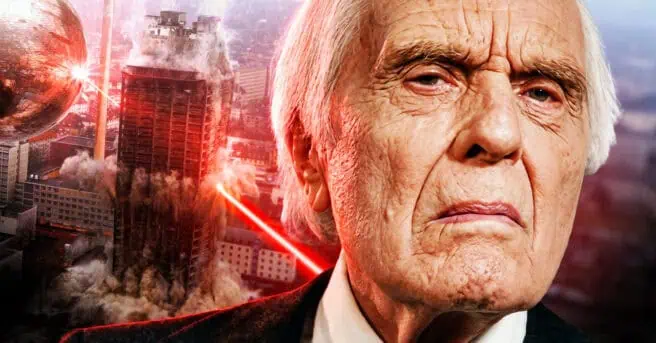
Even in his late 80s, Scrimm still has it. He’s mostly relegated to being filmed while lying down, but his voice and imposing presence remain effective. This was the last scene the actor ever shot, and he was shown the finished movie before he passed away, months before its public release. Despite the film’s flaws, it’s good to know he liked what he’d done and was proud of it.
Scrimm, like Bannister, played one role so perfectly that he’ll always be associated with it, even though he had a much longer and more varied career. Did you know the six-foot-four actor had quite a career before he started acting? He won a Grammy for liner notes in 1974 after working on albums by Frank Sinatra and the Beatles. He was also a writer and journalist for TV Guide, so he was evil long before becoming the Tall Man.
Across a career that included approximately 70 screen appearances, Scrimm took memorable horror roles in movies like Chopping Mall, Subspecies, Munchie, and Munchie Strikes Back. He reunited with Bannister in Wishmaster and appeared in a Masters of Horror episode directed by Coscarelli. Outside horror, he showed up in the Nicolas Cage movie Deadfall and an episode of The Magical World of Disney.
It’s difficult to see him as anything other than the brooding Tall Man, but he’s great here, even if his age is impossible to ignore. His conversations with Reggie showcase his facial acting, and he delivers his lines with tremendous relish and evil intent.
Blood, Silver Spheres, and the Alternate Realities
Reggie snaps awake in a clever sequence that connects the story he’s telling Mike with what happened at Dawn’s cabin. He wants to stay a little longer, but something feels off. He checks on Dawn and finds her being drilled (not that way) by one of the floating spheres. It’s easily the movie’s goriest scene. Dawn is covered in blood, with a fountain erupting from her head. Reggie loads up on weapons from his trunk like the boys in Hot Fuzz and takes on the sphere, although the combination of poor CGI and digital gunshots is disappointing. To be fair, I couldn’t find the budget, and I can’t imagine it was much. This wasn’t a theatrical release backed by a major studio. The limitations are understandable, even if they don’t make the effects any better.
Reggie also encounters Dawn’s farmhand, Demeter, played by Daniel Roebuck, who brings a wonderfully silly yet somehow serious energy to the role. Roebuck has enjoyed a career that includes appearances in both the Terrifier and Rob Zombie cinematic universes. His horse is killed by a sphere, which wasn’t on my bingo card the first time I watched this movie. Naturally, poor old Demeter is then killed when one of the Tall Man’s spheres drains the blood from his throat.
And then Reggie wakes up again. He’s back beside Mike, who has no apparent memories of their adventures together. All he remembers is that Reggie looked after him after his brother Jody died. Mike offers theories about stacked universes in an effort to humor his friend, but Bannister would rather talk about bullets and last stands.
A moon-sized sphere eventually sneaks up on Reggie in the forest, forcing him to transport himself back to his conversation with Mike through one of the interdimensional gates we’ve come to know and love.
The dialogue between Bannister and Baldwin is excellent. Reggie talks about wanting to go out on his feet, fighting, rather than as an old man in bed. Suddenly, Mike disappears, and nobody really knows what’s going on anymore.
For all its problems, Ravager has an interesting central narrative. That deserves credit for Coscarelli’s writing. Even when he’s not directing, he understands this world and its characters as well as anyone could understand such a gloriously convoluted franchise. He keeps everything feeling like Phantasm, even if the movie doesn’t look much like the original.

Don Coscarelli: More Than the Phantasm Guy
Coscarelli feels like a filmmaker who should have had a longer career, although that may simply be because the movies he did make left such an impression on different audiences. Like Scrimm and Bannister, he’ll forever be known to the world at large as the Phantasm guy. But he did much more than that.
After a couple of early comedies and dramas that very few people have seen, Coscarelli made Phantasm on a minuscule budget and achieved remarkable results. He then changed genres and created another cult classic with The Beastmaster. The franchise that followed wasn’t necessarily anything to write home about, but that first movie is a stone cold fantasy classic, now celebrated in the genre much as Phantasm is in horror. It’s crazy to think the same guy made both.
Coscarelli doesn’t get talked about enough alongside the great genre filmmakers, probably because his output was smaller than that of John Carpenter or Wes Craven. But he’s a good comparison to another horror hero who became closely associated with one major franchise: George Romero. Romero gave us the living dead mythology we know today, but he also made underseen one-offs like Knightriders, which isn’t horror but is terrific, along with Martin, The Crazies, Creepshow, and Two Evil Eyes, among other films. Coscarelli is much the same. Yes, his four directed Phantasm movies are his calling card, but the man also gave us Bubba Ho-Tep, which, to me, is worth more than almost everything Craven did outside of A Nightmare on Elm Street or Scream put together. He also made The Beastmaster and the weird but wonderful adaptation John Dies at the End. Throw in Survival Quest and his Masters of Horror episode, and there’s plenty in his filmography worth discovering.
Coscarelli has long been associated with the proposed Bubba Nosferatu, but we all sadly know that’s unlikely to come to fruition. Like so much of his career, with its gaps and long stretches between projects, it’ll remain a great what-if.
Reggie Finds Himself Again
Back to our boy. Reggie has another terrific conversation with the Tall Man about regaining his friends. It’s a great metaphor for his struggle to recover his mind, memories, and identity. He then wakes up in a sequence that looks as though it may have been shot well before much of the rest of the movie. Given that the film had been teased since the early 2000s and footage was reportedly shot years before its release, that’s not hard to imagine.
Reggie fights some of the Tall Man’s diminutive henchmen, a great callback to earlier entries, and is eventually rescued by a now-living Dawn.
Peeling back the layers of this movie really does help its overall story. Reggie looks ROUGH by this point, and everyone treats him like, well, a dementia patient. He’s sad, scared, and angry, but he continues his mission anyway.
He encounters Mike in what appears to be an alternate universe, a possible future, or whatever else the movie wants us to believe. Whatever the explanation, the sequence connects at least some of Ravager directly to Phantasm IV: Oblivion. It’s wonderful to see Reggie find his friend again. The elation isn’t just about reuniting with someone physically; it’s also about recovering a part of himself. The idea that Reggie might prefer a “real world” of endless battles, with the Tall Man effectively winning, over a peaceful existence in which he’s losing himself is devastating. It hammers home the horrific reality of dementia and the fear of losing one’s identity.
On this second viewing, I’m also more forgiving of the terrible CGI and the appearance of the post-apocalyptic city. They had to work with what they had. That’s exactly how the original movie was made, too, even if I find the lo-fi aesthetic of that first film far more appealing. I can look past the effects because the heart of Ravager captures what the series has always done well: loud jump scares, creepy locations, haunting music, and characters we genuinely care about.
Reggie continues bouncing between worlds, but when he wakes up in the nursing home, Mike returns looking more paranoid and considerably more haggard than before. He tells Reggie that he had HIS dream last night.

The movie does a great job of transitioning between the hospital world and the post-apocalyptic one. Baldwin also gets to stretch himself as a convincing John Connor-type figure, without simply copying the Terminator universe, while retaining the familiar persona of a man who cares about his friend.
It’s here that I’ll give my final flowers to A. Michael Baldwin. Yes, he’s had a relatively small career outside this series, including his share of questionable direct-to-video fare. But he’ll always be Mike from Phantasm, and he does a terrific job here. This may well be his best performance in the role. They tried replacing him in part two with James LeGros, and all due respect to that actor, he isn’t Mike. He never was. Baldwin is all we ever needed for this character and this series.
He could have done other things, and we see that range here. But there’s something kind of beautiful about an actor being remembered for a character he played across decades.
The Final Battle and the Ending That Never Quite Arrives
The rest of the movie delivers more callbacks, including the return of original Jody actor Bill Thornbury. The three men reunite to go after the Tall Man and try to stop his ongoing campaign of terror.
Unfortunately, Ravager had an opportunity to close out the series with a definitive bang. Instead, we get a damn Marvel-esque mid-credits scene teasing even more action, complete with another returning character: Rocky from Phantasm III, once again played by the original actress.
The film could have ended in the real world with Reggie dying in his hospital bed. Alternatively, it could have given the three men who spent the better part of 40 years fighting the Tall Man a definitive victory over his dimension. But, alas, like so many other things connected to this series, that remains a what-if.
David Hartman, who previously worked on visual effects for Coscarelli, did a good job directing the actors and bringing the better-than-it-should-be script to life. Still, this could have been the movie that tied everything together neatly. Instead, it leaves us with more questions, more loose ends, and the sense that a definitive conclusion remains just out of reach.
Is Phantasm: Ravager a Good Finale?
As it stands, I like this one. I like it more every time I watch it, and if I were ranking the series, I’d put them in this order:
- Phantasm
- Phantasm III: Lord of the Dead
- Phantasm II
- Phantasm: Ravager
- Phantasm IV: Oblivion
Tell me I’m wrong, but that’s how I feel after my most recent viewing.
Ravager arrived rather unceremoniously after years of rumors about whether it would ever be made. Instead of a big announcement filled with casting news and excitement, we were essentially told the movie was coming out after it had already been completed. For such a beloved series, it was a surprisingly stilted and understated release.
The movie was shot over eight years by Hartman, who had previously worked with Coscarelli on visual effects. It’s amazing that it got released at all.
It’s also fitting that Ravager was the last movie Angus Scrimm saw before his death. The film’s bittersweet place in the history of the series makes it feel like it should have been the last movie for everyone involved.
We probably won’t see another franchise quite like Phantasm again, which is a bummer. At the same time, we probably won’t see another Phantasm movie, which is a good thing. Watch the movies as a series, but watch this one with the right expectations. It’s flawed, messy, and sometimes downright ugly. It doesn’t offer the definitive ending the franchise deserved, and its effects can’t match the haunting magic of the original. But underneath all that is a heartfelt farewell to a series that spent nearly four decades following a small group of people through nightmares, alternate realities, and an endless war against a towering figure of death.
It’s a kind of send-off that many horror icons never get. And for all its faults, Phantasm: Ravager is worth appreciating for that.
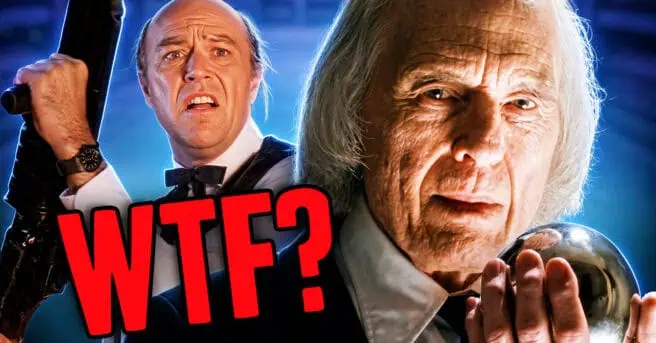
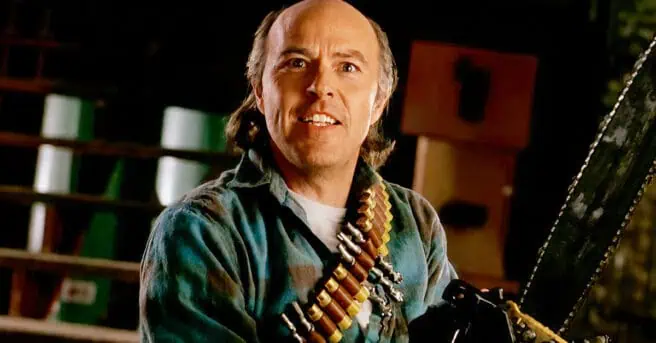
A couple of previous episodes of this show can be seen below. For more, check out the JoBlo Horror Originals YouTube channel—and don’t forget to subscribe!











The comment section exists to allow readers to discuss the article constructively and respectfully, focused on the topic at hand.
What’s Not Allowed