


Folks, it’s the spooky season— and as such, I feel that it’s my responsibility to warn you that your neighbors might be trying to kill you.
We’ve all got those neighbors that we don’t fully trust, right? Whether it’s that one guy who mows his lawn at 6 a.m. every Sunday morning, or that house where you never see anyone leave or enter, or maybe that one house that’s undoubtedly practicing some kind of satanic sacrifice in their basement just 40 feet from where you sleep—only for you to find out they’re a cult of ritualistic sadists who have literal skeletons in their closet.
Today, we’re going to be talking about The ’Burbs, one of the most underrated films of the 1980s—and probably one that (if just one or two things had gone differently) we wouldn’t have available to us today. It’s a film that highlights a fear we all have while still providing laughs, quirky adventure, and a hell of an impressive cast of characters that improvised most of it.
So, if you’re looking for a cozy-yet-attention-grabbing movie in the tradition of Gremlins, The Goonies, or an old Hitchcockian thriller—then put on your comfiest bathrobe, pour some coffee, and light up a cigar—because we’re going to talk about what REALLY happened to Joe Dante’s The ’Burbs. Let’s get into it.
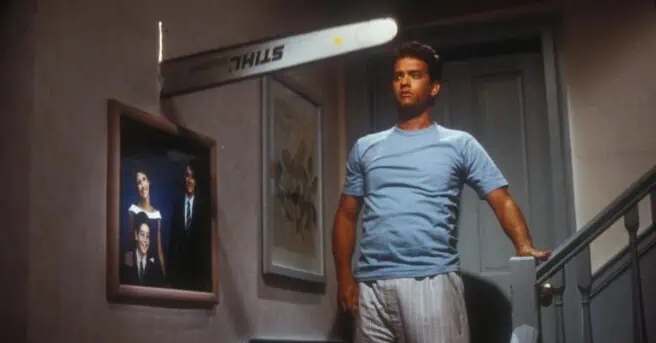
The ’Burbs is a 1989 dark comedy that follows Ray (played by Tom Hanks), a regular guy with a week off work that he wants to spend relaxing and watching baseball—until his oddball neighbor and a local hoodlum convince him that his new neighbors are secretly cultists plotting something sinister for the neighborhood. Of course, Ray then decides to spend his week investigating them while attempting not to disturb the peace and to keep his wife and son as in the dark as possible.
Now, while this movie is seen today as a beloved cult classic with a wonderful ensemble cast—Tom Hanks, Carrie Fisher, Rick Ducommun, Corey Feldman, and Bruce Dern—it started off as a project deeply affected by off-screen events that sabotaged the production at every turn. And if you’ve ever found yourself charmed by the fact that it all takes place on a single suburban street spanning less than a mile in radius, you have the cast and crew’s talents to thank for making it work.
See, this movie was in production in 1988 during one of the most extreme Hollywood writers’ strikes in film history. Ironically, this may have made the film as good as it is today—because the inability to get script rewrites or proper screenplay supervision led everyone on set to resort to improvised dialogue, exposition, and story elements that felt organic to the situation.

But that’s not all—due to these restrictions, the movie also had to be shrunk down into what’s called a “snow globe movie,” meaning it was all made in a small, concentrated area that (in theory) should have minimized the film’s scope—but again, that ended up working for the better.
In the documentary There Goes the Neighborhood: The Making of The ’Burbs, it’s revealed that production was originally planned to shoot in multiple locations—following the Klopek family on some of their exploits outside the neighborhood and checking in with Carol and the family at the lake house from time to time. Instead, when someone leaves the neighborhood for work or a trip to the mall in this movie, they’re gone until they return. The camera, the story, the details—don’t exist outside of Colonial Street on the Universal Studios backlot.
I actually think this adds to the mystery of the film and makes it seem darker and more dreamlike. As Ray and Art assemble their neighborhood watch crew to investigate the new neighbors, the mystery is thickened by us as the viewers not knowing what goes on outside this one street. Like, imagine if they showed the eerie Dr. Klopek leaving for work—and then we saw that he actually was going to work. It loses mystique.
The way it plays in the movie allows us to wonder what this family is REALLY doing because we don’t get to see it. Maybe they are just going to work—or maybe they’re doing exactly what Ray thinks they’re doing… murder.
Let’s talk a little more about the improv in this movie, because I’m telling you guys—it’s interesting.
Now, movies get made with improv all the time, and I’m sure some of you aren’t as impressed as I was to learn that much of the humor in this film was made up on the spot—I mean hell, most great comedies of the last few decades were improvised. But that’s by design. Where a movie like Anchorman is mostly one big improv show, it was meant to be that way from the beginning—with freestyle comedy legends attached to it.
For this movie, it was done out of necessity, not choice—and its actors were not known for a “yes-and” style of performance. This also meant that director Joe Dante was forced to rework the movie’s already short shooting schedule to film the scenes sequentially—that is, they filmed it in the order that it takes place in the movie. This allowed the improvised scenes to flow naturally and for the context to carry over from scene to scene. If Rick Ducommun made a joke in one scene, the context would carry into the next, as it would in a real conversation.
Of course, Tom Hanks being the leading man helps a lot—as he was becoming a bankable star just before this movie after the release of Big, assuring Dante that the production was in good hands. I mean, Tom Hanks playing a frustrated straight man who has to react to the comedic weirdos around him just sounds… right.

It should also be noted that despite the quirks and setbacks in production, the entire cast says that making the movie was fun and felt like summer camp. Usually, small productions like this one are against the clock, the budget, the schedules of the cast—you name it. But this time, the writers’ strike afforded everyone time to just hang out and make a movie in backyard tradition—trying things and making the most of limited resources. That really adds a charm to the film that shines through from behind the scenes.
Although, it is Hollywood—so you KNOW there were some shenanigans going on on set.
One notable story is that Corey Feldman, who plays his standard ’80s “bastard kid” role in this movie (which is GREAT, by the way—I’m realizing it might sound like that was a dig, but it wasn’t), was at the peak of his popularity. He was famously good friends with pop legend Michael Jackson at the time, and according to Dante, he would occasionally bring MJ’s pet chimpanzee, Bubbles, to visit the production and hang with the cast. It would’ve been really cool to see that monkey make a cameo in the movie.
Speaking of Feldman, he also made friends with the wonderful Carrie Fisher on set. Fisher, who played Tom Hanks’ wife, also made an impact off-screen. Feldman has said that Fisher pulled him aside during a rough patch in his life and gave him personal advice. In many ways, she was the same grounding presence in real life that she was in the film.
Of course, a fun set and a laid-back cast don’t mean that everyone believed in the work. The studio was losing faith after seeing the dailies each day, the set was constantly being redressed to match continuity, and at one point Joe Dante even said he thought The ’Burbs could be “the worst movie ever made.” Of course, we’re all happy to report that while Joe Dante is right about a lot of things—this wasn’t one of them. This is easily one of his most underrated films, and if you know someone who’s seen it, you can bet they liked it.
Production lasted for 10 weeks, and when all was said and done, Dante was left with what he felt was half a movie—a collection of scenes that served as a great A-plot, but with no world-building, no B-plot, no development outside of a single cul-de-sac. And while editing, some of those quirks couldn’t help but shine through.
Hanks was reaching an all-time career high, and the rest of the cast had moved on—but Dante and editor Marshall Harvey had work to do. Rather than trying to work around the limitations, they fully embraced them by cutting the movie so that the mystery of the Klopek family became both the A and B plot. Plot A is “Who are the Klopeks?” and plot B is “What are they up to?”
Here’s what I mean: half of this movie is Ray and his friends investigating the neighbors in secret, hoping to catch them for the sinister behavior they suspect. But between those moments, Ray and his crew try to get to know the neighbors on the up-and-up by taking their wives over with brownies and properly introducing themselves—only for the movie to then cut back to the A plot, where Ray and the gang ravenously dig through the Klopeks’ trash in the middle of the street.
And because we don’t see anything the Klopeks are doing outside of the cul-de-sac, we as the audience are just as suspicious—yet ignorant—as the characters. Which somehow doesn’t lose its charm even after you know the ending.
Speaking of endings, Joe Dante originally shot three different endings for the movie because he wasn’t sure exactly what the movie’s tone would end up being.
Of course, there’s the ending we all know, where Ray catches the Klopeks after a struggle in the ambulance when he burns their house down, exposing evidence of their crimes. There was an alternate ending where it turned out the Klopek family was innocent and Ray and his ragtag neighborhood watch were essentially meddling kids who destroyed the home of an innocent family. And in a third ending, the Klopeks are guilty—and when Ray exposes them, they kill him in the ambulance and get away.
I think Dante probably knew that with the limited footage he had, he would need a few different options to match the final cut’s vibe—and I’m glad we got the happiest version.
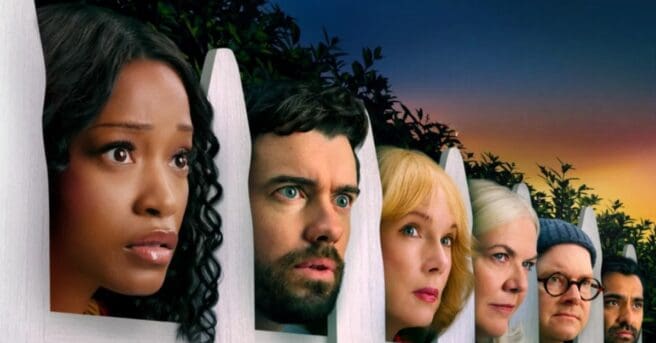
And just recently, in 2025, Peacock announced a new series adaptation of The ’Burbs. Original writer Dana Olsen is back as co–executive producer, with Joe Dante giving his blessing. Even he admitted he’s surprised the film still resonates so strongly after all these years.
So, whether you love The ’Burbs for its dark humor, its satirical look at suburban life, or just the sheer weirdness of its production, there’s no denying—it’s one of the most unique comedies of the 1980s.






















The comment section exists to allow readers to discuss the article constructively and respectfully, focused on the topic at hand.
What’s Not Allowed