

There are movies you admire the first time you see them. Movies you respect. Movies you immediately recognize as “great.” And then there are movies that don’t fully reveal themselves until much later, films that sit quietly in the background of your life, waiting patiently for you to grow into them. The Shawshank Redemption is one of those rare films. It doesn’t announce its importance with spectacle or shock. It doesn’t overwhelm you with twists, violence, or bombastic moments designed to grab your attention. Instead, it does something far riskier. It waits. It asks for your time. And eventually, it asks for your trust.
When you’re younger, Shawshank plays like a powerful story about injustice and perseverance. It’s emotional, compelling, and deeply satisfying. You remember the escape. You remember the rain. You remember the beach. You remember how it feels when everything finally clicks into place. But as the years pass, something strange happens. The movie doesn’t change — but you do. And suddenly, the parts that once felt like connective tissue begin to feel like the entire point. The waiting. The repetition. The quiet compromises. The slow erosion of belief. The film stops being a prison movie and starts becoming something far more personal: a reflection of how time works on all of us.
Shawshank Understands the Weight of Routine
One of the most quietly radical things The Shawshank Redemption does is refuse to rush. It understands that prison isn’t defined solely by violence or cruelty, but by monotony. By routine. By days that blur together until time loses shape. Frank Darabont lets scenes linger longer than most films would dare. Conversations breathe. Silence stretches. Years pass without fanfare. And that patience is thematic. Shawshank doesn’t just depict imprisonment. It makes you experience it. And the older you get, the more you recognize that feeling in your own life.
There’s something deeply uncomfortable about how familiar Shawshank begins to feel with age. The routines. The rules you stop questioning. The way people slowly adjust expectations downward just to make survival easier. When you’re young, the prison feels foreign, extreme, distant. When you’re older, it starts to resemble offices, commutes, obligations, and responsibilities you never imagined would feel so permanent. Shawshank becomes less about bars and walls, and more about the invisible structures that quietly dictate how much of yourself you’re allowed to keep.
Andy Dufresne and the Power of Small, Consistent Change
Andy Dufresne survives Shawshank not because he’s physically imposing or emotionally dominant, but because he understands something fundamental about systems: they don’t collapse under force alone. They erode under persistence. Andy doesn’t fight the prison head-on. He doesn’t rebel loudly. He studies it. He adapts to it. He finds the cracks. A rock hammer small enough to be dismissed. A chess set carved one piece at a time. A library built book by book. Financial advice offered to one guard at a time. None of these actions look revolutionary on their own. In fact, they almost seem insignificant. But over time, they accumulate into something transformative.
This is one of the film’s most powerful lessons, and one that lands harder with age: meaningful change rarely announces itself. It doesn’t arrive with applause or dramatic music. It happens quietly, often unnoticed, until one day you look back and realize you’re no longer the same person you were before. Andy’s long game isn’t flashy, but it’s sustainable. And when you’ve lived long enough to see impulsive decisions backfire and slow, patient effort pay off, that approach stops feeling passive and starts feeling profound.
Hope Is Dangerous — And Necessary

Red’s narration gives voice to the fear most of us don’t want to admit out loud. “Hope is a dangerous thing,” he says. “Hope can drive a man insane.” When you hear that line early in life, it sounds cynical. Bitter. Almost defeatist. But with time, it starts to sound like experience talking. Red isn’t afraid of hope because he lacks imagination — he’s afraid because he’s been disappointed too many times. Hope, for him, isn’t inspirational. It’s a liability. It opens the door to pain.
Andy and Red represent two fundamentally different survival strategies. Andy believes in a future he cannot yet see. Red believes in managing expectations to avoid disappointment. Neither approach is portrayed as weak or foolish. But over time, the film gently reveals that survival without hope isn’t really living, but enduring. Red isn’t broken because he’s unintelligent or passive. He’s broken because he’s learned how much it hurts to want something and not get it.
Brooks and the Fear of Becoming Obsolete
Few moments in the film illustrate this better than the story of Brooks. When Brooks is released after decades behind bars, freedom is supposed to be a gift. Instead, it’s overwhelming. The world has moved on without him. The routines that once sustained him are gone. The structure that defined his identity has vanished. Watching Brooks struggle outside Shawshank hits differently depending on where you are in life. When you’re young, it’s tragic. When you’re older, it’s terrifying.
Because Brooks forces you to confront an uncomfortable truth: that survival alone isn’t enough. That people need purpose, connection, and a sense of belonging to stay alive in any meaningful way. Brooks doesn’t fail because he’s weak. He fails because the world no longer has a place for the version of him that prison created. And that idea — that time can quietly make you obsolete — is something that grows more unsettling the longer you live.
Time Is the Real Villain of Shawshank
There’s also something quietly devastating about how Shawshank portrays time as something you don’t notice slipping away until it’s already gone. Years pass in the film almost casually: a new parole hearing, a new inmate arriving, a few gray hairs appearing where there were none before. The movie refuses to announce these shifts with drama, because that’s not how time works in real life. It doesn’t warn you. It doesn’t stop to ask permission. It just keeps moving.
And the older you get, the more you recognize that feeling. The sense that you were busy surviving, adjusting, adapting — and suddenly entire chapters of your life exist only in hindsight.
What makes Andy’s journey so affecting isn’t that he escapes Shawshank, but that he never allows the prison to fully claim his inner life. He refuses to let his imagination shrink to fit the walls around him. While others count the days until their next parole hearing, Andy thinks in decades. While others learn how to get comfortable inside the system, Andy quietly prepares for a world beyond it. That ability to think long-term, to envision a future that feels impossibly far away, becomes increasingly rare as life wears people down. Watching Andy hold onto that vision reminds us how easy it is to stop dreaming simply because dreaming starts to hurt.
Why People Revisit Shawshank During Difficult Times
There’s a reason The Shawshank Redemption becomes a movie people revisit during transitional moments in their lives — after loss, during burnout, or when they feel stuck between who they were and who they hoped to become. It doesn’t offer motivation in the traditional sense. It doesn’t tell you everything will work out. What it offers instead is permission to be patient with yourself. To accept that progress may be invisible for long stretches of time. That growth might look like repetition before it looks like change. And that sometimes, the bravest thing you can do is keep going quietly, even when no one else can see the wall you’re slowly chipping away at.
Shawshank understands something most films avoid: time itself can be violent. Not in loud, obvious ways, but in subtle ones. Time wears people down. It reshapes them. It convinces them to settle. Institutionalization isn’t just about prison walls, but about what happens when you stop believing change is possible. Andy resists that erosion not through grand speeches or heroic rebellion, but through consistency. He keeps planning even when there’s no visible exit. He keeps nurturing hope even when it feels irrational.
The Escape Isn’t Triumphant — It’s Exhausting
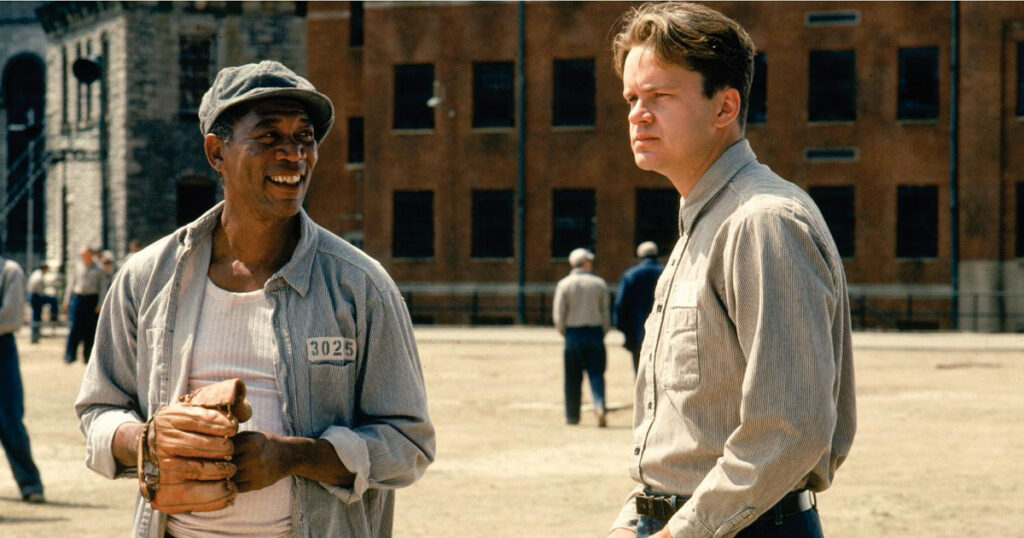
This is where Shawshank stops being inspirational in a traditional sense and becomes something far more honest. Hope here isn’t loud. It isn’t motivational. It’s quiet. Private. Sometimes almost embarrassing. It exists in small rituals and long-term visions that don’t make sense to anyone else. And yet, it’s the only thing that keeps Andy intact.
The escape, when it finally comes, doesn’t feel triumphant. It feels exhausting. Crawling through a sewage pipe isn’t heroic. It’s degrading. It’s filthy. It’s painful. And that’s exactly why it works. Freedom in Shawshank isn’t clean. It requires enduring the worst parts of the system before emerging on the other side. When Andy stands in the rain with his arms raised, it’s not a victory pose. It’s a release — the shedding of years spent merely surviving.
What makes that moment resonate even more deeply with age is the realization that most of us will never experience a single, definitive escape. Our battles are quieter. Slower. More incremental. We chip away at our walls a little at a time, often without knowing if we’ll ever see the other side. Andy’s story becomes less about prison and more about perseverance — about believing that small, consistent effort can eventually lead somewhere better, even if you don’t know exactly where that is yet.
Why the Ending Hits Harder as You Get Older
And then there’s the ending. It’s gentle, unhurried, and deeply humane. For years, some critics dismissed it as sentimental. But sentimentality implies dishonesty. Shawshank’s ending doesn’t erase the pain that came before it. It doesn’t undo the lost years, the trauma, or the scars. It simply allows space for something better. When Red says, “I hope,” it isn’t a declaration. It’s a risk. A quiet decision to believe again.
With age, that line becomes heavier. Hope isn’t naïve. It’s courageous. It means opening yourself up to disappointment again. It means refusing to accept stagnation as your final state. And that’s why The Shawshank Redemption continues to resonate so deeply. Not because it promises easy answers, but because it respects how difficult hope actually is.
Stephen King’s Novella vs Frank Darabont’s Film
One of the reasons The Shawshank Redemption feels so precise in its emotional construction is because it’s built on a literary foundation that already understood restraint. The film is based on Stephen King’s novella Rita Hayworth and Shawshank Redemption, a short but powerful work that strips away King’s usual horror trappings in favor of something quieter and more human. On the page, the story is less concerned with suspense and more interested in observation — in the way prison life reshapes people over time, and how hope survives not through grand gestures, but through patience.
Frank Darabont’s greatest achievement wasn’t simply adapting the story faithfully, but recognizing what to expand, what to soften, and what to reframe so the emotional core could resonate beyond the written word.
One of the most significant differences between the novella and the film lies in perspective. King’s story is almost entirely filtered through Red’s voice, and while the movie retains that narration, it externalizes Andy’s inner life far more visually. In the novella, Andy is more distant, more enigmatic — almost mythic in how little access we have to his internal thoughts. The film, by contrast, allows us to sit with Andy in silence, to watch him endure, to see the toll Shawshank takes on him even when he refuses to let it break him.
Darabont uses performance, framing, and time to give Andy emotional dimension without stripping away his mystery. The result is a character who feels both unknowable and deeply relatable, a balance that’s incredibly difficult to pull off in adaptation.
Why the Film’s Sentimental Ending Works
Another notable change is how the film reshapes the tone of hope itself. In King’s novella, hope is present, but it’s sharper, riskier, and more ambiguous. The ending, while optimistic, leaves more emotional space between Andy and Red — the future is promised, but not fully visualized. The movie chooses a different path. By showing the reunion on the beach, Darabont leans into emotional payoff, not as fantasy, but as an earned release.
It’s a creative decision that has been debated for decades, often labeled “too sentimental,” yet it aligns perfectly with the film’s long-game philosophy. After spending nearly three hours asking the audience to endure, to wait, to trust, the movie rewards that patience with clarity instead of ambiguity. And for many viewers, especially as they age, that generosity feels less like manipulation and more like mercy.
What’s fascinating is that neither version undermines the other. The novella is leaner, more observational, and slightly colder — a reflection of King’s interest in endurance over catharsis. The film is warmer, more expansive, and more openly emotional — a reflection of Darabont’s belief that hope, once earned, deserves to be seen.
Together, they form a rare example of adaptation as dialogue rather than replacement. The book asks you to imagine survival. The movie asks you to feel it. And the reason Shawshank endures in both forms is because neither mistakes hope for simplicity. In both versions, hope costs something. It requires time. It requires patience. And it requires the courage to believe that waiting doesn’t have to be wasted.
Shawshank’s Legacy and Why It Endures
There’s also something quietly radical about the way Shawshank refuses to mock sincerity. In an era increasingly dominated by irony, cynicism, and emotional distance, the film dares to be earnest without apology. It believes in friendship without undercutting it with jokes. It believes in kindness without framing it as weakness. And it believes in hope without pretending that hope is easy or safe.
That lack of irony is part of why the film grows more powerful with age. As life complicates you, as disappointment accumulates, and as sincerity becomes harder to access without fear of embarrassment, Shawshank feels almost defiant in its emotional honesty. It doesn’t ask you to be naïve — it asks you to be brave enough to care anyway.
The film’s legacy mirrors its message. It wasn’t an instant success. It didn’t dominate the box office. It didn’t collect an armful of awards. Instead, it found its audience through reruns, rewatches, and word of mouth. Over time, it became something rare: a shared emotional touchstone. A movie people don’t just watch, but return to again and again, as life reshapes their understanding of it.
What makes Shawshank timeless isn’t nostalgia. It’s recognition. Recognition of routines that once felt temporary but became permanent. Recognition of dreams deferred, compromised, or quietly abandoned. Recognition of how easy it is to wake up one day and realize years have passed while you were just getting through the day. The film doesn’t change. Its meaning deepens because we do.
In a world obsessed with speed, immediacy, and constant stimulation, The Shawshank Redemption feels almost defiant. It asks us to slow down. To endure. To believe in outcomes that may take years to arrive. And that’s why it doesn’t just hold up, but grows. Like the best friendships. Like the hardest lessons. Like hope itself.
Because hope is dangerous. But without it, you’re already serving a life sentence.






















The comment section exists to allow readers to discuss the article constructively and respectfully, focused on the topic at hand.
What’s Not Allowed