
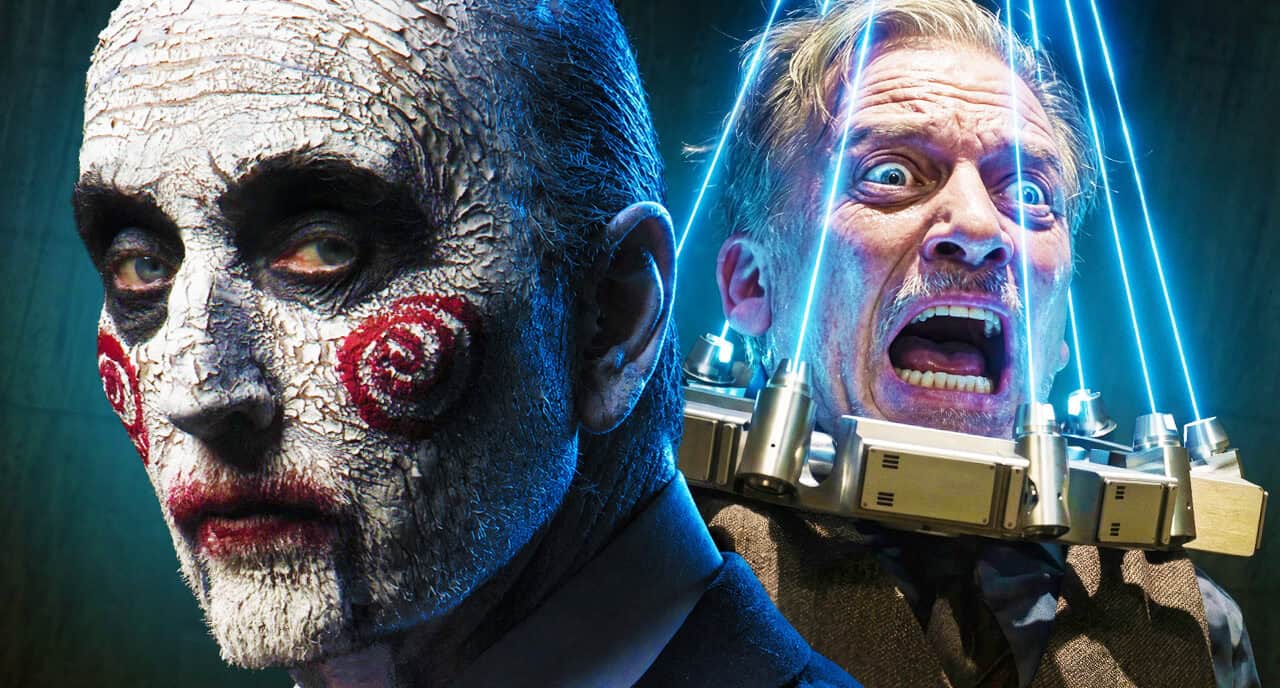

What happens when you take Saw out of its familiar industrial meatpacking plants, with their rusty metal and green-hued concrete walls, and put the story in a barn surrounded by wood and warm colors? Would that even be Saw? And what about the mandate to use less blood and guts? Oh God, what are we even doing here? Well, let’s play a game and see what happened to Jigsaw.
Released in 2017, Jigsaw attempted to revive the Saw franchise with a new cast, a different visual style, and another elaborate timeline twist. The film was a box-office success, but its cleaner aesthetic, convoluted mythology, and limited use of Tobin Bell’s John Kramer left it feeling like an awkward attempt to reinvent a series built on grimy atmosphere, inventive traps, and carefully timed revelations. Let’s revisit how Jigsaw came together, where its story went wrong, and why the franchise ultimately moved in a different direction.
Why Did Jigsaw Disappoint Some Saw Fans?
Jigsaw didn’t fail at the box office. Released in October 2017, the eighth Saw film grossed approximately $103 million worldwide against a reported $10 million production budget. Its problem was that the attempt to refresh the franchise changed some of the qualities that had made it distinctive.
Directors the Spierig brothers gave the film a cleaner visual style, moving away from the grimy industrial settings associated with earlier installments. The story also relied on another elaborate timeline reveal, introducing Logan Nelson as a previously unknown John Kramer protégé. For viewers who valued the original films’ atmosphere, mythology, and carefully constructed twists, these decisions could make Jigsaw feel more like a soft reboot than a natural continuation.
The film had its defenders, and its commercial performance demonstrated that audiences still had an appetite for Saw. But its mixed critical reception and the franchise’s subsequent move toward other approaches make Jigsaw an interesting turning point in the series.
The Development of Jigsaw
Saw 3D was originally intended to be the end of the franchise. Box office returns had been diminishing with each sequel, and the filmmakers had produced essentially seven movies in seven years. They were moving at a mile a minute just to get them made, so a break seemed like a good idea. But you can’t keep a popular franchise dead for long. Rumors of another entry surfaced just a year later, and in late 2013, Lionsgate officially announced that an eighth Saw movie was in active development. There was one obvious problem: John Kramer and Amanda were dead after Saw III, and Hoffman had seemingly met his end in Saw 3D. Who could possibly continue Jigsaw’s legacy?
The franchise’s fluid timeline gave producers Mark Burg and Oren Koules some options. Maybe the next movie could focus on a smaller character or explore a period between previous installments. Josh Stolberg and Pete Goldfinger, longtime fans of the series, pitched their idea to the producers. One element really stood out: the movie would take place on an oil rig in the middle of the ocean. Even if someone escaped a trap, they’d still be trapped, with nowhere to go. Unfortunately, Lionsgate wasn’t interested in that idea, so it was abandoned. The producers were impressed by the writers’ enthusiasm, however, and brought them aboard to write the screenplay.
The studio’s main mandate was that the new film shouldn’t require extensive homework. The franchise had become complicated, and they wanted something more accessible. Stolberg and Goldfinger also wanted to distinguish their entry by moving away from the series’ claustrophobic interiors. Their initial idea involved taking the action outdoors, but they couldn’t make it work. Instead, they settled on a farm, replacing the familiar rusty metal and concrete with wood and warmer colors. The story would eventually be scaled back to take place almost entirely inside a barn. I know I’d rather spend time in a barn than in a sewer or some mysterious meatpacking plant. But is that really what you want from a Saw film? Comfort? Ehh…
Peter and Michael Spierig, better known as the Spierig brothers, came onto the horror scene with Undead in 2003 and later worked with Lionsgate on Daybreakers, starring Ethan Hawke. They were brought aboard to direct Jigsaw, hoping to emphasize fun rather than simply piling on the gore.
Cinematographer Ben Nott helped establish the new look, favoring warm flesh tones and a slicker visual style over the green, gritty aesthetic associated with the franchise. Fortunately, series regular Kevin Greutert returned as editor, giving the movie at least some of the familiar Saw rhythm.

And then there’s Tobin Bell. Despite John Kramer dying way back in Saw III, Bell’s Jigsaw always finds a way to make his presence felt. A movie titled Jigsaw couldn’t exactly leave him out, could it? Time travel would be one way to bring him back, but don’t worry: Doc Brown and Marty McFly aren’t involved. Time itself would play a crucial role in the story.
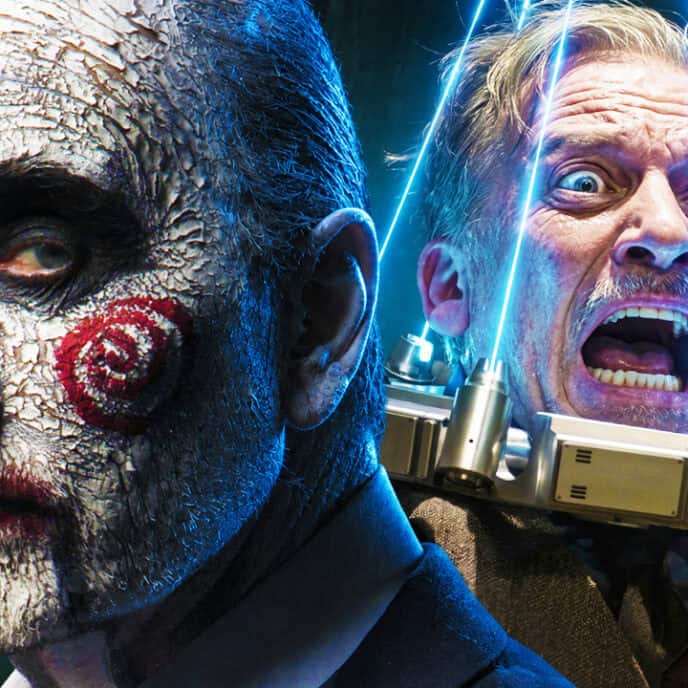
Even Billy the Puppet received a makeover, with longer hair, neon eyes, and lighting that made him look like he was about to start streaming on Twitch. There was a practical reason for some of the changes, too. Since Saw 3D was considered the final installment, several props had been sold off, including the original Billy Puppet. Consequently, older traps seen in Jigsaw had to be recreated.
The film was designed as a soft reboot, with Bell as the sole major returning presence and an otherwise new cast. Laura Vandervoort, Matt Passmore, Hannah Emily Anderson, Mandela Van Peebles, Callum Keith Rennie, and Brittany Allen joined the production. Filming began in Toronto in October 2016, with a budget of $10 million. The working title was Saw: Legacy before the film became Jigsaw.
Despite the franchise’s dark subject matter, cast members described the production as lighthearted and fun. In typical Saw fashion, the ending was kept secret from most of the actors. Rennie wasn’t even sure whether his character was the new killer for much of filming, although the actor who actually played the killer knew the truth and could plant hints along the way.
But what exactly is this eighth Saw movie about?
The Story and Traps of Jigsaw
Rather than opening with a typical Jigsaw trap, Jigsaw begins with police pursuing a suspect. The action-packed sequence feels strangely out of place in a Saw movie, but the suspect eventually ends up on a rooftop with what appears to be a dead man’s switch. Five people will die unless Detective Halloran arrives within 17 minutes.
Halloran, played by the wonderful Callum Keith Rennie of Battlestar Galactica, shows up and only makes things worse. It’s pretty ironic to declare, “I’m not fucking dying,” only to then… well, die. It’s easily one of the franchise’s weakest transitions into a title sequence, and it signals a problem that persists throughout the film: its desire to break from the formula makes it feel more like a spinoff than a main installment.
Things finally feel more like Saw when we’re introduced to five victims wearing metal buckets locked over their heads. Chains connect them to a wall of buzzsaws, and they must confess their sins and sacrifice their own blood to escape. The victims are Anna, Ryan, Mitch, Carly, and a mysterious fifth man.
It’s a simple but effective setup. The buckets conceal the victims’ identities, while the chains slowly drag them toward gruesome deaths. One victim appears to be cut by the saws, yet seemingly completes the task required to survive. His door never opens, though, and he presumably dies. I know Jigsaw’s traps have their share of plot holes, but this one feels particularly obvious.
The victims’ bodies are subsequently displayed in public, and the police investigate. Enter Logan Nelson, a coroner tasked with examining the first body. A jigsaw-shaped wound and a voice recording suggest that John Kramer is back with a new batch of victims.
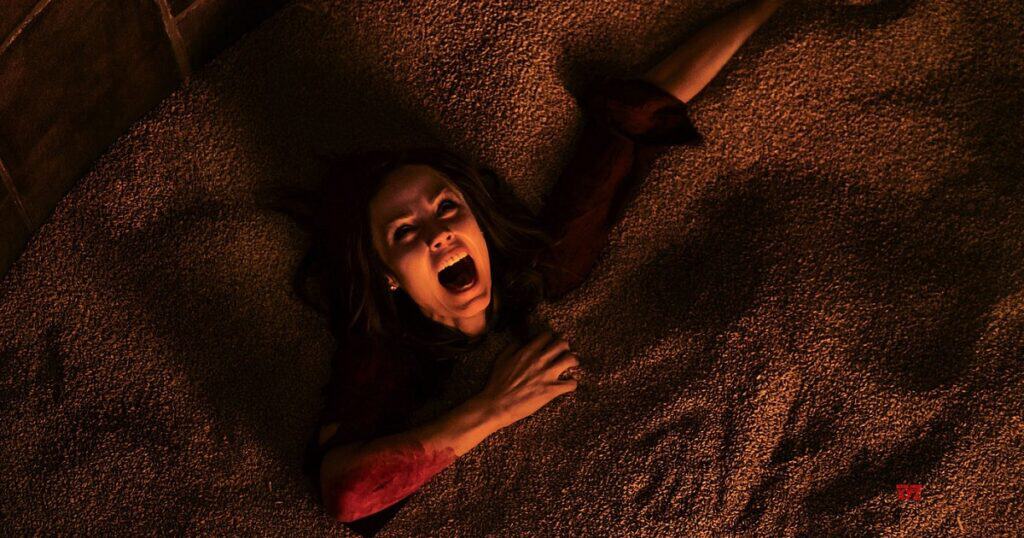
The film follows two parallel stories: the chained victims attempting to escape their traps and the police trying to find them. Logan clearly dislikes Halloran, whose investigative methods are questionable, and the mystery surrounding the victims gradually reveals the connections between their pasts. Carly, for instance, is a purse snatcher who accidentally caused the death of an asthmatic woman. Somehow, Jigsaw knows everything about her. Sorry, but this killer seems to have access to information that only God Almighty should know.
Carly is poisoned and given three syringes: one contains an antidote, one contains saline, and one contains acid. She must choose correctly while the chains threaten to hoist the victims toward the ceiling. Ryan decides to make the choice for her by injecting her with all three. It’s brutal, and it establishes that Ryan isn’t merely an asshole; he’s downright evil.
Ryan subsequently finds himself facing a trap that requires him to sacrifice his own leg by pulling a lever. If he fails, Anna and Mitch will be buried beneath grain in a silo, with weapons raining down from above. The cramped set was particularly challenging to film, and the production had to carefully manage the grain to keep the actors safe.
Ryan eventually pulls the lever, but we later learn that he caused his friend’s death by driving drunk. So never mind: total prick.
Meanwhile, Logan’s assistant Eleanor is revealed to be a Jigsaw enthusiast who builds replicas of the killer’s traps. Her studio contains recreations of familiar devices, including the Angel Trap, the Water Cube, and the Reverse Bear Trap. She’s an obvious suspect, which makes her a pretty effective red herring for anyone familiar with the franchise.
The next major trap involves Mitch, who sold John Kramer’s nephew a faulty motorcycle that caused his death. John takes this personally, and the resulting Spiralizer trap feels more like torture than a test designed to offer a fair chance of survival. The device was inspired by a spiral vegetable cutter, enlarged and painted red to evoke Billy’s spiral-patterned cheeks. Its blades had to rotate at just the right speed to preserve the visual effect.
Anna appears to help Mitch escape, but things go horribly wrong, leading into the movie’s increasingly convoluted finale.
The Twists and Timeline Explained
Twists are as synonymous with Saw as Billy the Puppet, and Jigsaw has several. Throughout the film, the filmmakers encourage us to believe that John Kramer might actually be alive. At one point, the police even attempt to exhume his body, only to discover that it’s missing. This is despite the franchise having already shown us his full autopsy.
The first major reveal comes when a younger-looking John appears and explains that he knew Anna. He witnessed the truth about her baby’s death: Anna deliberately suffocated her child and framed her husband for the murder.
Anna and Ryan eventually find themselves chained to pipes in a setup reminiscent of Adam and Dr. Gordon in the original Saw. A shotgun sits between them, and Anna makes the disastrous decision to shoot Ryan. The gun kills her, while Ryan discovers that the keys have been destroyed. He’s left to rot in the barn. But that’s not the big twist.

The real reveal is that Logan Nelson is a secret John Kramer protégé who has been involved since the beginning. Logan was the mysterious fifth victim wearing a bucket over his head, and John supposedly taught him that people can be redeemed. Logan’s mistake on John’s X-rays delayed the discovery of his cancer, potentially costing him his life. In a rather ridiculous bit of backstory, Logan is therefore presented as one of the people responsible for John becoming Jigsaw.
The two stories we’ve been watching aren’t happening at the same time. The barn victims belong to John’s first game as Jigsaw, while the police investigation takes place ten years after John’s death. Logan has recreated the earlier game as part of an elaborate revenge plot against Halloran for his wife’s death.
The final confrontation initially suggests that Logan and Halloran are caught in a laser trap. Then the familiar “Hello Zepp” music kicks in, revealing Logan as the mastermind. Halloran is sliced apart by the lasers, and Logan walks away.
It’s a classic Saw reveal, but the timeline creates some ridiculous complications. Logan apparently found people whose circumstances paralleled the original victims and recreated their deaths in precisely the right way. The original game was never discovered, so the matching outcomes exist primarily for the audience’s benefit. It’s all rather convoluted, but that’s Saw for you.
The problem with Logan’s reveal isn’t simply that Jigsaw introduces another secret John Kramer protégé. The franchise has always relied on hidden connections and carefully timed revelations. The difficulty is that Logan’s backstory asks the audience to accept an entirely new piece of Jigsaw history, one that retroactively makes him central to the mythology without having been part of the preceding films. Rather than deepening an established relationship, the twist creates a new one at the moment the movie needs its biggest surprise.
That doesn’t make the reveal automatically worthless. It gives Logan a personal motive for targeting Halloran and provides a way to connect the barn game to the modern investigation. But the story’s reliance on an undiscovered original game, a perfectly reconstructed set of circumstances, and another secret apprentice makes the mythology feel increasingly engineered around the twist instead of the other way around.
Post-Production, Release, and Legacy
Jigsaw had the longest post-production period of any Saw movie to that point, with more than ten months to prepare for its fall premiere.
Charlie Clouser returned to score the film but took a different approach, favoring cleaner, more ambient sounds over the heavy industrial distortion that characterized his earlier Saw scores. He also praised Greutert’s rhythmic editing style as a natural fit for the music.
Tobin Bell’s involvement was kept relatively low-key during the marketing campaign. Although he appeared on the poster, the filmmakers needed to conceal his physical appearance to preserve the timeline twist.
Jigsaw opened in the United States on October 27, 2017, earning $16.6 million during its opening weekend. It ultimately grossed approximately $102.9 million worldwide on a reported $10 million budget, making it a commercial success despite mixed reviews. Audiences were considerably more receptive than critics, with Rotten Tomatoes reporting an 88% audience score against a 32% critics’ score.
Still, the barn setting creates some obvious problems. With wooden walls surrounding the victims, why don’t they simply smash their way out? A locked metal door in a concrete room is one thing. A barn is another.
Hannah Emily Anderson’s Eleanor was reportedly intended to return for two additional films, but those plans never materialized. Logan, meanwhile, hasn’t technically been erased from the franchise’s canon, yet subsequent movies largely ignore his existence.
The financial success of Jigsaw was enough for Twisted Pictures to greenlight two more sequels that presumably would have followed its story. Those direct follow-ups never happened. Instead, the franchise moved on to Spiral, a spinoff, and Saw X, which brought John Kramer and Amanda back into the spotlight.
I’m still intrigued by what those Jigsaw sequels might have looked like. Eleanor was one of the film’s strongest elements, and Logan’s story had room to develop. Unfortunately, we’ll probably never know where those plans would have gone.
Jigsaw seemed to teach us one important lesson: you can’t simply reboot Saw and expect it to work. The franchise needs more than victims trapped in elaborate contraptions. It needs a certain look, a certain sound, and a certain editing style. Saw isn’t supposed to be cleaned up. It’s gritty. And by God, it needs Tobin Bell as Jigsaw in an active role. It’s never too late to learn that lesson. And that, my friends, is what happened to Jigsaw.
A couple of previous episodes of this show can be seen below. For more, check out the JoBlo Horror Originals YouTube channel—and don’t forget to subscribe!











The comment section exists to allow readers to discuss the article constructively and respectfully, focused on the topic at hand.
What’s Not Allowed