


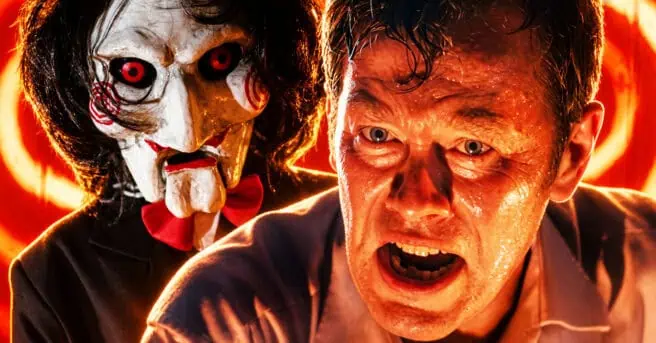
After five movies, it can be hard to know where to take your series, especially when you kill your main bad guy off in the third film. And with annual releases, the filmmakers didn’t have much time to even think about their next step. Which is probably why this sixth entry almost ended up being about Hoffman facing off against the Mafia. No, I’m serious. But with its dedicated fanbase, the question was always when, not if, a new Saw was coming. So which actress actually scared the director with her dedication to being in a Jigsaw trap? And did you know that one of the actors in the opening trap actually won their role on a reality TV series? I want to play a game as we look at what happened to Saw VI.
Making Saw VI
The Saw franchise has always had insanely quick turnarounds. Ever since the first film made its debut in 2004, we received a new movie every single year until 2010. Once a film would release in October, work would quickly begin on another. They were cheap to make and had become staples of movie theaters every year.
Kevin Greutert had long been an editor on the Saw films and was chosen to make his feature-length directorial debut with Saw VI. It could be argued that there was no one who knew Saw better than Greutert, as he had to pour over nearly every single frame of the series during the editing process.
The writers first started spit-balling ideas and trying to figure out who they wanted to see face off against Jigsaw. They were actually almost forced to write a story that would have essentially been Hoffman versus the Mafia. Instead, they settled on a health insurance executive who essentially determines who lives and dies by denying insurance claims. It’s something that still resonates today and allowed for plenty of karmic retribution to take place. Everyone in a trap deserves to be there. At least in theory.
Greutert also really wanted the film to provide some resolution to things set up in previous entries, as he felt so many of the Saw movies were simply setting up sequels. That’s not to say Saw VI wouldn’t also be setting the stage for the future, but he wanted to bring some other aspects of the story to a close.
Just one week before filming, producers informed Greutert that the film would be post-converted to 3D, a massive trend at the time. The director was understandably angry, as he hadn’t planned or storyboarded for 3D, completely upending his plans. Thankfully, the fast turnaround and complicated nature of 3D filmmaking meant they had to save that particular gimmick for the next installment.
The cast of Saw VI
Tobin Bell, Shawnee Smith, and Costas Mandylor all returned as Jigsaw, Amanda, and Hoffman. Despite being her first appearance since Saw III, this would serve as Shawnee Smith’s final entry in the series until 2023’s Saw X. Betsy Russell also had her biggest role yet as Jill Tuck, John Kramer’s wife, while Mark Rolston’s role was expanded from the previous film.
Athena Karkanis’s Agent Perez was actually intended to be dead after a trap blew up in her face in Saw IV. However, producers wanted her back, and since she wasn’t explicitly shown being killed, they were able to work her back into the story.
The rest of the cast included Peter Outerbridge, Samantha Lemole, Melanie Scrofano, Darius McCrary, and Karen Cliche. This would mark Devon Bostick’s second appearance in the series. He had previously appeared as an extra in Jill’s clinic in Saw IV, but because his role was largely cut, he was able to return as a completely different character.
Greutert was also hoping to bring Cary Elwes back as Dr. Lawrence Gordon, but Elwes was unavailable. Thankfully, the movie did set the character up for a future appearance.

Scream Queens helped cast Saw VI
VH1’s Scream Queens was a reality TV competition in which 10 actresses competed for a role in Saw VI. Hilariously, the writers weren’t even informed that this was happening until they saw an advertisement for the show.
The studio was only required to feature the winning actress in the movie, whether she appeared in the background or had a larger role. Thankfully, Tanedra Howard was such a good actress that the writers wanted to give her a substantial part. They liked her so much and thought she did such a good job that she also returned for Saw 3D.
The look and effects of Saw VI
Cinematographer David Armstrong returned to the series, though this would mark his final outing. He wanted the color palette to be more neutral and to show natural flesh tones.
In order to avoid continuity errors, the timers in the film were digital so they could be changed depending on what the edit required.
The Billy Puppet was also radio-controlled this time around and cost $15,000.
The traps of Saw VI
The opening kill is important for a Saw movie because it sets the tone for everything that follows. Will it start the movie on a gross note for audiences, or will it land with a whimper? Saw VI‘s opening sees Eddie and Simone, two predatory lenders, wake up wearing head harnesses with screws bearing down on their temples. They’re told they have one minute to each cut flesh from their bodies. Whoever puts the most weight on the scale survives. Eddie tries taking out his love handles while Simone opts to cut off her entire arm, winning the game and sentencing Eddie to a screwy finish.
The filmmakers went fully practical with the effects. Eddie actor Marty Moreau had two different prosthetics for the scene, one for his stomach and one for his chest. The stomach contained three bladders that Moreau would then cut apart on camera. Tanedra Howard obviously needed a full prosthetic for the moment when Simone cuts off her own arm with a knife. The prosthetic arm ended up being much larger than Howard’s actual arm, so the filmmakers had to get creative. They used a prosthetic that bridged two different arms and made them look like one. A hand double could then hide underneath the table, allowing Howard to seamlessly cut away at the prosthetic between the very real human hand and upper arm.
There was a scary moment during the scene when Greutert yelled cut, only for Howard to think he meant the prop. She just kept going harder and harder. Thankfully, no one was hurt.
What happened to Agent Strahm?
We also get to see the brutal aftermath of what happened to FBI Agent Strahm at the end of Saw V. He’s essentially been turned into human mush. All that’s survived is his hand, which is important because Hoffman needs to pin the murders on Strahm.
Most of the people put in Jigsaw’s traps this time are connected to an insurance company. The main target is William Easton, an insurance executive being targeted for denying coverage to a man who eventually died. His reasoning is particularly flimsy, as he blames some oral surgery for why the company can’t cover the man’s heart disease. It’s exactly the kind of evilness we see in the world, so it’s nice to see these people getting some karmic retribution. At least, that’s the idea.
We also meet William’s team, affectionately known as “The Dogpit.” They’re the people who found discrepancies in the man’s application and seem to relish destroying people’s lives to save the company a few bucks.
Meanwhile, Hoffman still has to walk a tight line between investigating the murders and secretly carrying out Jigsaw’s games. Evidence starts piling up that pokes holes in the theory that Strahm was the killer, forcing the FBI to re-examine the death of Seth Baxter, the junkie Hoffman murdered for killing his sister.
William Easton’s Jigsaw game
When William wakes up, he’s given a classic Jigsaw ultimatum: “If you don’t reach the end before the timer hits zero, you will never see your family again.” He has bombs attached to his arms that will seemingly explode when the 60 minutes are up.
His first trap sees William facing off against his janitor, both strapped into a machine that will crush their ribs if they breathe. William has a big advantage over the janitor, who is a lifelong smoker. It’s one of many times in this film where the game feels very one-sided. I get it, these people worked for the insurance company, but not all of them are bad.
The janitor dies, and William is able to remove one of the explosives.
Unlike many of the traps, which were featured in small, confined spaces, the Breathing Room was envisioned by Greutert as a wide-open space. Armstrong pulled that off by utilizing darkness, allowing the space around the characters to disappear into shadow.
Throughout William’s game, we see Tara and Brent, who appear to be William’s family. They’re given a direct feed to his game and get to watch it unfold. There’s hydrofluoric acid above them that looks as though it will eventually rain down on them.
Pamela Jenkins, a reporter investigating Jigsaw, is also kidnapped and put in a similar situation. It’s not a big surprise why she’s targeted either, as she’s in possession of a letter Hoffman wrote to Amanda. Maybe writing a book about Jigsaw isn’t the greatest idea if you don’t want to be targeted by him.
As William continues through the game, we learn why he’s been chosen. He denied John Kramer coverage when John was seeking alternative treatment. John is disgusted by William, who uses a mathematical formula to determine who lives and dies.
When William encounters his file clerk and secretary, Jigsaw explains that he must choose who lives. The secretary is a diabetic woman with a family, while the file clerk is young, healthy, and has no family. They have barbed wire wrapped around their necks, and the loser will hang.
William goes against his insurance formula and chooses to save his secretary. John sure does love to make his points.
Oddly enough, this was actually the most expensive sequence in the movie because all of the actors were attached to safety cables that later had to be digitally painted out.

Hoffman and John Kramer
A flashback shows the friction between John and Hoffman. As Hoffman prepares one of the traps in Saw III, it’s clear that he doesn’t care about the subjects as much as John does. It highlights the very different methods they use when creating their games. Amanda even questions why Hoffman hasn’t been placed in a game himself.
Meanwhile, William enters a room filled with pipes and steam and finds his legal counsel trapped in a maze below him. She’s given 90 seconds to make it through the maze, or a spike attached to her chest will pierce her skull. William has to hurt himself to give her enough time to make it through the precarious sections.
In the final portion, he’s supposed to cut a key out of his side, causing her to try to attack him. Of course, she doesn’t make it. Time runs out, leading to a grisly demise.
Because of the dynamic lighting caused by the steam, the director of photography considered it one of the best-looking traps in the entire franchise.
During filming, Greutert said actress Caroline Cave actually frightened him with how committed she was to the role. She threw herself around so much that she ended up with several very real cuts and bruises.
The background steam was actual steam, while smoke machines were used for moments when the steam needed to interact with the actors. The hot-metal glow of the pipes was actually neon paint with a light shining on it.
The carousel trap
William’s final test comes when he finds “The Dogpit” strapped into a horrifying carousel. He’s told that he can only save two of them. The others will be shot in the chest with a shotgun. To save someone, William must press a button that pierces his hand.
They all plead for their lives, with one of the women even claiming she’s pregnant in an attempt to get William to save her. He ultimately saves two women, but not the pregnant woman, allowing the others to die.
Originally, 10 people were written into the carousel trap, but that number was ultimately reduced to six, tying into the movie’s title. The writers never actually intended to have 10 people in the finished trap. They simply used a larger number as a tool to get the number they wanted, knowing it would eventually be whittled down. Pretty ingenious workaround.
The carousel itself was fully functional, rotating the actors around and stopping whenever necessary. It’s also a fun parallel to the rotating-camera trick that the first Saw popularized. Now, instead of the camera rotating, the people themselves do.
Hoffman is exposed
Hoffman gets called away by FBI agents, who reveal that they’re in the process of removing the distortion from the old Seth Baxter tape. It’s clear that they’re pretty suspicious of the whole “Strahm is the killer” theory.
When Hoffman’s voice is revealed on the recording, he murders everyone in the room, desperate to know who else knows his true identity. “Everyone.” Oh shit.
The Twist in Saw VI
Like most Saw films, we get multiple reveals. The first comes when we learn that the letter Hoffman sent Amanda threatened to reveal to John that she was the person who instigated Cecil to go into the clinic, resulting in the death of John and Jill’s unborn baby. Hoffman had blackmailed Amanda into killing Dr. Lynn in Saw III, causing her to fail her game. Hoffman is the reason Amanda is dead.
Jill electrocutes Hoffman and sets him up for a game of his own. The sixth envelope John left behind was meant for him.
The movie then reveals that Tara and Brent aren’t William’s family at all. William has actually been going through the game to save Pamela, who is his sister. Tara and Brent are the family of the man William denied coverage to. It was a total fakeout. They’re given the choice to get revenge on the person who killed their husband and father. The acid was never meant for them. It was meant for William.
Tara can’t do it, but Brent pulls the lever, causing William to be pierced by needles that pump acid into his body. He damn near dissolves. Nothing like Jigsaw giving a kid some generational trauma by brutally killing a dude.

Hoffman’s reverse bear trap
Hoffman wakes up to find himself wearing the newly designed reverse bear trap, only he’s not given any way to escape. The film ends with him freaking out and jamming the trap between metal bars, stopping it from opening all the way but still tearing his cheek apart.
We get the classic scream to end it.
There was originally a post-credit scene featuring Amanda telling the little girl rescued at the beginning of Saw V not to trust Hoffman. It was a fun way to have Amanda remain the cause of Hoffman’s demise from beyond the grave. The scene was one of several things excised from the theatrical cut, although it can be seen in the Director’s Cut.
Saw VI Post-Production
The filmmakers originally intended to use a song from Shawnee Smith’s own band, Smith & Pyle, for the scene where Amanda and Cecil are in the car outside the clinic. Unfortunately, they weren’t able to use it in the final film for undisclosed reasons.
You’ll probably be surprised to hear that one of the most expensive elements of post-production was actually footage from previous Saw movies. Every time the filmmakers showed footage from an earlier film, they had to pay thousands of dollars in royalties. So remember that the next time you see a montage or flashback.
Charlie Clouser was very busy at the time and couldn’t do a full score for the movie. What you hear in the final film is about 75 percent new material, with the rest pulled from other Saw movies, mostly the original. It’s one of those times when the franchise’s quick turnaround worked against it.
The filmmakers also had a lot of difficulty earning an R rating. Only 24 seconds were trimmed overall, but they took a micro-editing approach to the changes, removing a few frames at a time and then resubmitting the film. It took many attempts, with the opening, steam room trap, and acid trap being the biggest offenders. Thankfully, they finally earned their desired rating with a runtime of 91 minutes.
The Director’s Cut features more than just a little additional gore. There are creative changes, alternate cuts, and minor moments added throughout.
Saw VI Release and Reception
Saw VI was released in the United States on October 23, 2009, and brought in $14.1 million during its opening weekend. It ultimately ended its worldwide run just shy of $70 million, with a total of $69.8 million. Sadly, this was the lowest-grossing opening for any film in the franchise at that point.
It wasn’t particularly well received by critics or fans, earning 39 percent and 54 percent respectively on Rotten Tomatoes. The critical consensus was: “It won’t earn the franchise many new fans, but Saw VI is a surprising step up for what has become an intricately grisly annual tradition.”
Two countries the film wouldn’t receive a release in were Ukraine and Thailand, which both banned it over its violence. It was also banned by major theater chains in Spain after the country’s Ministry of Culture gave it an X rating.
Saw VI at Halloween Horror Nights
Halloween Horror Nights at Universal Studios had long been creating haunted houses based on various horror properties. To promote Saw 3D, Saw: Game Over became a maze at the theme park in the fall of 2010. It featured many different traps from throughout the history of the franchise and ended up being one of the highlights of that year’s festivities.
The Saw VI commentary
On a personal note, I have to recommend the audio commentary with the writers and director because it’s genuinely hilarious. They’re constantly pointing out the film’s plot holes and acknowledging its flaws while still clearly having a love and appreciation for the franchise as a whole.
Greutert even hints at the incident that would see him contractually forced to leave Paranormal Activity 2. But that’s a story for another time.
What Happened to Saw VI?
While it’s certainly not perfect, the sixth Saw entry has some very fun moments as it takes out some very evil people. Sure, there are some pretty innocent people taken out too, but hey, that’s Jigsaw for you.
It was nice to see Shawnee Smith return, and Tobin Bell always seems to be absolutely relishing every line delivery.
And that, my friends, is what happened to Saw VI.
A couple of previous episodes of this show can be seen below. For more, check out the JoBlo Horror Originals YouTube channel—and don’t forget to subscribe!








The comment section exists to allow readers to discuss the article constructively and respectfully, focused on the topic at hand.
What’s Not Allowed