
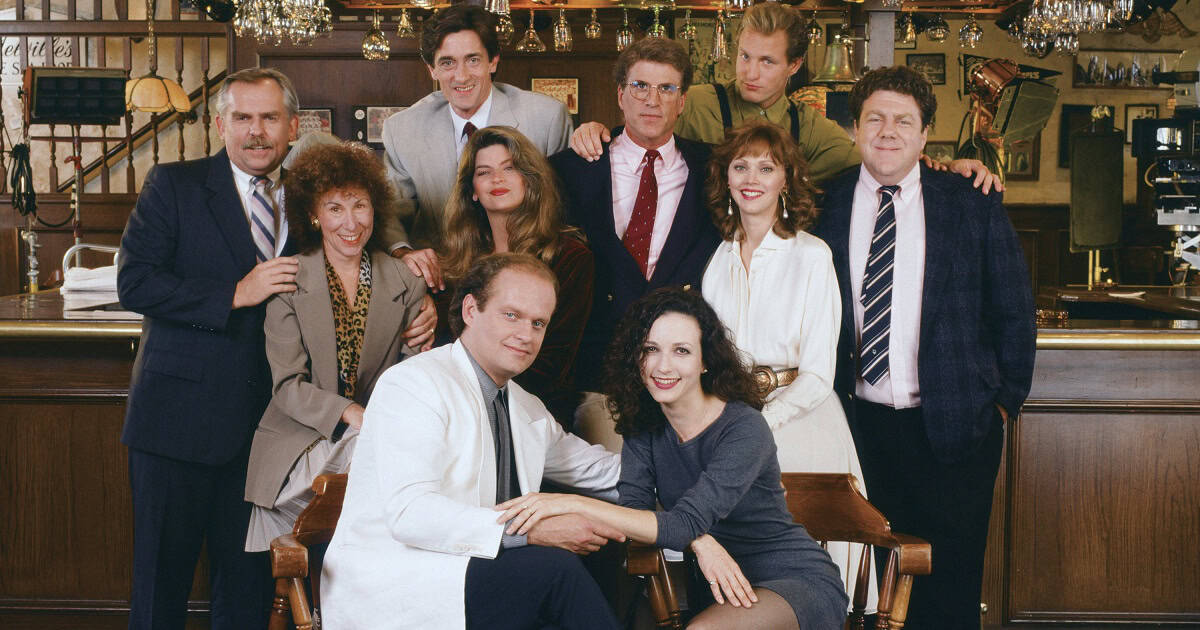
It started as NBC’s last-ditch effort and almost became its biggest disaster. Why did the creators suddenly abandon their plan to remake Fawlty Towers? Which actor lost his job after mocking his co-star live on air? And how did one cast member’s death leave a hidden message on the set that nobody noticed until it was gone? From real-life feuds to a spin-off that eclipsed the original, this is the untold story of the bar where everybody knows your name, but few know what really happened behind it.
NBC Needed a Miracle
Cheers was created by three men: brothers Glen and Les Charles, along with James Burrows. At the time, NBC was struggling badly in the early 1980s. Ratings were abysmal, the network was losing money, and executives desperately needed a hit. That atmosphere of panic created the perfect opportunity for fresh ideas.
The Charles brothers had already built strong television résumés working on legendary series like MASH* and The Mary Tyler Moore Show. The trio first connected while working on the Mary Tyler Moore spin-off Phyllis. Eventually, Glen and Les became head writers on Taxi, while Burrows rose through the ranks as a sought-after television director thanks to work on shows like MASH*, The Bob Newhart Show, and The Mary Tyler Moore Show.
All three shared the same agent, who encouraged them to team up and pitch a series to the struggling network.
The Original Idea Was a Remake of Fawlty Towers
The earliest concept for Cheers was actually an American adaptation of the classic British sitcom Fawlty Towers. However, the creators quickly realized that the most entertaining interactions always happened in the hotel bar. That revelation changed everything.
A bar allowed characters to naturally come and go, creating endless comedic possibilities. The creators knew they wanted an East Coast setting and briefly considered a small town before settling on Boston. After years spent writing for the grimy world of Taxi, they wanted something warmer and more sophisticated. That desire even influenced the title. Unlike Taxi, the word “Cheers” sounded welcoming and inviting.

As the concept evolved, the creators decided the show would revolve around a romantic couple inspired by the classic on-screen chemistry of Spencer Tracy and Katharine Hepburn. Their films often featured romantic tension mixed with constant conflict, exactly the dynamic envisioned for Sam and Diane.
Because bars and sports culture naturally overlap, Sam Malone was initially conceived as a former football player. But once Ted Danson was cast, the writers felt his physique made more sense for a retired baseball player instead.
The Real Bar That Inspired Cheers
The iconic bar from Cheers was inspired by a real Boston establishment: the Bull & Finch Pub. Glen and Les Charles reportedly spent months searching through bars before finding it. Ironically, the breakthrough came after flipping through a phone book and asking a hotel concierge for recommendations. Both pointed them toward the same place. The moment they saw the narrow staircase leading underground into the pub, they knew they had found the perfect setting.
Eventually, James Burrows joined them in Boston, and the trio approached the owners about using the location’s exterior for the show. The agreement reportedly cost the production only one dollar.
Casting Sam Malone and Diane Chambers
Casting Sam Malone became one of the most important decisions in television history. NBC initially pushed hard for Bill Cosby to star in the series, but the creators resisted. They feared that casting a huge celebrity would transform Cheers into a vehicle centered around one actor instead of an ensemble comedy.
The three finalists for Sam were William Devane, former NFL player Fred Dryer, and Ted Danson. Devane was the network’s favorite due to his tough-guy image and successful film and television career. Dryer’s football background also made him a natural fit. But Ted Danson brought something different: vulnerability and charm.
That vulnerability became even more obvious once he auditioned opposite Shelley Long.
Three actresses were finalists for Diane Chambers: Lisa Eichhorn, Julia Duffy, and Shelley Long. Eichhorn had recently earned major acclaim for Yanks, while Duffy impressed the creators with her neurotic interpretation of Diane. Shelley Long ultimately stood out because she understood comedy on a deeper level. A member of Chicago’s famed Second City improv troupe, she knew how to sacrifice vanity for the joke.
But the deciding factor was her chemistry with Danson. The creators immediately saw the Spencer Tracy and Katharine Hepburn dynamic they had envisioned. Long’s refined, intellectual Diane perfectly contrasted with Danson’s blue-collar Sam.

Finding the Voices of Sam and Diane
Both stars struggled differently with their characters. Shelley Long believed Diane was written too aggressively in the pilot, so she softened the character by making her more feminine and soft-spoken. That choice gave Diane the sophisticated air that made her so hilariously out of place inside a Boston bar.
Ted Danson had an even harder time finding Sam Malone. Unlike Sam, Danson described himself as awkward and more of a serial monogamist than a ladies’ man. He later admitted it took nearly two years before the role fully clicked.
According to Danson, acting opposite Shelley Long helped him discover the character. Watching her confidence and total understanding of Diane relaxed him enough to let Sam emerge naturally. Danson later stated that he believed he only landed the role because of Shelley Long.
Building the Rest of the Cheers Cast
Once the leads were locked in, the rest of the cast slowly came together.
Nicholas Colasanto as Coach
The role of Ernie “Coach” Pantusso was offered to several experienced actors, including Robert Prosky and even legendary football coach John Madden. Both declined. Eventually, the role went to Nicholas Colasanto, a veteran actor and television director who had nearly retired because of declining health and frustration with the industry. Landing Cheers became a second chance for him, and the cast quickly fell in love with his sweet, childlike personality.
George Wendt as Norm Peterson
George Wendt originally auditioned for a tiny role simply called “George,” whose only line was “Beer.” His audition made the producers laugh so hard that they expanded the role into Norm Peterson.
Norm was reportedly inspired by a real-life bar regular Les Charles knew in college, a man who spent so much time at the bar that he instructed employees to tell his wife he was not there if she called. Although Wendt later became heavily typecast as Norm, he never resented it. Fans regularly shouted “Norm!” at him in bars, and he happily responded in character.
John Ratzenberger Created Cliff Clavin Himself
John Ratzenberger originally auditioned for Norm and immediately realized he was completely wrong for the part. So he improvised a new idea. After finishing the audition, he reportedly asked the creators, “When are you going to audition the bar know-it-all?”
He then launched into an improvised monologue about the history of a BIC pen. The creators loved it so much that they invented Cliff Clavin specifically for him.
Ratzenberger based Cliff’s attitude on a police officer he knew growing up in Connecticut. Cliff was originally meant to be a security guard, but the writers changed him into a postal worker shortly before filming because they felt it better justified his endless supply of useless trivia.
Years later, Ratzenberger successfully avoided typecasting by becoming Pixar’s unofficial “good luck charm,” appearing in virtually every Pixar film.
Rhea Perlman as Carla Tortelli
Rhea Perlman inspired the character of Carla before the role even existed. The creators had first seen her playing a sweet character on Taxi, but later watched her perform as a rough-edged tomboy in a one-act play. That performance convinced them she was perfect for Carla. To prepare for the role, Perlman even trained as a waitress at the real Bull & Finch Pub.

The Story Behind the Famous Theme Song
The Cheers theme song, “Where Everybody Knows Your Name,” nearly never happened. Songwriters Gary Portnoy and Judy Hart-Angelo originally wrote the song for a failed Broadway musical called Preppies. The production bombed so badly that its final performance reportedly sold only 11 tickets.
Even though the musical failed, the Cheers producers loved the song. Unfortunately, the rights became tangled in legal complications. Portnoy and Hart-Angelo repeatedly rewrote the track while racing against production deadlines. Eventually, just six weeks before the premiere, they finalized the now-iconic version while riding in a taxi to the recording studio.
The song’s simple arrangement was intentional. The sparse instrumentation gave it the relaxed feel of music you might actually hear in a neighborhood bar. One clever trick involved the vocals. The “group” singing the chorus was actually Gary Portnoy recording himself multiple times and layering the tracks together.
Cheers Was Originally a Ratings Disaster
When Cheers premiered on September 30, 1982, it was a failure. The series finished dead last in the ratings. NBC itself was struggling, and Cheers faced brutal competition from Magnum, P.I. Normally, those ratings would have guaranteed cancellation. But NBC had a problem: there was nothing better to replace it with. That accidental second chance saved the series.
During the summer hiatus, viewers slowly discovered reruns, and ratings climbed dramatically during season two. By season three, the show exploded in popularity thanks partly to one enormous factor: The Cosby Show. The massive success of Bill Cosby’s sitcom gave NBC a powerhouse lineup, and Cheers benefited from airing directly afterward.
Kelsey Grammer Changed the Show Forever
Season three introduced Dr. Frasier Crane, played by Kelsey Grammer. Originally intended as a temporary obstacle in the Sam-and-Diane romance, Frasier quickly became too funny to remove. The writers kept expanding the role until Grammer became a permanent cast member. Ironically, part of that expansion reportedly came from tensions with Shelley Long. According to behind-the-scenes stories, Long disliked how similar Frasier’s intellectual humor felt to Diane’s dialogue and complained that Grammer was taking her best material.
The writers, who reportedly had their own frustrations with Long, responded by giving Grammer even more lines. That tension unintentionally helped create one of television’s greatest spin-off characters.

The Death of Coach and the Hidden Message on Set
Tragedy struck when Nicholas Colasanto died from heart failure near the end of season three. Although the cast knew he struggled with health issues, the loss devastated everyone.
Because of memory problems late in life, Colasanto often wrote cue lines on props around the set. After his death, the cast reportedly discovered a line written on the back steps of the set: “It’s as if he is still with us.”
For years, cast members touched the message before filming as a tribute to him. Then one offseason, painters accidentally covered it over. The cast became furious and reportedly threatened to quit until producers agreed to honor Colasanto another way: by hanging a photograph of Geronimo inside the bar.
The photo had been Colasanto’s personal good-luck charm and remained visible on the set for the rest of the series. In the finale, Sam quietly straightens the picture before leaving the bar one last time.
Woody Harrelson Revitalized the Series
Replacing Coach was nearly impossible, but Woody Harrelson somehow pulled it off. Harrelson played Woody Boyd, a younger and more innocent bartender whose optimism completely changed the energy of the show.
Contrary to popular belief, the character was not named after Harrelson. It was just a coincidence. Harrelson added many of Woody’s defining traits himself, including the habit of politely calling everyone “Mr.” and “Ms.” Audiences immediately embraced the character, and ratings continued climbing.
Behind-the-Scenes Drama and Feuds
Despite the success, tensions behind the scenes were common. Shelley Long frequently clashed with writers and cast members because of her extremely detailed, method-style approach to acting. Script readings often dragged on for hours as she questioned dialogue and character motivations.
Kelsey Grammer battled severe addiction issues throughout much of the series, using alcohol and cocaine while coping with devastating personal tragedies, including the murders of his father and sister. Ted Danson and Grammer also reportedly endured a decades-long falling out before finally reconciling publicly in 2024 during Grammer’s podcast Where Everybody Knows Your Name.
Another infamous incident involved actor Jay Thomas, who played Carla’s husband Eddie LeBec. While hosting a radio show, Thomas joked that working on Cheers was “brutal” because he had to kiss Rhea Perlman. According to reports, Perlman heard the comments and demanded he be fired. As a result, Eddie LeBec was killed off-screen in a bizarre Zamboni accident between seasons.

Shelley Long Leaves Cheers
In 1986, Shelley Long shocked television audiences by announcing she would leave Cheers after season five. Long stated that she wanted to spend more time with family and pursue film opportunities, though rumors of behind-the-scenes tensions persisted for years. Her departure forced the writers into a terrifying challenge: how do you continue Cheers without Diane Chambers?
Kirstie Alley Saved the Show
The answer came in the form of Rebecca Howe, played by Kirstie Alley. Rather than create another Diane clone, the producers deliberately designed Rebecca as Diane’s opposite. Originally envisioned as a glamorous, confident businesswoman, the character gradually evolved into a hilariously neurotic disaster after writers discovered Alley’s naturally quirky personality.
NBC initially resisted casting Alley because her most famous role at the time was the stoic Vulcan Saavik in Star Trek II: The Wrath of Khan. Executives worried she lacked comedic ability. But the creators trusted their instincts, and they were right.
Kirstie Alley successfully revived the series and helped keep Cheers dominant through its later years.
The Rise of Lilith Sternin
Another breakout recurring character was Lilith Sternin, played by Bebe Neuwirth. Much like Frasier, Lilith was originally intended for only a handful of appearances. But the chemistry between Neuwirth and Grammer proved so strong that the writers continuously expanded her role. She eventually became one of the defining characters of both Cheers and Frasier.
The Final Last Call
By the eleventh season, Ted Danson had grown exhausted and announced he would leave the series. Everyone understood that Cheers could not continue without Sam Malone. So on May 20, 1993, television’s most famous bar officially closed.
The finale became a cultural event, accompanied by a retrospective special and a live broadcast from the Bull & Finch Pub. The special became infamous for the visibly intoxicated cast, while Jay Leno struggled to keep the chaos under control. Oddly enough, it felt like the perfect ending for a show built around lovable misfits.

Frasier Became an Even Bigger Phenomenon
Even though Cheers ended, its universe continued through Frasier. The spin-off lasted an astonishing 11 seasons (followed by a two-season revival series) and became one of the most acclaimed sitcoms in television history. Many Cheers cast members eventually appeared on the series. Ironically, the spin-off that began as a supporting character experiment eventually became just as legendary as the original show.
Why Cheers Will Probably Never Return
While many classic sitcoms, including Frasier, have received revivals, Cheers likely never will. Ted Danson has repeatedly stated that the original series should remain untouched. Many fans agree, especially following the deaths of George Wendt and Kirstie Alley. For many viewers, the magic of Cheers belonged to a specific cast, a specific era, and a chemistry that simply cannot be recreated.
Still, the series remains timeless. If you want to revisit one of television’s greatest sitcoms, the entire series is currently streaming on Hulu. And if you ever find yourself in the mood to sit down at a bar where everybody knows your name, just walk down those famous stairs… and don’t forget to say hello to Norm.











The comment section exists to allow readers to discuss the article constructively and respectfully, focused on the topic at hand.
What’s Not Allowed