
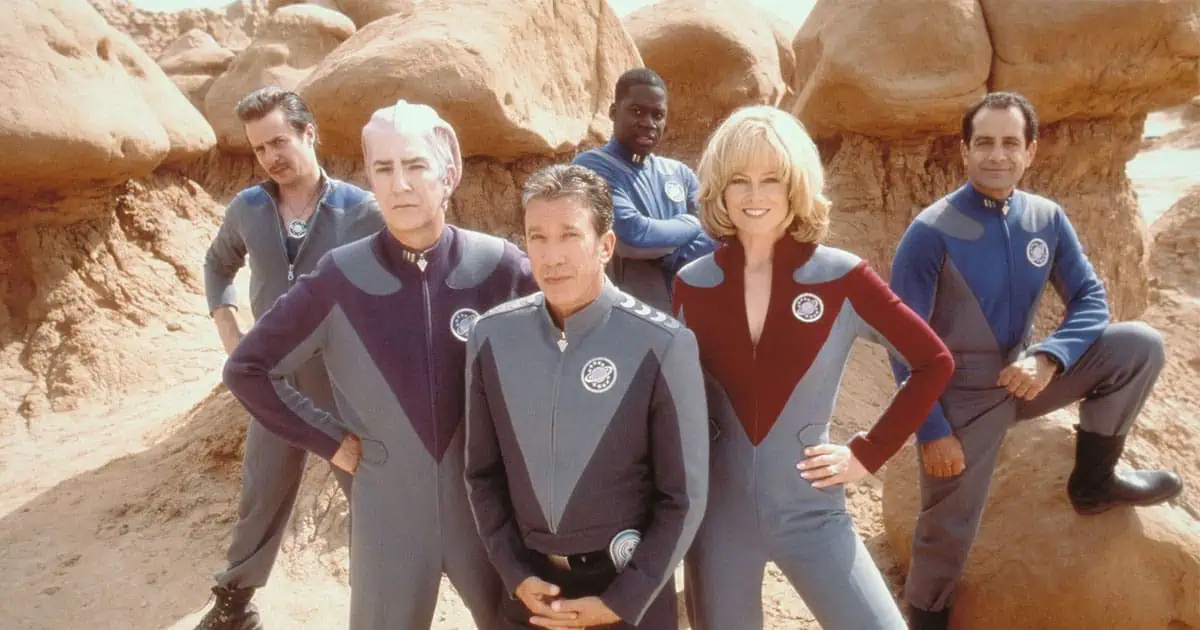

Galaxy Quest is a special film. It’s a film about Star Trek superfans, BUT it was made by a Trekkie superfan that’s critiquing the very thing he’s a fan of. It uses fandom and IP loyalty to both point the finger at the absurdity of Star Trek, while also paying sincere respects to the incredible people who give the franchise life. And for what it’s worth, Galaxy Quest somehow became the best Star Trek movie ever made.
Before you grab your pitchforks, we at JoBlo are huge fans of Star Trek ourselves, but you kinda gotta admit, Galaxy Quest goes HARD on delivering a charming (albeit meta) Star Trek-style story that also has a tongue-in-cheek layer of commentary to tip its hat to the audience. Combine that with this incredibly dynamic cast, and a wealth of Star Treksource material to draw from, and we got ourselves the makings of a classic. Let’s talk about it.
What Is Galaxy Quest?
Okay, for those of you who don’t know, Galaxy Quest is the 1999 sci-fi comedy that follows fictional Hollywood actors who played the cast of an iconic Star Trek-esque TV show. The former glory of the show has faded but the fandom is stronger than ever, and when REAL aliens who think the TV show is real come to Earth to seek their help, the actors must embrace their character counterparts to help save an alien race from absolute extinction at the hands of a gross, slimy, grasshopper-ass alien conqueror. Will they save the day? OH YEAH. And do they do it while honoring the TV series they’re poking fun at? DEFINITELY.
The big distinction to keep in mind throughout this video is that Galaxy Quest isn’t really making fun of Star Trek itself. It’s making fun of the entire phenomenon surrounding it. And that’s an important distinction, because Galaxy Quest could have been a very different movie. The easy version of this concept would basically be ninety minutes of pointing at Star Trek and laughing. Look at the cheap sets. Look at the rubber aliens. Look at William Shatner’s acting. Look at these nerds arguing about continuity. And, sure, Galaxy Quest makes all of those jokes. But underneath them is something much more affectionate. The movie understands that the ridiculousness of Star Trek and the greatness of Star Trek aren’t mutually exclusive. In fact, sometimes they’re the same thing.
Jason Nesmith and the Captain Kirk Archetype
Jason Nesmith is very clearly modeled on the popular caricature of William Shatner: the leading man who became inseparable from his fictional captain, enjoys being the center of attention, and occasionally irritates his fellow cast members. Tim Allen even gives Nesmith that exaggerated leading-man physicality: the heroic stance, the dramatic turns, the pauses, the constant awareness that everybody in the room should probably be looking at him. Interestingly, Allen later said he wasn’t literally doing a Shatner impression. He claimed the way Nesmith sits in the captain’s chair was actually inspired by Yul Brynner in The Ten Commandments. But whether Allen intended it or not, audiences immediately recognized the archetype. Nesmith feels like the pop-cultural version of Captain Kirk that had developed over decades.
Alan Rickman and Alexander Dane
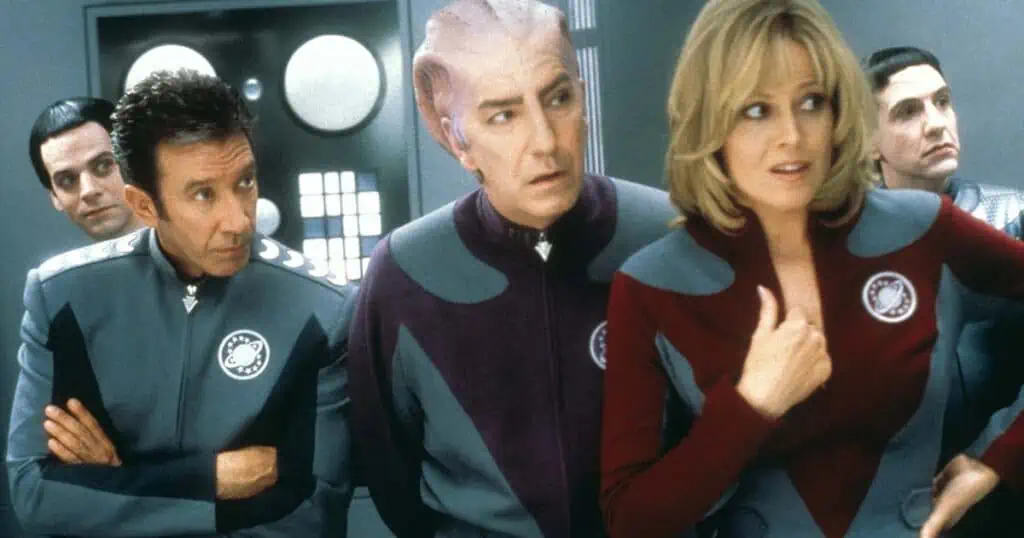
Now, my boy Alexander Dane, played by the late but GREAT Alan Rickman, is the opposite side of that equation. He’s a classically trained British actor who considers himself above the silly science-fiction program that made him famous, yet nobody will let him forget his catchphrase:
“By Grabthar’s hammer…”
That’s partly a parody of actors becoming permanently identified with genre roles. His alien makeup and position as the intellectual, serious member of the ensemble make Leonard Nimoy and Spock the most obvious comparison. But Dane also represents something broader than Nimoy. He’s every respected actor who took a genre role, expected it to be one job among many, and then discovered that forty years later people are still asking him to put the rubber forehead back on. And Alan Rickman was almost absurdly perfect casting for that joke. This is Alan Rickman we’re talking about: a Royal Shakespeare Company veteran playing a Royal Shakespeare Company-type actor who is furious that his career has been reduced to saying a ridiculous space-alien catchphrase at electronics-store openings. I mean… The casting itself is the punchline, no? But the movie doesn’t leave Dane there.
When the Actors Become Their Characters
One of the cleverest ideas in Galaxy Quest is that the actors’ real lives gradually begin to mirror the roles they played on television. Jason actually has to become a captain. Alexander has to stop resenting Dr. Lazarus and embrace what the character means to other people. Gwen has to become useful beyond repeating the computer. Tommy actually learns to pilot the ship. Fred becomes the technical specialist. Their supposedly superficial television personas gradually become genuine heroic identities.
And then there’s Guy Fleegman. His entire character is basically one enormous Star Trek joke.
He appeared briefly in one episode of Galaxy Quest and doesn’t even have a character name. Once they’re placed in a real science-fiction adventure, he becomes convinced he’s going to die because that’s what happens to anonymous guest characters. He’s essentially a self-aware redshirt. And Sam Rockwell plays him brilliantly because Guy understands the rules of the genre better than everyone else.
Everybody else is thinking:
“We’re actors. We can’t do this.”
Guy is thinking:
“I’m an actor who played Crewman Number Six. I’m absolutely screwed.”
Rockwell described the character as both a coward and a “Trekkie geek,” with some Bill Paxton from Aliens thrown into the performance. Which explains why Guy spends so much of the movie operating at roughly the same emotional level as Hudson screaming about game over.
The Thermians and Star Trek Fandom
The Thermians provide another important comparison. They have intercepted Galaxy Quest broadcasts and misunderstood them as “historical documents.” That allows the movie to joke about people treating Star Trek canon with extreme seriousness while simultaneously arguing that fiction actually matters. The Thermians modeled their entire civilization around the ideals they saw on television. That’s exaggerated for comedy, obviously. But it’s also surprisingly sincere.
Star Trek genuinely inspired generations of people interested in science, engineering, spaceflight and storytelling. The fictional future gave people something to aspire toward in the real world. The Thermians are simply the most literal version imaginable of that idea.
They watched television and said:
“That seems like a pretty good civilization. Let’s build that.”
And they actually did.
That’s why the convention scenes matter so much. Early in the movie, Jason dismisses Brandon, the teenage superfan played by a very young Justin Long, who asks incredibly specific technical questions about the Protector. Jason doesn’t know the answer because, of course, Jason doesn’t care. He’s an actor. There wasn’t really a Protector. There was a set. Someone yelled “action,” Jason said his lines, everybody went home. But ol’ Brandon has apparently spent enough time studying the fictional engineering of this nonexistent spaceship to qualify for a doctorate in Galaxy Quest Studies. Initially, he’s the joke.
Then Jason actually calls him for help. And suddenly all that supposedly useless information becomes incredibly useful. Brandon and his friends know the ship better than the actors do. That’s almost Galaxy Quest‘s thesis about Star Trekfandom: the thing outsiders ridicule fans for caring about can have genuine value to them. And the movie arrived at a particularly interesting moment for that idea. When Galaxy Quest was released in 1999, modern convention culture hadn’t yet become the gigantic mainstream industry it is today. Star Trek conventions were among the most visible examples of organized pop-culture fandom, so audiences immediately understood what the opening convention was referencing. Even Star Trek’s official site has retrospectively noted how recognizable that convention culture would have been to audiences at the time. And rather than simply treating those people as losers, Galaxy Quest eventually makes them heroes. The fans aren’t wrong for caring too much. Jason is wrong for caring too little. That’s a surprisingly important distinction.
How Galaxy Quest Was Made

The movie’s affection for Star Trek becomes even clearer when you look at how Galaxy Quest was actually made. The original concept came from screenwriter David Howard and was initially called Captain Starshine. The central idea was already there: washed-up actors from an old science-fiction television show encounter actual aliens who believe their adventures were real. Producer Mark Johnson liked the premise enough to develop it, and Robert Gordon eventually reworked the material into the movie we know. Gordon was himself a Star Trek fan, and that knowledge allowed the screenplay to become much more specific than a generic “space show” spoof. At one stage, the script was even called Galaxy Quest: The Motion Picture—a pretty obvious wink at Star Trek: The Motion Picture. Gordon has also acknowledged references to the transporter malfunction and the painfully slow departure from space dock, while the rock-monster sequence owed more to Kirk’s famous fight with the Gorn in “Arena” than to some generic alien-monster scene.
Director Dean Parisot was an even bigger Star Trek fan. Parisot has recalled that when he was young, his brother actually marked their mother’s station wagon with NCC-1701 and they attached tubes to the roof rack that could launch rockets. So this wasn’t somebody approaching Star Trek from the outside and asking, “Okay, what do nerds like?” The director knew this stuff. Parisot later described part of his mission on Galaxy Quest as essentially trying to make a genuinely good episode of Star Trek. And that explains why the movie’s science-fiction half works much better than it technically needs to.
The ship looks good. The aliens are memorable. Sarris is actually threatening. The action scenes work.
The score treats everything seriously. The movie could have saved a lot of money by making the entire universe deliberately cheap and stupid. Instead, once the characters leave Earth, Galaxy Quest starts becoming a legitimate space adventure. That’s essential to the joke. Because if the movie itself doesn’t eventually believe in Galaxy Quest, why should we?
The Cast of Galaxy Quest
Even the production of the film had a slightly chaotic path to the screen.
Harold Ramis was originally attached to direct, and several actors were considered for Jason Nesmith before Tim Allen ultimately got the part. Kevin Kline was at one point a serious possibility. Ramis eventually left the project, and Parisot stepped in. And casting Allen turned out to be crucial because he occupies this strange middle ground the movie needs. He’s funny enough that Jason’s ego is ridiculous, but he’s also believable enough as a mainstream television star that you understand why thousands of people would still show up to see him. Then you surround him with Sigourney Weaver, Alan Rickman, Tony Shalhoub and Sam Rockwell, and suddenly the fake cast starts feeling weirdly plausible. Sigourney Weaver’s involvement is particularly funny because audiences naturally associate her with science fiction through Alien, but Weaver herself has said she was never much of a science-fiction fan and had largely missed Star Trek. She has joked about watching episodes and noticing the cheap sets while also admiring the actors’ ability to give dignity to completely absurd situations.
Which, when you think about it, is basically Gwen DeMarco’s entire job.
Parisot, then, was the genuine Trek devotee behind the camera. Weaver was the prestigious science-fiction icon looking at the genre from a slightly bemused distance. Rickman understood Alexander primarily as an actor trapped by a role he considered beneath him. And Rockwell approached Guy as the terrified genre-savvy fan who knows exactly how these stories work. That combination of perspectives probably helped the movie enormously. Nobody is approaching the material in exactly the same way. Which is also true of the fictional cast.
Galaxy Quest as a Star Trek Episode
There’s also a deeper structural resemblance between Galaxy Quest and Star Trek. A lot of Galaxy Quest is constructed like an especially elaborate Star Trek episode. Strange aliens contact the crew. A hostile alien commander threatens them. There’s an away mission to a bizarre planet. Dangerous indigenous creatures appear. The ship suffers damage. The crew has to improvise a technical solution. Someone has to crawl through absurdly dangerous machinery. And the captain ultimately has to outthink the villain. The production design deliberately sits between cheap television science fiction and convincing reality. The actual Protector resembles what a 1960s or ’70s television designer might have imagined if given an unlimited budget. Even ridiculous television-design conventions become physically real. The funniest example is the corridor containing giant crushing metal pistons for absolutely no logical reason.
Gwen looks at them and essentially asks the question audiences have been asking about science-fiction production design forever: Why would anybody build this?
And there isn’t an answer. Because there doesn’t need to be an answer. It was on the television show.
Therefore, the Thermians built it. It’s the ultimate explanation for bad production design.
Is Galaxy Quest the Best Star Trek Film Never Made?
But this is where I think Galaxy Quest becomes more interesting than a normal parody.
Because in some ways, Galaxy Quest is actually a better version of Star Trek than a surprising number of real Star Trekmovies.
And I realize that sentence is designed to start an argument. But hear me out.
Galaxy Quest understands one of the most important things about Star Trek: The spaceship isn’t really the point. The aliens aren’t the point. The technobabble isn’t the point. The people are the point. The best Star Trek stories usually work because you like watching a group of very different personalities solve problems together. Kirk needs Spock. Spock needs McCoy. Picard needs Riker, Data, Worf, Geordi and Crusher. The fantasy isn’t just flying around in a cool spaceship. The fantasy is being part of an ensemble where everybody has a purpose. And Galaxy Quest builds its entire story around a group of people who have forgotten that. At the beginning, they’re barely a crew anymore. They’re coworkers who stopped working together years ago. Jason takes all the attention. Alexander hates Jason. Gwen is tired of being treated like eye candy. Tommy is irritated. Fred has basically checked out. Guy isn’t even really part of the cast. They don’t become heroes because Jason suddenly becomes stronger than Sarris. They become heroes because they become an ensemble again.
And that feels incredibly Star Trek. The movie also gives almost everybody a meaningful payoff. Tommy’s stupid television piloting becomes real piloting. Fred’s fictional technical competence becomes real technical problem-solving. Gwen’s apparently pointless job of repeating the computer becomes necessary because she’s the person actually paying attention to what the computer says.
Even Guy’s paranoia becomes useful because he’s the one genre-savvy enough to recognize how dangerous their situation is.
By Grabthar’s Hammer
The joke gradually transforms into characterization. And Alexander gets the best version of this arc. For most of the movie, he hates Dr. Lazarus. Not because Lazarus ruined his life. Because Alexander believes Lazarus prevented him from having the life he deserved. Then he meets Quellek. Quellek doesn’t care about Alexander Dane’s Shakespearean ambitions. He cares about Dr. Lazarus because Dr. Lazarus gave him something to believe in. And when Quellek is dying, Alexander finally says the line sincerely:
“By Grabthar’s hammer… by the Sons of Warvan… you shall be avenged.”
The joke disappears. For a few seconds, Galaxy Quest isn’t parodying anything. And Rickman plays the moment completely straight. That’s the movie in a nutshell. It spends an hour teaching you why the catchphrase is stupid so that it can suddenly show you why the catchphrase matters.
The Idealism Behind Galaxy Quest
And this is where the movie’s relationship with idealism becomes important.
Star Trek often argues that humanity can become better than it currently is. Galaxy Quest initially appears to mock that kind of earnestness. Its actors are washed-up celebrities doing convention appearances and store openings while repeating dialogue from an old television program. They’re not explorers. They’re not heroes. They’re actors signing autographs next to folding tables.
Then the movie gradually flips the joke. The Thermians believe the ideals presented by Galaxy Quest are real. And because they believe that, the actors eventually live up to those ideals. Jason becomes the man the Thermians thought Commander Taggart was. Alexander becomes the honorable figure Quellek believed Dr. Lazarus was. The rest of the cast follows. In other words, the television show wasn’t true. But the values inside it were. And that’s a remarkably good summary of why people love Star Trek.
Nobody watching Star Trek thinks the Enterprise is actually orbiting some distant planet. The Federation isn’t real. Starfleet isn’t real. Vulcans aren’t real. But the ideas are real. Curiosity matters.
Knowledge matters. Courage matters. Trying to understand somebody before shooting them matters.
And sometimes fiction gives people a model for behavior that reality hasn’t managed to provide yet. The Thermians simply take that concept literally. They don’t understand fiction. But ironically, they understand why fiction matters better than almost anyone else in the movie.
Why Galaxy Quest Works
There’s another reason Galaxy Quest sometimes feels like better Star Trek than Star Trek. And that is that as a movie, it’s remarkably efficient.
In about an hour and forty minutes, it introduces an entire fictional franchise, explains the personalities and resentments of its cast, establishes its fandom, introduces an alien civilization, gives us a villain, stages multiple action sequences, gives nearly every major character an arc, delivers an emotional death scene and brings everything back around to the convention. Some actual Star Trek movies have twice the lore and half the character development. Galaxy Quest doesn’t get distracted trying to make its universe seem important. It makes its characters important, and the universe follows. There’s no gigantic mythology lecture. You understand Sarris almost immediately. He’s the bad guy. You understand the Thermians. They’re sweet aliens who don’t understand lying. You understand the Omega 13. Nobody knows what it does. That’s all you need. The movie trusts simplicity. And because of that, it has room for character. It also understands that Star Trek can be exciting without becoming embarrassed about being Star Trek. That’s something the actual franchise has occasionally struggled with. Every few years, somebody decides Star Trek needs to be darker, tougher, sexier, more militaristic, more contemporary or generally less like that nerdy television show your parents watched. Galaxy Quest goes in the opposite direction.
It says:
No. The nerdy stuff is the good stuff. We like the goofy spaceship. We trust the optimistic aliens. We accept the ridiculous terminology. We quote the heroic speeches. We ARE the fans arguing about blueprints. Keep all of it. Just make the characters good.
What the Star Trek Cast Thought of Galaxy Quest
And perhaps the greatest endorsement of Galaxy Quest came from the people it was supposedly making fun of. Patrick Stewart initially wasn’t particularly interested in seeing it. According to Stewart, Jonathan Frakes encouraged him to go, and Stewart ended up loving the movie. He later recalled laughing enormously while also appreciating how affectionate it was toward the fans.
George Takei similarly praised how recognizable the details were.
Wil Wheaton has called it brilliant satire of both Star Trek and fandom. And that’s the ultimate test. The people who lived through the exact culture being parodied recognized themselves in it and largely embraced it. The film even went on to win the Hugo Award for Best Dramatic Presentation, putting this fake Star Trek movie in the rather funny position of winning an award that actual Star Trek had won decades earlier.
Is Galaxy Quest Making Fun of Star Trek?
Which brings us back to the central question.
Is Galaxy Quest making fun of Star Trek?
Absolutely. Yes.
It makes fun of the acting, the costumes, the conventions, the catchphrases, the continuity, the disposable crewmen, the nonsensical spaceship architecture, the aliens, the fans, the actors, I mean… Pretty much nothing escapes. But the movie never confuses ridiculousness with worthlessness. That’s the key.
Something can be silly and still matter. Something can be cheap-looking and still inspire you.
You can laugh at a rubber alien while genuinely caring about what that alien represents.
And a teenage kid obsessing over the schematics of an imaginary spaceship might understand something about that imaginary spaceship that even the guy who played its captain doesn’t.
So by the end, Galaxy Quest has gone from parodying Star Trek to essentially defending it.
That’s a major reason the movie works so well. You don’t have to dislike Star Trek to understand the joke. In fact, the more affection you have for Star Trek, its actors, its occasionally ridiculous production conventions, and its intensely devoted fandom, the more affectionate Galaxy Quest becomes.
Galaxy Quest is humbly cracking jokes at an empire of iconic media. And for all of its charm, it manages to become something that uses the template of its inspiration to make something arguably better.
Never give up. Never surrender.




















The comment section exists to allow readers to discuss the article constructively and respectfully, focused on the topic at hand.
What’s Not Allowed