

What does Captain Kirk have to do with Michael Myers? More than you might think. The iconic mask worn by the killer in John Carpenter’s Halloween (1978) began as a Captain Kirk mask depicting Star Trek star William Shatner. Production designer Tommy Lee Wallace bought the Don Post mask for just $1.98, altered its hair and features, and painted its face white. The result became one of horror cinema’s most recognizable images.
This is the story of how Star Trek crossed over into Halloween: how the likeness of the ultimate hero became that of the ultimate villain, how a familiar, expressive face became blank, soulless, and frightening, and how Shatner reacted to all of this—even though I’m not totally sure he understands it.
How Captain Kirk Became Michael Myers
In 1978, John Carpenter and Debra Hill were making Halloween on a tight budget. The film’s killer needed a mask: a pale, nearly featureless human face. Carpenter’s script had already imagined something simple and disturbing—a face that could stare back at you without telling you what it was thinking.
Finding that face became Tommy Lee Wallace’s job. Wallace was the film’s production designer and editor. As often happens on low-budget productions, some people have to do many, many things. So, yeah, Tommy Lee Wallace helped find locations, props, costumes, and cars. Now he was assigned to find a mask—but not just any old Halloween mask. He needed a mask that could make the audience feel uneasy.
Wallace went to a shop on Hollywood Boulevard and looked through the Halloween masks. There was an Emmett Kelly clown mask, a Richard Nixon mask, a Mr. Spock mask, and a Captain Kirk mask. The clown, of course, had a built-in horror story: young Michael had killed his sister while wearing a clown costume. So, yeah, the clown mask did work. It was strange, spooky, and made sense for the story.
But the Captain Kirk mask had something else. It didn’t look especially like William Shatner. It was just kind of a blank human face, more neutral and harder to read. When the filmmakers tested out the masks, Tommy Lee Wallace later recalled, the clown mask made an impression. But when the altered Captain Kirk mask appeared, it took the room’s breath away. Suddenly, everybody knew they had a horror movie—and the killer was Kirk.
That’s the remarkable part. They didn’t choose the Captain Kirk mask because it looked evil. They chose it because it didn’t look like anything at all.
Transforming the Captain Kirk Mask

Tommy Lee Wallace bought the Captain Kirk mask, reportedly for $1.98. He took it back to work and began erasing the person underneath. He removed the eyebrows, shaved off the sideburns, teased and darkened the hair, enlarged the eyeholes, and painted the face a stark, flat white. Years later, Wallace recreated the process and remembered the original conversion taking perhaps 45 minutes to an hour. The mask’s bright finish was dulled with a little matte paint so the lighting could shape its shadows.
It wasn’t a complicated transformation, but that’s part of the magic—the movie magic. A few small changes shifted the face from familiar to unknowable.
The eyes were especially important. Like I said, Wallace cut them larger, allowing more mystery to sink into those pits of darkness. The eyeholes didn’t reveal the character’s thoughts. They swallowed them. Under the mask, Michael Myers could be looking at you, looking through you, or simply standing there, completely empty.
They had been trying to make a spooky Halloween mask, but what they got was more primal: an ordinary face stripped of its humanity, robbed of its usual signals. No expression tells the audience what will happen next.
Why the Michael Myers Mask Is So Frightening
Film students often learn about the Kuleshov effect, a famous editing experiment. Show an actor with a neutral expression, then cut to a bowl of soup, a child in a coffin, or a woman, and the audience will read hunger, grief, or desire into the exact same face. The actor hasn’t changed. The shot beside him changes what we think we’re seeing.
The Michael Myers mask works kind of like that. The mask never changes expression. It’s the movie that gives it meaning. With the help of a dark hallway or some awesome John Carpenter music, the audience looks at that blank face and sees the fear the film has planted in us. William Shatner’s face didn’t become evil. Our terrified little movie-watching minds turned it into a monster. And that’s cinema’s quiet magic right there. That’s the power of the unseen.
That uncertainty is what makes the mask so powerful. We project danger into the blankness. The mask becomes a screen for our imagination, and our imagination can be crueler than anything the mask itself could show.
The Origins of William Shatner’s Mask
But whose face are we really looking at?
The popular version of the story is that Tommy Lee Wallace grabbed a William Shatner Captain Kirk mask and turned it into Michael Myers. The deeper history takes a slightly stranger route. William Shatner himself has said that he recognized the face as a clay mask—a “death mask,” as he calls it—that was made for Star Trek and used so the makeup team could prepare facial prosthetics without him being present. He remembered that someone later got that mask and made the Halloween mask from it.
Sometimes I don’t think William Shatner knows what he’s talking about, but sometimes I trust him with my whole heart. So, yeah, Shatner recalls the mask’s connection to Star Trek’s makeup department, while the Halloween franchise’s own account traces the mold behind the Don Post Captain Kirk mask to Shatner’s 1975 film The Devil’s Rain. The surest part of the story is the one Tommy Lee Wallace can tell personally: he bought a Don Post Captain Kirk mask and modified it for the film.
How William Shatner Reacted to Halloween
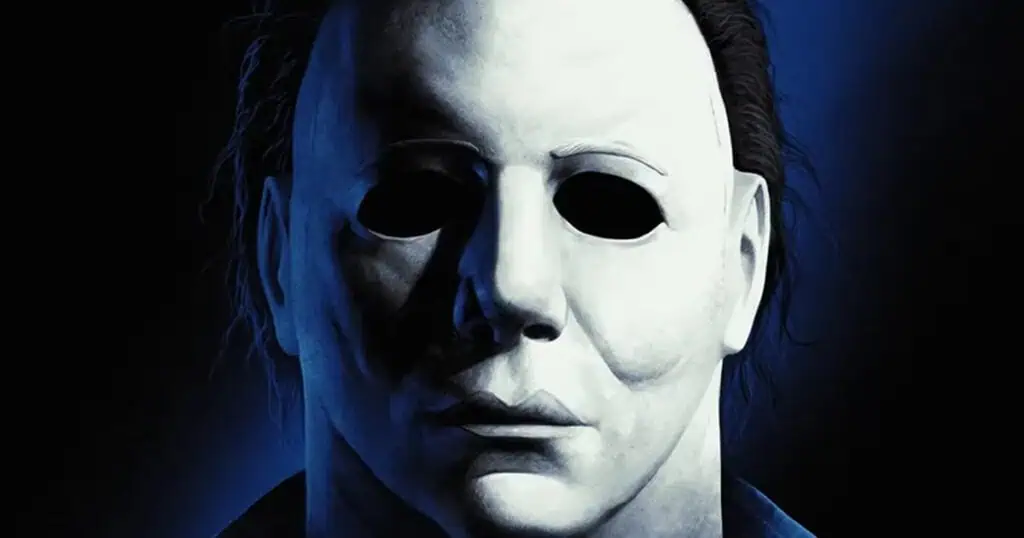
William Shatner was not on the Halloween set. He did not play Michael Myers, and he didn’t design the mask or approve it. For years, he didn’t even know his face had become one of horror cinema’s most enduring images.
When someone finally told him, his first reaction was essentially, “Is this a joke?” Shatner said that once he saw a picture of the mask—in a magazine or somewhere—he recognized the face behind the white paint. But even Shatner has admitted that he doesn’t remember exactly when he first heard the story, and that he doesn’t know how true every version is.
When he talks about it, though, he seems to be having fun. He seems to enjoy telling the joke and sharing this bit of movie trivia. In one appearance back in the ’90s, I think on Conan O’Brien, Shatner tried to explain that his face became a horror mask, but then got very confused and tangled up between the names of Michael Myers, Jason, and Freddy Krueger. Like many people, he didn’t know the difference between Halloween, A Nightmare on Elm Street, and Friday the 13th. Conan, Andy Richter, and the audience tried to steer him back to the right franchise, but even they didn’t get it right. It’s a wonderful little Shatner moment: part confidence, part improvisation, part total confusion.
Shatner has also told several versions of wearing the Michael Myers mask while trick-or-treating with his children or grandchildren. In one telling, he ends up getting more candy than the kids. In another, a homeowner tells the group of trick-or-treaters to leave. So Shatner walks up to the door in his Michael Myers mask, reveals his real William Shatner face, and scares the man somehow.
And then, did he give the kids candy? I don’t know. It’s not really a story. It’s not even really a joke. It’s just something Shatner says, and the details shift from one retelling to another. But I guess the punchline stays the same: the actor whose face became Halloween’s boogeyman eventually wore that face back into the neighborhood on Halloween.
There’s something there. It means something.
From Star Trek Hero to Halloween Villain
The mask also creates an unlikely bridge between two very different kinds of movie history. Captain Kirk represents the future: curiosity, bravery, exploration, kindness, the good of mankind, and the promise that the unknown can be understood. Michael Myers represents almost the opposite. He’s just a shape, a presence that refuses explanation, an unstoppable force who only wants blood. Pure evil that can’t be understood.
This one image of this one face crosses from Star Trek into Halloween—from the bright possibility of the final frontier to the dark quiet of a suburban street full of dead babysitters. The captain who spoke to us about strange new worlds became a silent stranger at the end of the driveway. No longer holding a phaser set to stun, he carries a knife set to kill. This famous face became terrifying by becoming anonymous. And it’s a terrifying, beautiful thing.
That blank mask also captures something essential about movie stardom. Actors give us their faces again and again until those faces feel like they belong to everyone—like we can rip them off, wear them around the neighborhood, and ask for candy. But then you make one tiny change: a different haircut, a layer of white paint, a pair of dark eye sockets, and the familiar image becomes something strange.
Sometimes when I’m watching Halloween, I pretend it’s a nightmare episode of Star Trek. Some unknown alien force hurls Captain Kirk’s face into the past, strips it of its voice, and recasts it as a killer. Spock can’t save him. Scotty can’t beam him up this time. No, no, no. The captain is trapped in that mask, condemned to stalk and kill through sequel after sequel, reboot after reboot, reimagining after reimagining.
A Strange Columbo Connection
And then there’s one more strange bit of foreshadowing in the Columbo episode “Fade in to Murder.” William Shatner wears a dark blue jumpsuit that looks remarkably like Michael Myers’ coveralls. Two years before his face was turned into the Shape’s mask, he was already dressed to kill. Pure coincidence, of course. …Or is it?
The Mask’s Lasting Legacy
The original mask was made by the great Don Post Studios. Then the great Tommy Lee Wallace altered it. Then the great John Carpenter lit it. The audience gave it meaning. The legend was born, and cinema changed forever.
Halloween gave that mask a second life—one William Shatner never planned and Tommy Lee Wallace never could have predicted. The face was famous before it became frightening, and that frightening image became famous all over again.
That’s the beautiful accident at the center of this story: the mask became iconic by hiding the iconic person who made it recognizable. But deep down, somewhere beneath that blank white face, Captain Kirk is still there, quietly staring out at us while Michael Myers waits in the dark.












The comment section exists to allow readers to discuss the article constructively and respectfully, focused on the topic at hand.
What’s Not Allowed