


What if the groundbreaking technology behind companies like 23andMe or Ancestry.com evolved to the point where it could predict every genetic defect you would ever have on the day you were born? And what if that information determined your entire life? A dystopian world emerges from that question, one where people born with genetic “defects” are pushed into a lower class, living under constant judgment and limitation.
Today’s film explores that idea through an elegant, unsettling, and deeply human science fiction story. A script so ahead of its time that it is still studied and discussed in academic circles more than twenty years later.
But the real question is this: How does a film with incredible performances, a brilliant concept, and genre-blending ambition, from futuristic thriller to murder mystery to romance, completely bomb at the box office? This is the story of what happened to Gattaca.
Andrew Niccol’s Vision: From Commercials to Cinema
After a decade directing television commercials, Andrew Niccol was ready for something bigger. He wanted to make films longer than sixty seconds. He would eventually become known for thought-provoking works like Lord of War, but his breakthrough moment came early with The Truman Show and Gattaca.
Niccol moved from London to Los Angeles chasing Hollywood opportunity and managed to land his The Truman Show script with producer Scott Rudin. Rudin was impressed, but not enough to hand a first-time director a $60 million Jim Carrey project. That job went to Dead Poets Society director Peter Weir. That left Gattaca as Niccol’s chance to make his official feature directorial debut.
The Birth of a “Parallel Future”
Niccol’s fascination with dystopian futures that are clean, bright, and terrifyingly controlled comes through clearly in Gattaca. The title itself (a change from the original The Eighth Day) carries meaning, referencing the four nucleobases of DNA:
- Guanine
- Adenine
- Thymine
- Cytosine
Niccol was inspired by the Human Genome Project, an international effort in the 1990s to map human DNA. At the time, scientists and ethicists were already warning about genetic privacy, discrimination, and class division based on biology. Those fears would eventually become law-level concerns, leading to protections like the Genetic Information Nondiscrimination Act in the United States.
But Gattaca imagines what happens if those protections fail.

Genetics as Destiny: The World of Gattaca
In Niccol’s world, children are no longer simply born, they are designed. “Valid” children are genetically engineered to eliminate defects like heart conditions, addiction, or aggression. “Invalids” are naturally born and immediately marked as inferior. The system is ruthless.
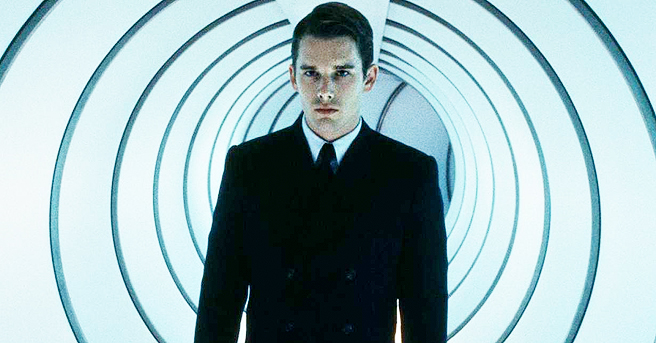
Vincent Freeman, the film’s protagonist, is born with a predicted 99% chance of heart failure and a life expectancy of just 30 years. His parents respond by having a second, genetically enhanced child: Anton.
Vincent grows up watching his brother surpass him in every measurable way: strength, intelligence, and parental approval. But instead of giving up, Vincent turns limitation into fuel.
Vincent’s Impossible Dream
Vincent’s goal is simple and absurd in his world: become an astronaut at Gattaca Aerospace Corporation. But Invalids are not allowed anything beyond menial labor. Even applying for such a job is pointless. So Vincent takes a radical step: he becomes a “borrowed ladder.”
He assumes the identity of a genetically superior man, Jerome Morrow, a former elite swimmer whose life ended after a crippling accident. This identity swap becomes the backbone of the film, a psychological and physical transformation built on deception.
The Body Horror of Identity
To maintain Jerome’s identity, Vincent must constantly replace every biological trace of himself:
- Blood stored in hidden containers
- Synthetic urine samples
- Skin and hair removal daily
- Constant surveillance avoidance
Even his height becomes an issue, requiring surgical alteration. It is part espionage thriller, part body horror, and entirely obsessive.
Meanwhile, Jerome, played by Jude Law, spirals into alcoholism and despair while financially benefiting from the arrangement. This uneasy partnership sits at the emotional core of the film.
Crime, Romance, and Pressure
The film also opens with a murder investigation involving a powerful figure within Gattaca. This puts immediate pressure on Vincent, who is weeks away from achieving his dream. Law enforcement begins closing in, led by Inspector Hugo and Vincent’s own genetically “valid” brother Anton.
At the same time, Vincent begins a relationship with co-worker Irene, adding emotional risk to his already impossible deception. Everything tightens and threatens collapse.

The Cast That Carried the Future
The casting of Gattaca is one of its strongest elements:
- Ethan Hawke as Vincent
- Jude Law as Jerome
- Uma Thurman as Irene
- Alan Arkin as Detective Hugo
- Loren Dean as Anton
- Xander Berkeley as Lamar
The performances balance restraint, tension, and emotional vulnerability, grounding the film’s high-concept science fiction in human reality.
Style, Design, and the Look of Tomorrow
The production design avoids flashy sci-fi clichés. There are no flying cars or neon megacities. Instead, the future is clean, retro, and eerily familiar.
Key contributors include:
- Cinematography: Slawomir Idziak
- Production Design: Jan Roelfs
- Score: Michael Nyman
A standout filming location is the Frank Lloyd Wright-designed Marin County Civic Center, which serves as Gattaca Aerospace headquarters. The result is a “future that feels like it already happened.”
A Box Office Disaster
Gattaca was released on October 24, 1997. Despite a $36 million budget, it earned only $4.3 million in its opening weekend and finished with roughly $12.5 million domestically. It was a box office failure.
The reasons were straightforward:
- Difficult-to-market premise
- Lack of traditional blockbuster spectacle
- No major box office stars at the time
- Misaligned marketing strategy
In the blockbuster-heavy landscape of the late 1990s, Gattaca simply didn’t fit.
Critical Success and Cultural Longevity
While financially unsuccessful, the film was critically respected.
- Rotten Tomatoes: ~82% critics / ~87% audience
- Roger Ebert called it “a thriller with ideas”
Over time, its reputation grew significantly. NASA once ranked it among the most scientifically compelling science fiction films ever made.

The “Gattaca Effect”
Today, Gattaca is widely used in academic discussions about genetics and ethics. Universities such as Berkeley, Toronto, and Sydney have used the film as a teaching tool.
The “Gattaca Effect” refers to how the film anticipates real ethical debates in genetic science, especially concerns about class division and biological determinism.
A 2022 Oxford Academic study described it as:
- “Ahead of its time”
- “More relevant now than ever”
Conclusion: A Film Ahead of Its Time
At its core, Gattaca is not just about genetics or the future. It is about limitation, identity, and resistance. It asks whether human potential is defined by biology or by determination.
Despite its box office failure, it remains one of the most enduring science fiction films of its era. And that is what happened to Gattaca.
FAQ: Gattaca Explained
What is Gattaca about?
Gattaca is a science fiction film set in a future where society is divided based on genetic engineering. People born naturally are considered “Invalids,” while genetically designed humans are “Valids.” The story follows Vincent Freeman, an “Invalid,” who assumes another man’s identity to achieve his dream of becoming an astronaut.
Why is Gattaca considered ahead of its time?
The film explores genetic discrimination, a topic that became increasingly relevant with real-world advances like the Human Genome Project and modern DNA testing companies. It predicted ethical debates about privacy, class division, and biological determinism before they became mainstream scientific concerns.
Is Gattaca based on real science?
Not directly. While the science of DNA and genetic screening is real, the film’s deterministic interpretation of genetics is speculative. Real-world genetics cannot predict life outcomes with the precision shown in the film, but the ethical concerns it raises are grounded in actual scientific debate.
Why did Gattaca fail at the box office?
The film struggled commercially due to limited marketing appeal, a lack of traditional blockbuster elements, and relatively unknown lead actors at the time. Its intellectual tone also made it harder to position in the action-heavy 1990s box office landscape.
Who directed Gattaca?
Gattaca was written and directed by Andrew Niccol, who is also known for films such as The Truman Show and Lord of War. It marked his feature directorial debut.
What does the title Gattaca mean?
The title comes from the four nucleotide bases of DNA:
- Guanine
- Adenine
- Thymine
- Cytosine
The film uses this structure as a symbolic foundation for its world-building.
Why is Gattaca still popular today?
The film has gained long-term recognition for its philosophical themes, visual style, and relevance to ongoing debates about genetic engineering. It is frequently used in academic discussions about bioethics and class inequality.
What is the “Gattaca Effect”?
The “Gattaca Effect” refers to the film’s influence on real-world discussions about genetics and ethics, particularly the fear that genetic profiling could lead to social stratification or discrimination based on biology.
Did scientists actually reference Gattaca?
Yes. The film has been referenced in academic and educational settings, including universities and bioethics programs, as a framework for discussing the social implications of genetic technology.
A couple of previous episodes of this show can be seen below. For more, check out the JoBlo Horror Originals YouTube channel—and don’t forget to subscribe!












The comment section exists to allow readers to discuss the article constructively and respectfully, focused on the topic at hand.
What’s Not Allowed