
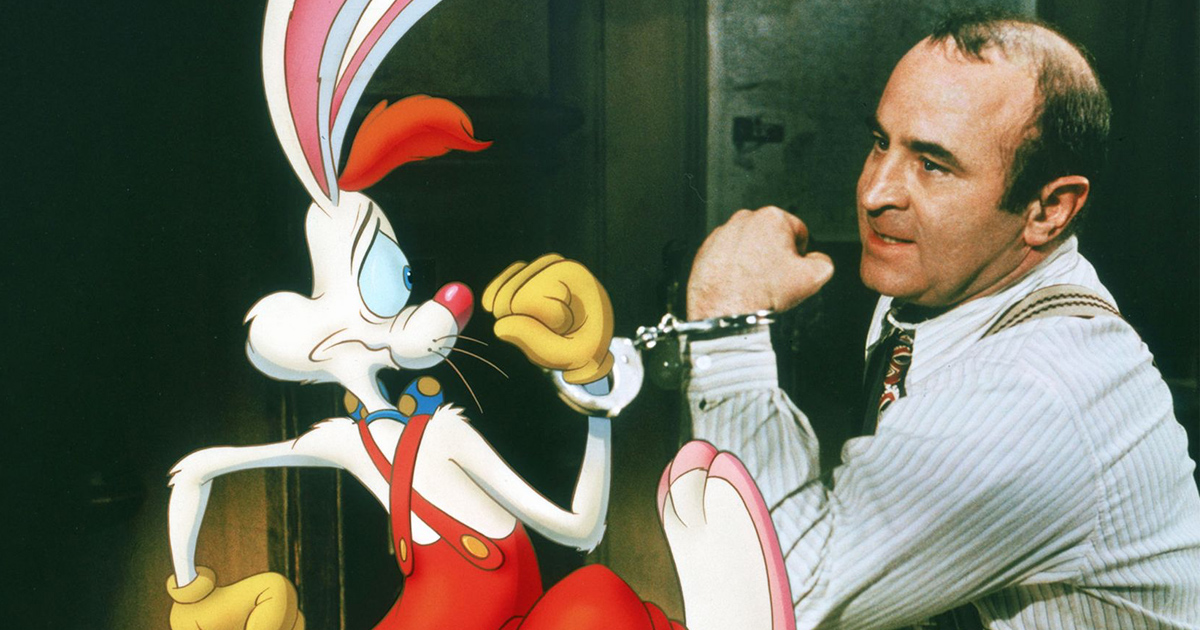

There are movie performances where an actor disappears into the role. There are movie performances where the actor suffers for the role. And then there’s Bob Hoskins in Who Framed Roger Rabbit?, where the role apparently followed him home, rewired his reality, and altered the chemistry in his brain. Because according to Hoskins himself, making Who Framed Roger Rabbit? did something very strange to his sanity. You could say that rabbit hippity-hopped all over his mental health. Bob did not just pretend to see cartoons. He trained himself to literally see his animated co-stars. He was freaking hallucinating.
And then, after months of doing that, Bob Hoskins had trouble making them go away. Who Framed Roger Rabbit? is a movie about a human detective entering the world of cartoons. That’s the story. And behind the scenes, it was the story of a human actor forcing his imagination to believe the impossible so completely that, for a while, the impossible became his reality. This is not just some behind-the-scenes movie trivia. This is a ghost story about the art of acting. A psychological horror story disguised as an animated comedy. A story about what happens when make-believe becomes muscle memory, and when one man stares into empty space for so long that it eventually stares back.
Mr. Bob became lost in an animated abyss. The cartoons were contaminating his consciousness. This is the story of Bob Hoskins, his brain, his talent, Roger Rabbit, and the weasels that would not leave Bob alone.
Welcome to Toontown
Released in 1988, Who Framed Roger Rabbit? was part detective story, part slapstick comedy, part animation history lesson, part technological magic trick, and part cinematic masterpiece. The movie imagined a version of 1940s Los Angeles where human beings and animated characters live side by side. You know, Disney coexisting with Warner Brothers, like it’s some sort of Ready Player One, but it’s actually good. And a cartoon rabbit is framed for murder. And the only man who can solve the case is a hard-drinking private eye named Eddie Valiant. And at the center of all that cartoon chaos, in front of and behind the scenes, was Bob Hoskins.
He was not some obvious American movie-star detective type. He was not Jack Nicholson. He was not Humphrey Bogart. He was not Clark Gable. He was a short, tough, brilliant British actor with a gravelly voice, a hard face, sadness behind his eyes, and the body of Danny DeVito, but hairier. But he had the exact right kind of soul for this character. That’s the secret of the whole movie. Bob Hoskins does not wink at the cartoon world. He does not act like he’s above it. He treats Roger Rabbit like an actual pain in the butt. He treats Jessica Rabbit like an actual woman. And he treats the weasels like actual little psychotic cartoon demons.
And because he believes it, we believe it. That’s why the movie works. That is acting. That is movie magic.
Learning How to Hallucinate
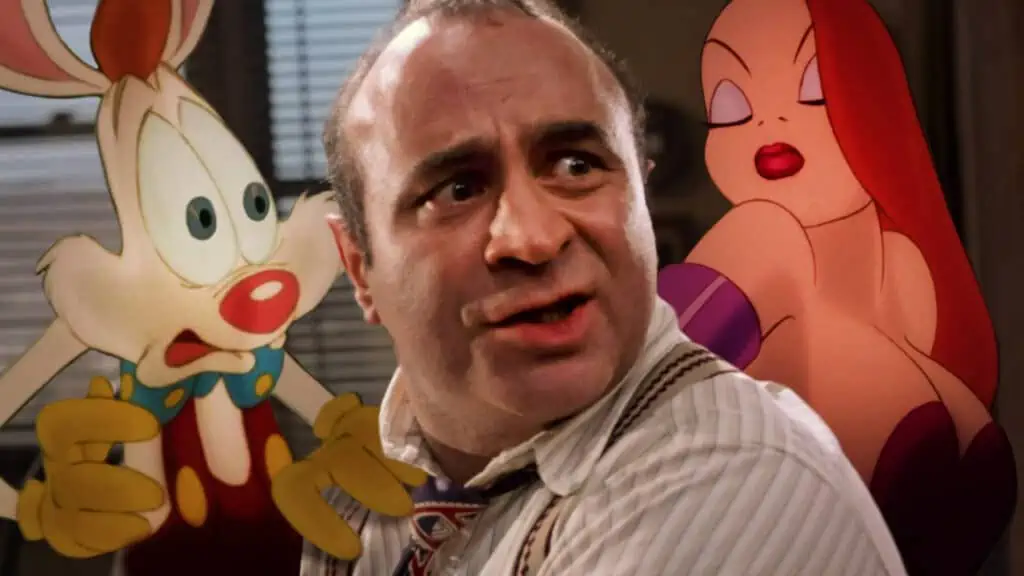
Actors learn lines, but Bob Hoskins learned how to hallucinate. The problem was simple. The cartoons were not there. Obviously, they would be drawn in later, but Bob still had to look directly at them. He still had to touch them, react to them, argue with them, and sometimes engage in battle with them. So Bob had to convince his body that these nonexistent creatures were really standing there. They were really looking into his eyes, and he had to make his eyes stop in the right place. He had to focus on empty air.
And if he got that wrong, the whole illusion would collapse. The movie would not work because your eye follows his eye. You believe it because he believes it. That’s why the movie works. Hoskins practiced by watching his young daughter play and interact with her imaginary friends. He studied the way children could project life into empty space without hesitation, without shame, without the adult curse of overthinking. It’s just like, “Look, there’s a rabbit.” And yeah, there’s a rabbit. Hoskins took that childhood ability and weaponized it for cinema. And then he did that for months, for hours and hours a day, sometimes 16-hour days on set. This guy was staring into imaginary dimensions for like half a year.
It was freaking rabbit season inside of his head 24/7. And at some point, his brain did what brains do. It adapted. It learned the trick. And then it would not stop doing the trick. Bob’s brain went to Toontown.
When the Toons Followed Him Home
Here is where it goes from a charming behind-the-scenes story to a psychological cartoon nightmare. Hoskins later said that after doing this for so long, he started to lose control. He would be in normal situations, living his normal life, and suddenly cartoon characters would appear where they weren’t supposed to be. There were animated apparitions appearing before him anytime, anywhere. The weasels were weaseling their way into his brainwaves. Bob often told the story of being at an event, a fancy event, talking to a very proper country lady wearing a big hat, and suddenly there was a weasel in the hat, just sitting right there on her head.
And apparently, Bob couldn’t take his eyes off it and even started to talk to this imaginary weasel on this lady’s head. Bob Hoskins’s daughter noticed what was happening and basically told him to slow down because he was going mad.
As Hoskins later explained, “I think I went a bit mad while working on that. Lost my mind. The voice of the rabbit was just there behind the camera all the time. You just had to know where the rabbit would be at all times, and Jessica Rabbit and all the weasels. The trouble was, I had learned how to hallucinate. If you do that for eight months, it becomes hard to get rid of it. I got talking to a very country lady with a big hat, and there was this weasel in her hat. My daughter said, ‘Dad, slow down. Slow down. Slow down. You’re going barmy, mate.’ And I was.”
He summed it up even more bluntly when he said, “I trained myself to hallucinate, and it ended up screwing up my brain. I would be sitting, talking normally, and suddenly a weasel would creep up on the wall at me.” His doctors told him to take a few months off to restore his mental health. So after that, Bob Hoskins did not work for a year. Yeah, it was that bad. And honestly, imagine being Bob Hoskins for a moment. You just starred in one of the most groundbreaking movies ever made. You helped resurrect animation. You gave one of the greatest, most interesting performances in cinema history.
And now you cannot enjoy a normal party because a cartoon weasel is apparently hanging out on some lady’s hat. That is the witchcraft of show business. That is the price of art. Bob discovered that once you teach your brain that empty space is never really empty, good luck turning that switch off. And that’s the eerie part, because in the film, Eddie Valiant is a man haunted by Toons. He hates them. He drinks because of them. His brother was killed by a Toon. His whole life was broken by cartoon logic invading his human reality.
And then, in real life, the actor bringing Eddie Valiant to life, Bob Hoskins, becomes a man haunted by Toons. The movie infected the actor with its own metaphor or something. Eddie Valiant had cartoon trauma. Bob Hoskins had cartoon hallucinations. And somewhere in the middle of all of that, performance became possession.
Method Acting

When we talk about actors losing themselves in roles, we usually talk about dark performances. The kind of roles where everybody on set starts whispering, “Oh, wow. He stayed in character the whole time. It was really freaky. He made everybody miserable on set.” You know, method acting has become some strange, sacred artistic ritual to some actors. But yeah, Roger Rabbit is supposed to be a fun cartoon, but somehow, it actually features one of the most psychologically intense acting jobs ever put to film. We have learned that fantasy can be just as dangerous as realism.
A cartoon rabbit can burrow into your mind just as deeply as Shakespeare or some gritty arthouse drama. Maybe even deeper. Because with most productions, at least there’s another actor standing there. With Roger Rabbit, there was sometimes just a wall, a mark, a voice off-camera, and Bob Hoskins’s brain doing all the heavy lifting. And Bob’s performance has become somewhat of a commentary on the future of acting. He was accidentally beta-testing the next 40 years of blockbuster cinema.
Because today, actors fight tennis balls. They cry at green screens. They fall in love with creatures who will be added in months later by hundreds of overworked visual effects artists. These actors are looking into the eyes of aliens or dragons, but they’re actually just looking at a pole. They’re getting attacked by monsters, but they’re actually just men in green pajamas. They have emotional conversations with superheroes who aren’t even in the room because of, you know, scheduling conflicts. That’s how they do it now. That’s the norm. But in 1988, Bob Hoskins was already there.
He was ahead of his time. Maybe too far ahead, actually.
Roger Rabbit Walked So CGI Monsters Could Run
Before Roger Rabbit, there had been other famous live-action animation combinations. Gene Kelly danced with Jerry Mouse in Anchors Aweigh. Mary Poppins popped around with some popping penguins in Mary Poppins. And later, Michael Jordan would play basketball with Bugs Bunny in Space Jam. But you can feel the difference. In a lot of other live-action cartoon sequences, the human performer is just doing a charming trick. The camera is often more controlled, mostly still. The sequence is more contained. The actor is performing with the idea of a cartoon. But in Roger Rabbit, the cartoons are the world.
The Toons are the co-stars. And this is why Bob’s performance is so much more convincing than like anything ever done. Take Space Jam, for example. Michael Jordan is just a superstar visiting a cartoon movie. Hoskins is a man trapped inside of one. And that’s the difference. Michael Jordan just plays along. Bob Hoskins believes. And like I said, when Bob believes, we believe. It’s why the movie works. The visual effects are amazing. The animation is incredible. Look at that lighting, the shadows, the compositions. They’re all brilliant. But the real-life special effect is Bob’s face and Bob’s body and Bob’s brain and Bob’s balls.
It’s funny that the most advanced piece of technology in this movie about cartoons might be the human actor convincing himself that the rabbit is real. Then he followed it down the rabbit hole and lost his mind.
Reality
This is where the Bob Hoskins story starts to connect to something bigger. Actors need reality. Not total reality, of course. They are actors. Their entire job is to lie, but they need something. They need another face to look at, another body to interact with, at least a prop, at least a heartbeat. Acting is not just pretending alone. Acting is reacting. So when you take away the other actor, you take away the creature, you take away the world, and now we’re supposed to believe your performance, you’ve become both the performer and the audience. Both the actor and the animator. Both the believer and the creator.
And that’s a lot to take on for any actor. Look at actor Ian McKellen. He ran into a version of this decades later on The Hobbit when he became frustrated and emotional while acting alone on green-screen sets. You could tell this veteran actor was starting to break because the reality had been stripped from him. And honestly, that makes sense to me. And that’s the dark little joke at the heart of modern movie magic. The audience sees the wonder while the actor sees nothing. Or worse, in the case of Bob, the actor sees too much.
Was Bob Haunted?
So, yeah. Now, let’s dive a little deeper down that Roger rabbit hole and ask another question that maybe we’re not really thinking about. What if Bob was not hallucinating? What if he unlocked some kind of unknown mind superpower that science can’t understand yet? What if Bob was able to smuggle in beings from another dimension who were using Bob’s imagination to manifest into our world? What if these were entities or deities come to life by Bob’s imagination? Some people believe in that kind of stuff. What if Toontown exists slightly to the left of our reality? And when Bob and Bob’s brain slipped into madness, he somehow accidentally tuned his brain to a different frequency.
I’m just asking the tough questions here, people. Come on. Maybe he did not train himself to hallucinate. Maybe he became a receiver of something paranormal, something supernatural. Like, didn’t an animated pig appear before somebody in The Amityville Horror true story? Like, didn’t that happen? I’m just saying that if a man spends months acting opposite invisible cartoon creatures and then sees them crawling on the walls in real life, there are only a few possibilities. One is that the human mind is fragile and fascinating. And another theory is that Bob opened a portal.
This is why this story feels like a real-life Harvey and also kind of like a real-life Donnie Darko. In Harvey, Jimmy Stewart’s character has an invisible rabbit friend. And the whole movie becomes a sweet, strange little question about whether he’s crazy or whether the rabbit’s actually there. And in Donnie Darko, the rabbit’s not so sweet. The rabbit looks like it crawled out of the underworld. And maybe these Bob Hoskins Roger Rabbit hallucinations sit somewhere between them, somewhere between Harvey the Rabbit and Frank the Rabbit. So Bob was the man standing between the cartoon and the real, trying to keep both worlds from collapsing into each other.
And because Hollywood has a sick sense of humor, Bob later played Mario in the live-action Super Mario Bros. movie, which means after being haunted by cartoons, Bob basically became a live-action cartoon himself. And weirdly, that just adds to the mythology.
The Lesson of the Weasels
So, what does this story actually mean? Besides the obvious lesson, which is: do not spend months professionally hallucinating rabbits unless you have a good doctor or maybe a priest nearby. I think the real lesson is about the danger and beauty of imagination. Imagination has the power to build a wonderful Toontown inside of your skull, but imagination also has the power to forget to install an exit. That’s why Bob’s story is so fascinating. It’s funny because cartoons are funny. It’s scary because hallucinations are scary. But it’s kind of moving because it shows how much he cared. It shows how much of himself he gave to the work.
The man did not phone it in. He did not just stand there. He did not treat this like a silly little kids’ movie. He treated Roger Rabbit like a real scene partner, like an equal. And because of that, he gave us the most unbelievable, believable, impossible performance ever put to film, if that makes sense. He suffered for the rabbit. He suffered for cinema. He suffered for his art. And somehow, that is noble. It’s ridiculous, but yes, it’s noble.
That’s All, Folks
In the end, Who Framed Roger Rabbit? is a movie about two worlds colliding: human and cartoon, reality and imagination. But Bob stood right at the collision point. And that’s why he’s so great. That’s why this movie still works. Trust me, I just watched it. That is why this Roger Rabbit hallucination story feels less like a weird footnote and more like the secret meaning of the whole thing. Because every great movie asks us to hallucinate a little. That is cinema. It’s a socially acceptable hallucination, and it can be sober.
The difference is that most of us get to leave the theater and go home. Bob had to carry the hallucinations around for a while.
And maybe that’s why we love the story, because it makes him sound like the ultimate moviegoer. Like, in his mind, they were making Roger Rabbit sequels. The story was continuing on loop inside of his cranium. He was a man who believed too much. He was a man who saw too deeply. He was a man who did his job so well that the cartoons refused to clock out. The demons refused to be exorcised.
So yeah, maybe Bob Hoskins lost his mind a little while making Who Framed Roger Rabbit?
But maybe he also found the secret of movies, the secret of acting.
If you believe hard enough, even if you’re looking at nothing, eventually that performance becomes good enough that everyone else can see it too.














The comment section exists to allow readers to discuss the article constructively and respectfully, focused on the topic at hand.
What’s Not Allowed