


If you’re a child of the eighties or nineties, one of your touchstone franchises had to be the Lethal Weapon series. I vividly remember how excited I would get when one of them was playing on TV back in the day (before I ended up buying all of them on VHS), as there was nobody who didn’t love the adventures of Riggs and Murtaugh. I watched these movies so much that my father would refer to Riggs and Murtaugh as my friends because they were a kind of cinematic comfort food to me. The same goes for most of my friends growing up—we couldn’t get enough of them.
But how does each movie stack up against the others? I’d argue that the best-to-worst order goes directly in line with the order they were made in, with the first being the best and the fourth being the weakest. While that may not make this the most unpredictable list, I still think it’s worth exploring what makes these movies endure (and who knows, maybe we’ll get a fifth?)—so here goes nothing! The Lethal Weapon movies ranked!
| Rank | Film | Release Year | Key Theme |
|---|---|---|---|
| 4 | Lethal Weapon 4 | 1998 | Franchise excess and action escalation |
| 3 | Lethal Weapon 3 | 1992 | Family bonds and aging cops |
| 2 | Lethal Weapon 2 | 1989 | Buddy-cop comedy perfected |
| 1 | Lethal Weapon | 1987 | Emotional reinvention of the buddy-cop genre |

1. Lethal Weapon (1987)
- Buddy-Cop Dynamic: Dangerous loose cannon vs family man veteran
- Franchise Theme: Friendship, trauma, and redemption
- Setting: Los Angeles
- Tone: Dark action-thriller with grounded humor
- Action Style: Gritty practical stunt work and street-level violence
- Emotional Core: Riggs overcoming suicidal grief
- Legacy Character Presence: Original Riggs and Murtaugh partnership
- Commentary Focus: Masculinity, loneliness, and emotional healing
- Most Memorable Element: Riggs and Murtaugh spending Christmas together
- Biggest Strength: Emotional depth combined with action-comedy chemistry
- Biggest Criticism: Slightly messy final fight choreography
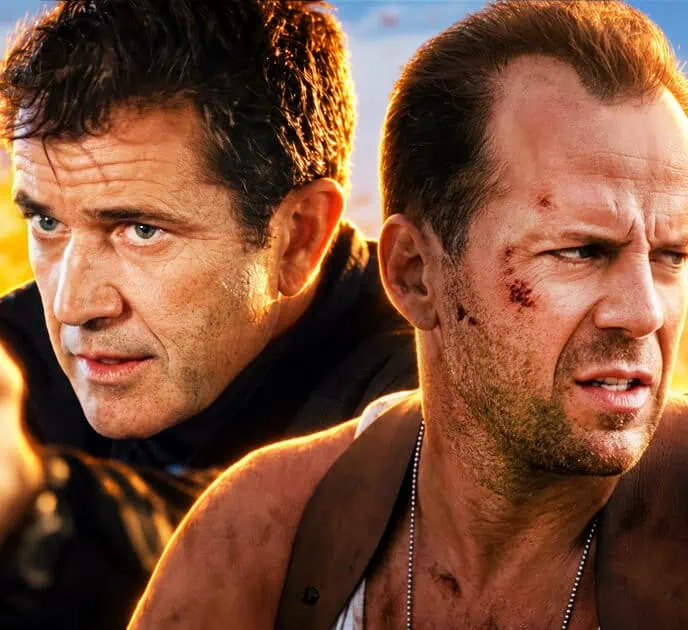
It’s hard to accurately explain just how influential this movie was when it came out. Granted, the buddy cop formula wasn’t new—and neither was the white guy/Black guy buddy flick. I Spy did it in the sixties, and in the eighties there were several great examples, like 48 Hrs. (although only one of them is a cop) and the underrated Running Scared (with the late, great Gregory Hines and Billy Crystal in his only action role). Yet, the actor pairing in Lethal Weapon was lightning in a bottle. You had Mel Gibson, the live-wire heartthrob, paired with the classy, older (although he was a good decade younger than he played on-screen) Danny Glover. One is a madman, the other a family man.
Whereas 48 Hrs. and Running Scared relied on edgy humor and jokes, Lethal Weapon, while funny, was grounded by an emotional hook—that Riggs wants to die, and that Murtaugh doesn’t want to be around when he goes off. You buy their evolving friendship, especially when Murtaugh’s daughter is kidnapped and Riggs goes all-in helping rescue her. The payoff—them spending Christmas together—is a classic “guy cry” moment. Plus, it has lean direction by Richard Donner, a classic score by Michael Kamen (with Eric Clapton and David Sanborn), and a great script by Shane Black. My only complaint is that I’ve always found the final fight between Riggs and Gary Busey’s Joshua a bit of a mess, as North American movies hadn’t quite figured out how to stage mano-a-mano fights choreographed so intricately. (The moves Riggs uses—a style of improvised martial arts called “Jailhouse Rock”—are really tight.)

2. Lethal Weapon 2 (1989)
- Buddy-Cop Dynamic: Fully formed comedic partnership
- Franchise Theme: Family integration and sequel escalation
- Setting: Los Angeles
- Tone: Perfect balance of comedy and danger
- Action Style: Bigger practical action and explosive set pieces
- Emotional Core: Riggs finding love and emotional stability
- Legacy Character Presence: Leo Getz introduced
- Commentary Focus: Diplomatic corruption and found family
- Most Memorable Element: “Diplomatic immunity” storyline
- Biggest Strength: Balances comedy and darkness almost perfectly
- Biggest Criticism: Slightly less emotionally raw than the original
To some, this is the peak of the franchise. Richard Donner emphasized the comedy in this one by bringing Joe Pesci into the fold as Leo Getz, and unlike the later films—which lean a little too hard on comedy—this one gets the mix just right. It’s anchored by a pretty dark storyline about racist South African drug dealers operating under the cover of diplomatic immunity and makes some bold choices, such as having Patsy Kensit’s character, Riggs’ love interest, killed off. Yet, the movie also has a lot of warmth, with some really nice scenes depicting Riggs’ evolving role in the Murtaugh household, such as a heartfelt moment he shares with Darlene Love, who plays Murtaugh’s wife, Trish. To me, this one is just a tiny notch below the original, but it’s great in its own right.

3. Lethal Weapon 3 (1992)
- Buddy-Cop Dynamic: Comfortable long-term partnership
- Franchise Theme: Aging, loyalty, and expanding family
- Setting: Los Angeles
- Tone: Lighter and more comedic
- Action Style: Big-scale stunt-driven action
- Emotional Core: Riggs becoming fully part of the Murtaugh family
- Legacy Character Presence: Leo Getz and Lorna Cole
- Commentary Focus: Police violence, family, and emotional maturity
- Most Memorable Element: Introduction of Rene Russo’s Lorna Cole
- Biggest Strength: Strong character relationships and emotional warmth
- Biggest Criticism: Comedy sometimes overwhelms the darker elements
This one holds a special place in my heart, as it was the first Lethal Weapon movie I saw in theaters. I was ten years old in the summer of 1992, and my buddy Danny’s folks took us to see it—I was riveted. While some say they leaned too heavily into comedy with this one (there was really no reason to bring Pesci back as Leo Getz), the movie also has some amazing stuff in it. Rene Russo is awesome as Lorna Cole, the love of Riggs’ life, while Glover’s Murtaugh has a rich plotline where one of the gangbangers he shoots happens to be a former friend of his son’s. It also continues to show Riggs’ devotion to the Murtaugh clan, and the theme song by Sting, “It’s Probably Me,” is a classic.
4. Lethal Weapon 4 (1998)
- Buddy-Cop Dynamic: Veteran partners nearing the end of their run
- Franchise Theme: Franchise excess and generational transition
- Setting: Los Angeles
- Tone: Broad comedy mixed with high-intensity action
- Action Style: Martial arts-heavy action spectacle
- Emotional Core: Riggs and Murtaugh confronting aging and fatherhood
- Legacy Character Presence: Expanded ensemble cast
- Commentary Focus: Immigration crime networks and franchise escalation
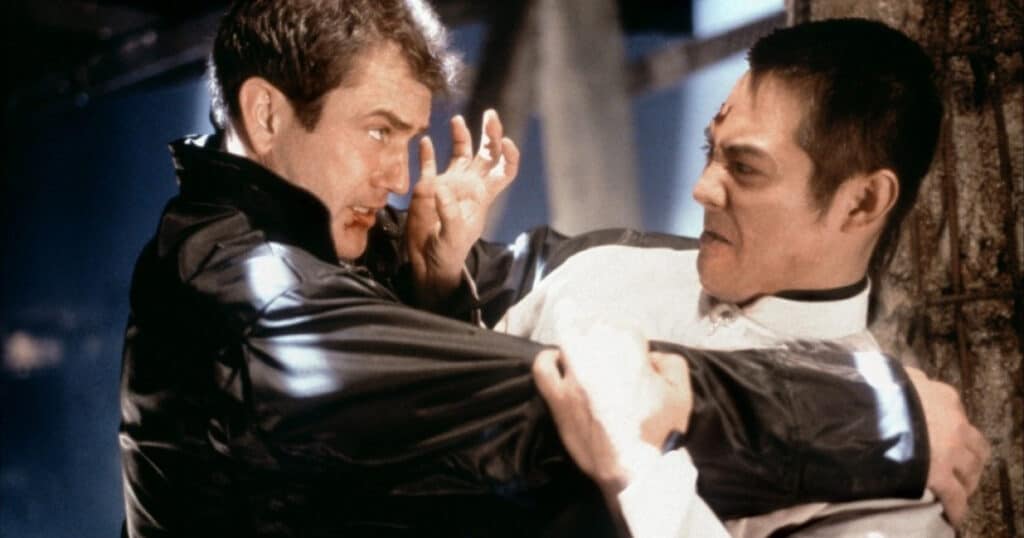
- Most Memorable Element: Jet Li’s villainous martial arts showcase
- Biggest Strength: Jet Li brings real physical danger to the franchise
- Biggest Criticism: Overstuffed story and excessive slapstick comedy
This was the first movie I ever wrote a review for. I hated this movie so much when I saw it in theaters that I came home and sent an angry rant to the old Rec.Arts.Reviews newsgroup. It’s a problematic film—overstuffed with way too many characters, taking the emphasis away from Riggs and Murtaugh. Director Richard Donner also went way overboard with the comedy, which approaches slapstick levels this time. However, Jet Li is one of the better villains of the franchise, and it’s the one time when you genuinely feel like Riggs and Murtaugh might be outmatched—at least physically. Is it a good film? Not really, but it’s still watchable.
Lethal Weapon Franchise FAQ
Which Lethal Weapon movie is considered the best?
Most fans and critics consider Lethal Weapon (1987) the best entry because of its emotional storytelling, iconic Riggs and Murtaugh partnership, and influence on the buddy-cop genre.
Which Lethal Weapon movie is the funniest?
Lethal Weapon 2 is often considered the funniest film in the series thanks to Joe Pesci’s introduction as Leo Getz and the stronger comedy emphasis.
Which Lethal Weapon movie is the darkest?
The original Lethal Weapon remains the darkest entry due to Riggs’ suicidal depression and the film’s more grounded emotional tone.
Which Lethal Weapon movie has the best action?
Many fans point to Lethal Weapon 4 because of Jet Li’s martial arts-driven fight scenes and the franchise’s biggest action sequences.
Do you need to watch the Lethal Weapon movies in order?
Yes. The emotional evolution of Riggs and Murtaugh’s friendship is one of the franchise’s defining strengths, and each sequel builds on their relationship and family dynamics.
Why was Lethal Weapon so influential?
Lethal Weapon helped redefine the modern buddy-cop formula by blending action, comedy, emotional drama, and character-driven storytelling in a way many later action films copied.
Who created the Lethal Weapon franchise?
The franchise was created by screenwriter Shane Black, with Richard Donner directing all four films.
Will there be a Lethal Weapon 5?
A fifth film has been discussed for years, though development has faced delays following the death of director Richard Donner. Mel Gibson has expressed interest in continuing the franchise.
And there you have it. What would your rankings be? Let us know in the comments!













The comment section exists to allow readers to discuss the article constructively and respectfully, focused on the topic at hand.
What’s Not Allowed