

It’s the summer of 1986, and you walk into a movie theater expecting Indiana Jones with a mullet: muscles, machismo, and a poster featuring Kurt Russell holding a gun like he’s about to save the world. Instead, you get a klutzy trucker who gets knocked out by a chunk of falling masonry, fires his gun straight into a ceiling, and spends two hours getting rescued by a guy half his size. What if the poster that sold you this movie was lying to you? Could that be part of the reason Big Trouble in Little China bombed so badly at the box office that it effectively damaged John Carpenter’s relationship with major studios? And how does a movie go from being trashed by critics to becoming a beloved cult classic that influenced everything from Mortal Kombat to Thor?
The answer has almost nothing to do with theaters and almost everything to do with a little black plastic rectangle with magnetic tape inside it. This is the story of how VHS saved Big Trouble in Little China, why Kurt Russell was John Carpenter’s Harrison Ford long before anyone thought to call him that, and how a movie nobody showed up for became one nobody can shut up about now. Grab the Pork Chop Express keys. We’ve got some driving to do.
From Western to Kung Fu Monster Comedy: The Origins of Big Trouble in Little China
To understand how weird Big Trouble in Little China is, you have to understand how weird its road to the screen was. The film didn’t start as a kung fu monster comedy set in San Francisco’s Chinatown. It started life as a western. Screenwriters Gary Goldman and David Z. Weinstein originally wrote it as a turn-of-the-century gunslinger story, with a cowboy teaming up with a Chinese railroad worker to rescue his kidnapped fiancée. Somewhere in that Old West version of the script, a mystical sorcerer named Lo Pan was already lurking. He was pretty much the only major piece of the original draft that survived the journey into the twentieth century.
Enter W.D. Richter, the man who wrote and directed the gloriously unhinged cult favorite The Adventures of Buckaroo Banzai Across the 8th Dimension. Richter reportedly thought the original script needed a “complete overhaul,” calling it a “dreadful screenplay.” So he gutted it, dragged it into modern-day San Francisco, and turned the cowboy into a blowhard eighteen-wheeler trucker named Jack Burton.
Carpenter came aboard and made further tweaks, beefing up Kim Cattrall’s Gracie Law and removing material that could have been offensive to the Chinese American community the film was so obviously in love with. When the dust settled on the credits dispute, Goldman and Weinstein received the “written by” credit, while Richter received an “adapted by” credit following a Writers Guild ruling.
A western. A total rewrite. A studio dealing with genre whiplash before a single frame was shot. That’s the DNA of this thing, and somehow, none of it ever really left the movie. You can still feel the ghost of a gunslinger walking around inside Jack Burton’s cowboy swagger.
Twentieth Century Fox, for its part, seemed to think it was making the next Raiders of the Lost Ark. John Carpenter, who was branching out from horror after the goodwill generated by Starman, had other ideas. He was making, in his own perfect words, an “action adventure comedy Kung Fu ghost story monster movie.” Did the studio actually read that script? Watching the finished film, you have to wonder.

Kurt Russell, Jack Nicholson, and the Search for Jack Burton
Here’s a fun bit of alternate history trivia: the studio’s first choices to play Jack Burton were Jack Nicholson and Clint Eastwood. Both passed.
Carpenter, who had already made Elvis, Escape from New York, and The Thing with Kurt Russell, wanted his guy and eventually got him. That wasn’t without some studio hand-wringing, though. Paramount had a similarly themed movie in the pipeline: Eddie Murphy’s The Golden Child. Fox was worried about losing the race with a lesser-known leading man.
Even weirder, the role of Wang Chi, the actual hero of the movie, as we’ll get to, was almost played by Jackie Chan. Chan was reportedly the frontrunner, but he passed, partly because his English wasn’t strong enough at the time and partly because his previous attempt at Hollywood stardom, The Protector, had flopped. He returned to Hong Kong to keep building the career that would eventually make him a global icon on his own terms. That opened the door for Dennis Dun, fresh off Year of the Dragon, who landed the role just days before cameras started rolling.
Then there’s Kim Cattrall as Gracie Law, Carpenter’s first choice, secured despite the studio initially wanting to cast a rock star in the role instead. James Hong, playing the ancient, cursed sorcerer David Lo Pan under mountains of prosthetics, delivered one of the most gloriously over-the-top villain performances of the decade. Victor Wong’s Egg Shen, the tour-bus-driving Chinatown wizard, rounds out an ensemble that, frankly, has more chemistry than movies with triple the budget.
Kurt Russell Was John Carpenter’s Harrison Ford
Let’s talk about Kurt Russell for a second, because this is the piece of the puzzle that doesn’t get discussed enough. Every great director of that era had a guy. Scorsese had De Niro, and later DiCaprio. Spielberg had Harrison Ford. And John Carpenter? He had Kurt Russell.
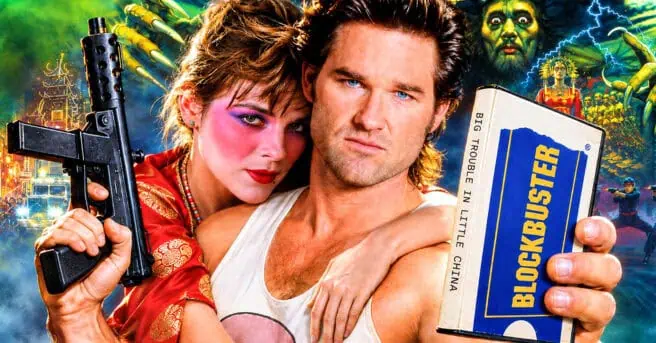
By the time Big Trouble in Little China rolled around, Russell and Carpenter had already made Elvis, Escape from New York, and The Thing together. Three wildly different projects, all of which hinged on Russell’s ability to be the tough, charismatic center of gravity a movie needs. He had the jawline, the swagger, and the “I could believably survive an Antarctic research station full of alien parasites” energy. Fox executives looked at him and saw an action hero waiting to happen, an Indiana Jones type, a leading man they could sell with muscles and a gun on a poster.
But here’s what makes Russell and Carpenter’s partnership so special, and why Big Trouble is its purest distillation: they used that action hero trust to pull off a total bait-and-switch. Jack Burton isn’t Han Solo. He’s not even really Indiana Jones. He’s a lovable idiot who thinks he’s Han Solo. As Carpenter himself put it, the character is about “this idiot, who stumbles into a world he doesn’t understand, staggers through it and does absolutely nothing, thinks he’s done EVERYTHING, and staggers away into the night.” That’s an incredibly ballsy thing to build a $25 million studio picture around. It only works because Russell had already banked so much trust with Carpenter, and with audiences, that he could play the fool and remain magnetic. Only an actor with real leading-man gravity can convincingly play a guy who’s constantly failing upward. Russell nails it in a way that, frankly, most “real” action stars of the era couldn’t have touched.
He’s Carpenter’s Harrison Ford in the sense that matters most: the collaborator a filmmaker trusts enough to take real risks with, repeatedly, across genres, for years. The difference is that Ford’s risks with Spielberg mostly paid off at the box office immediately. Russell and Carpenter’s biggest swing struck out on release, only to matter more decades later than almost anything else either of them made.
How Big Trouble in Little China Subverted the White-Savior Action Hero
Here’s the thing that makes Big Trouble in Little China more than just a fun cult curio: it’s doing something clever with the “white hero saves the day” formula that dominated so much of eighties action cinema.
The eighties were obsessed with East-meets-West stories: The Challenge, Chuck Norris’s Forced Vengeance, Year of the Dragon, and, of course, The Golden Child, the Eddie Murphy vehicle racing Big Trouble to theaters. That entire subgenre effectively collapsed a year later when the Sean Penn and Madonna disaster Shanghai Surprise became one of the decade’s biggest flops.
Typically, in these movies, the white lead is the hero, while the Asian character is the sidekick who supports him. Big Trouble in Little China flips that arrangement. Jack Burton has the John Wayne swagger, the one-liners, the truck, and the gun. He has every visual signifier of the white American action hero. But he has almost no idea what’s actually happening around him. He’s constantly wrong, constantly outmatched, and constantly saved by other people. Dennis Dun’s Wang Chi is the one with the martial arts skills, the emotional stakes (his fiancée is the one Lo Pan has kidnapped), and the actual competence to do something about it.

The film even opens with a framing device in which Egg Shen narrates Jack Burton’s legend in glowing, mythic terms. The studio reportedly insisted on adding this late in the process to inflate Jack’s heroic stature. Carpenter, being smarter than the note he was given, used it to set the audience up for a classic white savior story before spending the rest of the runtime pulling the rug out.
Jack fires his gun into the air during the climactic fight and knocks himself out with falling debris. He shouts his own catchphrases with total confidence while being completely useless. Wang Chi does the actual work of saving the day, even though Jack gets to throw the final knife.
Not everyone got the joke in 1986. Roger Ebert’s review dismissed the film as being “straight out of the era of Charlie Chan and Fu Manchu, with no apologies and all the usual stereotypes.” It’s a fair criticism on the surface. James Hong’s Lo Pan does visually echo old “yellow peril” villain archetypes like Christopher Lee’s Fu Manchu. But watched today, and considered alongside more recent criticism, the film looks less like it’s celebrating those stereotypes and more like it’s acknowledging and subverting them. It deploys the visual shorthand of old Hollywood Orientalism while dismantling the “white guy saves the day” myth sitting underneath it. It’s not a perfect movie on this front, and it doesn’t claim to be. But it’s doing something far more self-aware than it got credit for at the time.
Why Big Trouble in Little China Flopped at the Box Office
So if the movie is this clever, why did it die such a quiet death in theaters? A few reasons, and none of them are really about the quality of the film itself.
The Golden Child competition: Big Trouble in Little China was rushed into production specifically to beat The Golden Child to theaters. Both movies were mining similar East-meets-West, supernatural-kidnapping territory, and Eddie Murphy was, at that moment, one of the biggest movie stars on the planet. Even racing to market didn’t help. The Golden Child still made real money despite lukewarm reviews, while Big Trouble barely scraped back half its budget.
Misleading marketing: The studio had no idea how to sell a movie whose lead character was a lovable buffoon. So it didn’t try. Instead, the iconic Drew Struzan poster leaned hard into Kurt Russell’s muscles and the gun he carries for part of the film, selling audiences a Stallone-adjacent action fantasy the movie was never actually offering. It’s worth noting that Jack Burton only kills three people across the entire runtime, one of them by accident. This was never that movie, but you’d never know it from the poster.
The Aliens factor: James Cameron’s Aliens hit theaters shortly after Big Trouble, and it was one of the most anticipated releases of the year. Fox threw its promotional weight behind Cameron’s juggernaut and functionally abandoned Carpenter’s film, which disappeared from screens almost as quickly as it had arrived.
The failure hit Carpenter hard, hard enough that, with the exception of 1992’s Memoirs of an Invisible Man, he mostly steered clear of major studio productions for the rest of his career. He retreated into the kind of independently financed filmmaking that gave us cult classics like They Live and Prince of Darkness. In the moment, Big Trouble in Little China looked like a career-altering disaster. What nobody in 1986 could have predicted was that it was about to get a second life nobody saw coming.

How VHS and Video Stores Saved Big Trouble in Little China
This is where the story turns, and it turns because of the single most important piece of consumer technology in film culture history that nobody talks about with enough reverence: the video store.
Think about the mid-to-late eighties and early nineties. There’s no internet. There’s no algorithm quietly suggesting, “If you liked this, try that.” If you want to watch an obscure movie, you have to physically walk into a video store, scan a shelf of plastic clamshell cases, and take a gamble based on nothing but cover art and vague word of mouth. Most towns had two or three different video stores in rotation, each with a slightly different inventory. Finding a genuine gem felt like actual treasure hunting. It’s a completely different cultural experience from anything streaming can replicate: the element of chance, the tactile ritual, and the community of clerks and regulars who’d steer you toward the good stuff.
Big Trouble in Little China was custom built for that kind of discovery. It hit home video at the height of the VHS boom and slowly, not overnight but steadily, tape by tape and rental by rental, built the kind of grassroots audience a theatrical flop needs to claw its way back from the dead. JoBlo’s own Chris Bumbray has told the story of picking up the tape as a thirteen-year-old in Canada, where the film never even aired on television, purely because the Indiana Jones-style cover art promised high adventure and Kurt Russell was already a personal hero. He had no idea who John Carpenter was. By the time the tape stopped rolling, he’d tracked down every Carpenter film he could find. For years, he assumed he’d stumbled onto some secret nobody else had discovered. That was until he got his first computer in 1996 and realized the movie already had an entire cult fanbase waiting for him online.
That’s not a unique story. It’s basically the origin story of an entire generation of Big Trouble in Little China fans: a movie passed hand to hand, video store to video store, and word of mouth to word of mouth, completely outside the machinery that had declared it a failure.
Cable television did its part, too, quietly rerunning the film into households that would never have sought it out in a theater. Midnight movie screenings kept the communal, rowdy, quote-along energy alive in the years before internet fan culture had a name. By 2001, the cult had grown large enough that Carpenter and Russell got to sit down and record a gleefully drunk commentary track for a special-edition DVD release. That release simply wouldn’t have existed if tape trading, cable reruns, and video-store word of mouth hadn’t spent a decade and a half quietly building an audience the theatrical run never got to meet.
Russell has since called Big Trouble in Little China one of his favorite movies he’s ever made. Not bad for something that made back less than half its budget.
Why VHS Was the Perfect Format for John Carpenter’s Movie
There’s something almost poetic about the mismatch between the film’s aesthetic and the format that saved it. This is a movie made by a filmmaker obsessed with texture, shadow, practical effects, and synth-driven atmosphere. VHS, for all its flaws, was a format that added texture rather than stripping it away.
The grain, the tracking noise, and the slightly unstable color made Carpenter’s neon-soaked Chinatown feel less like polished studio product and more like something that had actually traveled to get to you. Something a little haunted. Something lived in.
Whether or not you buy into the idea that “analog warmth” is doing real aesthetic work, it’s hard to deny that Big Trouble in Little China found its natural home on a format that let its rougher edges breathe instead of scrubbing them away.

Big Trouble in Little China‘s Influence on Mortal Kombat, Thor, and More
Here’s the part of the story that really proves the VHS resurrection worked: the movie didn’t just survive. It seeped into the bloodstream of pop culture so thoroughly that plenty of people have absorbed its DNA without realizing where it came from.
Start with video games. Lightning, one of Lo Pan’s three elemental henchmen, is a direct visual and conceptual influence on Raiden from the Mortal Kombat series. The thunder-god look, the powers, the vibe: it’s all traceable back to this movie. Lo Pan himself is cited as an influence on Shang Tsung. An entire generation grew up button-mashing through references to a movie most of them had never seen.
Then there’s Marvel. Taika Waititi has been open about how heavily Big Trouble in Little China influenced his take on Thor: Ragnarok. Specifically, Jack Burton’s fish-out-of-water, overconfident-but-clueless energy became a direct template for Chris Hemsworth’s God of Thunder in that film. A movie that couldn’t get people into theaters in 1986 ended up helping shape the tone of one of the most financially successful superhero movies ever made, three decades later. Chris Pine’s character in the Dungeons & Dragons movie carries an obvious Jack Burton flavor, too, even if he leans a bit too smug where Burton was pure oblivious confidence.
The film also got its own extended afterlife in comics. Carpenter co-scripted a continuation through BOOM! Studios in 2014, followed by the four-issue Big Trouble in Little China: Old Man Jack in 2017.
There was even a serious attempt at a legacy sequel, with Dwayne Johnson, by his own account a massive fan of the original, attached to headline it as far back as 2015. That project has been stuck in development limbo ever since Fox merged with Disney in 2019, leaving the Pork Chop Express parked in some corporate garage, possibly forever. Somewhere out there, Jack Burton is still waiting on that callback.
Why Big Trouble in Little China Is More Than a Cult Classic
Maybe the most telling measure of the film’s legacy is the simplest one: it’s now old enough, beloved enough, and referenced by enough people that you almost can’t call it a cult movie anymore. A cult movie is something a small, devoted audience protects and champions against the mainstream’s indifference. Big Trouble in Little China has graduated past that. It is the mainstream now, at least in the specific, cherished corner of movie culture that cares about eighties genre filmmaking, practical effects, quotable one-liners, and directors who trusted their leading men enough to let them be idiots on purpose.
What’s remarkable, watching it now, decades removed from the theatrical bomb, the poster that lied to audiences, and the Aliens-shaped shadow it got buried under, is how effortlessly the movie still plays. It’s got James Lew’s terrific fight choreography, still sharper and more purposeful than much of what Hollywood was doing with martial arts at the time. Just look at how badly Jackie Chan himself was served by American productions like The Big Brawl around this same period, and you’ll appreciate how well Carpenter absorbed the rhythms of Hong Kong action cinema he clearly loved.
It’s got one of the best scores Carpenter ever wrote, co-composed with Alan Howarth, plus a genuinely great theme song from Carpenter’s own band, the Coup De Villes. It’s got a cast that’s clearly having the time of their lives, ensemble chemistry you can’t fake, and a screenplay that’s smarter about genre and stereotypes than it ever got credit for on release.
And it’s got Kurt Russell doing something very few action stars of that era, or honestly any era, would’ve had the guts to attempt: playing the hero as the fool, and doing it with total commitment because he trusted the director behind the camera, and that director trusted him right back.
That’s the whole story in miniature, really. A filmmaker and his favorite actor taking a real swing, missing on the first try in the format that was supposed to matter, and connecting anyway, years later, on the format nobody thought counted.
The suits at Fox thought they were selling Indiana Jones with a bigger gun. What they actually made, and what a generation of thirteen-year-olds scanning video-store shelves eventually found for themselves, one rental at a time, was something stranger, funnier, and a whole lot more special than that.
Nearly forty years later, Carpenter and Russell are still around, still friends, and the movie they once watched flatline in theaters together is now sitting comfortably in the pop culture pantheon it always deserved. So maybe it’s not too late for one more ride on the Pork Chop Express after all.













The comment section exists to allow readers to discuss the article constructively and respectfully, focused on the topic at hand.
What’s Not Allowed