
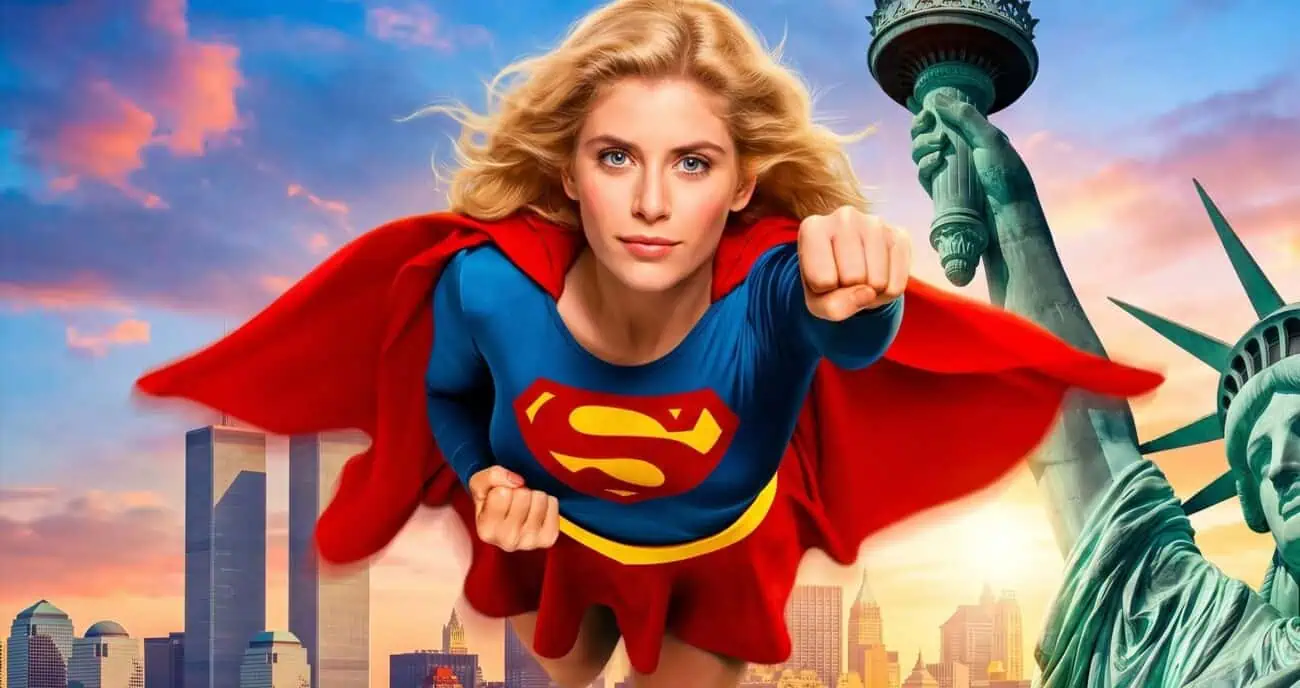
What happens when Hollywood takes a beloved comic book icon, surrounds her with two Oscar winners, one of the greatest living stage actors on the planet, and Mia Farrow, and still manages to crash the whole thing into a ditch? How does a movie with a $35 million budget (1984 money), a built-in fanbase, and the momentum of the Superman franchise open at number one at the box office… and still get classified as a bomb? And could the disaster that was Supergirl (1984) be the reason it took over forty years to get another Supergirl movie on the big screen?
This is the story of what happened to Supergirl.
The Superman Effect: Where It All Began
To understand Supergirl, you have to understand the world it came from.
After the success of Superman (1978), producers Alexander and Ilya Salkind became major power players in superhero cinema. Christopher Reeve had become Superman. John Williams’ score was iconic. The franchise was a cultural phenomenon.
The Salkinds also secured the rights to Supergirl early, planning ahead for expansion. Their original idea: introduce Supergirl in Superman III and spin her off into her own film. Then the Supergirl in Superman III story was scrapped and it was decided that her first appearance would be in her own spin-off.
But Superman III underperformed in 1983. Critics were harsh, audiences were lukewarm, and Warner Bros. began losing confidence in the franchise. Supergirl suddenly became a gamble meant to revive momentum.
The Missing Piece: Christopher Reeve Says No
Originally, Supergirl was designed to connect directly to the Superman universe. Christopher Reeve would appear as Superman, grounding the film in familiarity and credibility.
He declined. That decision changed everything. His absence is explained in the film via a brief line: Superman is on a “peace-seeking mission to a distant galaxy.”
Director Jeannot Szwarc later admitted that Reeve’s presence could have significantly improved the film’s credibility.
A Troubled Production and Changing Directors
The production struggled to secure a director.
- Richard Lester passed
- Robert Wise passed
- Eventually, Jeannot Szwarc (Jaws 2) took the job
He became the fallback option in a project already losing momentum.

The Cast: A Wild Mix of Legends and Newcomers
The casting of Supergirl is one of its most unusual strengths.
Supergirl Herself
Helen Slater, age 19, was cast after an extensive search that included Brooke Shields and Demi Moore. She had never led a major film and signed a multi-picture deal that never materialized. She trained for months before filming began.
The Villain Selena
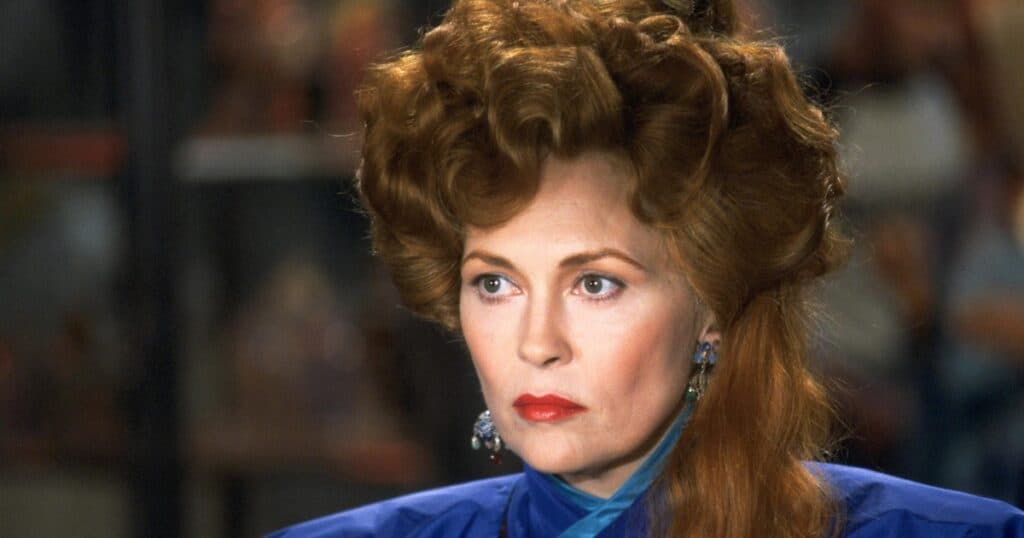
Dolly Parton was reportedly approached first for the role of Selena. She passed. The role went to Faye Dunaway instead, a two-time Oscar nominee, who delivered a performance that became one of the film’s most polarizing elements.
Supporting Cast
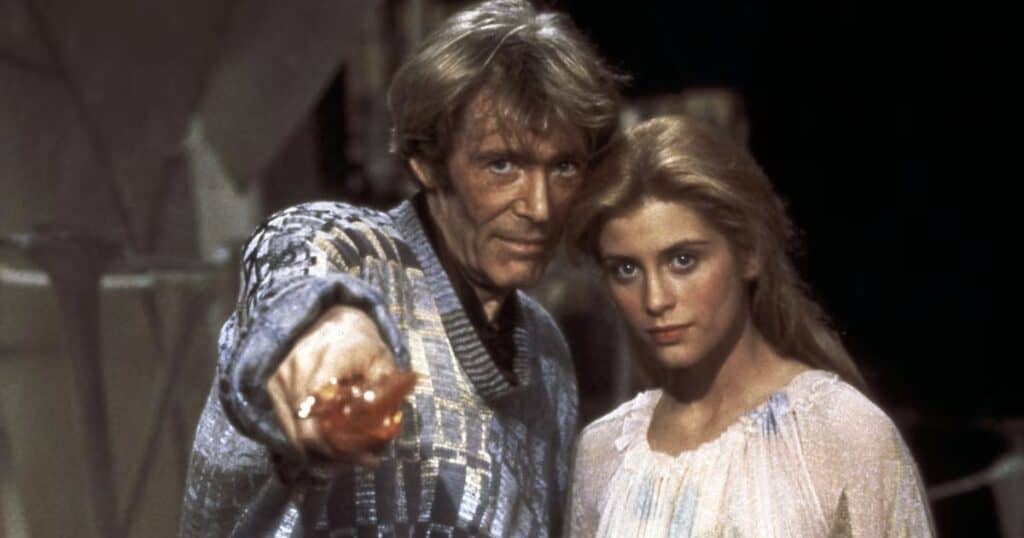
- Peter O’Toole as Zaltar
- Mia Farrow as Supergirl’s mother (brief appearance)
- Brenda Vaccaro as Bianca
- Peter Cook as Nigel
- Marc McClure returning as Jimmy Olsen
It is a surreal mix of prestige talent and comic-book absurdity.
Production and Studio Conflict
Filming took place at Pinewood Studios in the UK between April and August 1983. But behind the scenes, tensions were rising.
Warner Bros. and the Salkinds disagreed over release strategy. The Salkinds wanted a holiday release to avoid competition, including the 1984 Olympics season. Warner Bros. refused.
The result: Warner dropped U.S. distribution rights, and Tri-Star Pictures picked up the film.
- UK release: July 19, 1984
- US release: November 21, 1984
The Cut Problem: A Film That Changed Shape
Test screenings forced major cuts. The North American version was reduced from 135 minutes to 105 minutes. Deleted material included:
- Expanded Argo City scenes
- A longer villain introduction
- The “flying ballet” sequence
- Additional character moments and world-building
Multiple versions of the film would later circulate internationally.
What Works: Helen Slater and the Flight Sequences
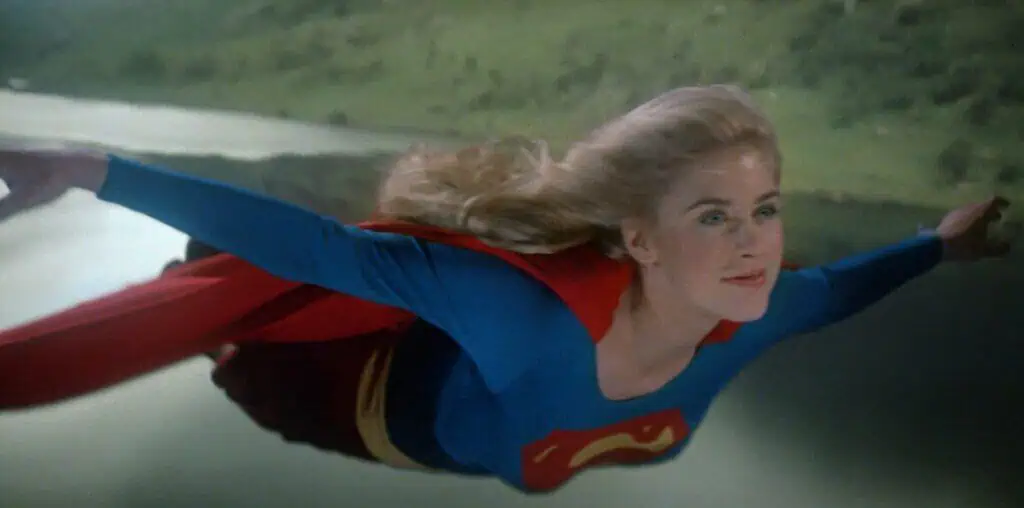
Helen Slater is widely considered the strongest element of the film. She brings sincerity, charm, and physicality to the role. Her flying scenes remain the film’s highlight: light, joyful, and visually expressive.
However, modern HD restorations reveal visible harness wires in some shots, a reminder of its practical effects era.
Faye Dunaway and the Selena Problem
Faye Dunaway’s Selena remains one of the film’s most debated performances. Critics have described the role as over-the-top, but also constrained by inconsistent writing.
Selena’s plan for world domination involves:
- A small-town takeover
- A party
- A love potion subplot
The narrative becomes increasingly disconnected from traditional superhero stakes.
Writing Issues and Tonal Inconsistency
The screenplay by David Odell (The Dark Crystal, Masters of the Universe) struggles with internal logic. Examples include:
- Inconsistent character intelligence
- Confused world-building rules
- The Phantom Zone behaving inconsistently
- The Omegahedron functioning as a flexible plot device
Despite this, the film contains moments of genuine charm and visual imagination.
Music and Visual Style: The Film’s Hidden Strength
Jerry Goldsmith’s score is widely praised and often considered the film’s strongest technical achievement.
Cinematographer Alan Hume (Return of the Jedi, James Bond films) contributes strong visual work.
The flying sequences, in particular, are frequently cited as emotionally effective despite technical limitations.
Box Office Failure
Supergirl opened at number one in the United States, but quickly collapsed.
- Budget: $35 million
- Domestic gross: $14.3 million
Critical reception was mixed to negative:
- The New York Times noted early curiosity fading quickly
- Variety called it “intermittently enjoyable spectacle”
The film was widely considered a financial disappointment.
Legacy: Multiple Cuts and Cult Status
Supergirl exists in several versions:
- 105-minute US theatrical cut
- 124-minute international cut
- 92-minute TV version
- 138-minute director’s cut
The director’s cut was rediscovered and released on DVD in 2000, becoming the most complete version available. A 2018 Blu-ray release included a restored international cut, but the director’s cut remains in lower quality SD format due to surviving source limitations.
Cultural Afterlife
Over time, Supergirl developed a cult following. It is frequently revisited in discussions of:
- Camp superhero cinema
- Studio mismanagement
- 1980s fantasy filmmaking
Helen Slater’s performance, in particular, has aged more positively than the film itself.
The Franchise That Didn’t End
Despite its failure, Supergirl never disappeared. Helen Slater later returned to the Superman universe:
- Smallville as Lara
- Supergirl (2015–2021) as Eliza Danvers
The character endured across decades of reinterpretation.
Conclusion: A Flawed First Flight
Supergirl (1984) was ambitious, expensive, and structurally unstable. It suffered from:
- Franchise instability
- Missing key cast members
- Studio conflict
- Tonal inconsistency
- Extensive re-editing
But it also holds a unique place in superhero history. It was the first theatrical female-led superhero film.
And even in its failure, it proved the character had staying power. Supergirl didn’t just survive the film, she outlived it.
FAQ: Supergirl (1984) Explained
What is Supergirl (1984) about?
Supergirl (1984) follows Kara Zor-El, Superman’s cousin, as she leaves her hidden Kryptonian world and comes to Earth. She must recover a powerful artifact called the Omegahedron while facing a human witch named Selena, who plans to use it for world domination.
Is Supergirl (1984) connected to the Superman films?
Yes. It exists in the same continuity as the Christopher Reeve Superman films, although Superman himself does not appear in the movie. His absence is explained as him being away on a mission.
Why did Christopher Reeve not appear in Supergirl?
Christopher Reeve declined to appear, which forced the filmmakers to rewrite the story. Originally, the film was meant to feature Superman as a mentor figure to Supergirl.
Who plays Supergirl in the 1984 film?
Supergirl is played by Helen Slater in her first major film role. She was cast at age 19 after an extensive audition process and physical training period.
Why did Supergirl (1984) fail at the box office?
The film struggled due to:
- Negative and mixed reviews
- Weak marketing and unclear tone
- A confusing script and uneven pacing
- Competition in a crowded 1984 release schedule
- Lack of Superman’s on-screen presence
It earned significantly less than its production budget.
Who plays the villain in Supergirl (1984)?
The villain Selena is played by Faye Dunaway. Her performance has become one of the film’s most discussed and divisive elements.
Was Supergirl (1984) critically successful?
Not overall. Critics were mixed to negative, although Helen Slater’s performance and Jerry Goldsmith’s musical score were widely praised.
How many versions of Supergirl (1984) exist?
There are several cuts of the film:
- US theatrical cut (105 minutes)
- International cut (124 minutes)
- TV broadcast version (92 minutes)
- Director’s cut (138 minutes)
Each version contains different scenes and edits.
Is Supergirl (1984) considered canon in the Superman universe?
Yes, it is generally treated as part of the Christopher Reeve Superman continuity, though its connection is loose and inconsistently referenced.
Has Supergirl (1984) become a cult film?
Yes. Over time, it developed a cult following due to its cast, production history, and reputation as an ambitious but flawed superhero film.
















The comment section exists to allow readers to discuss the article constructively and respectfully, focused on the topic at hand.
What’s Not Allowed