
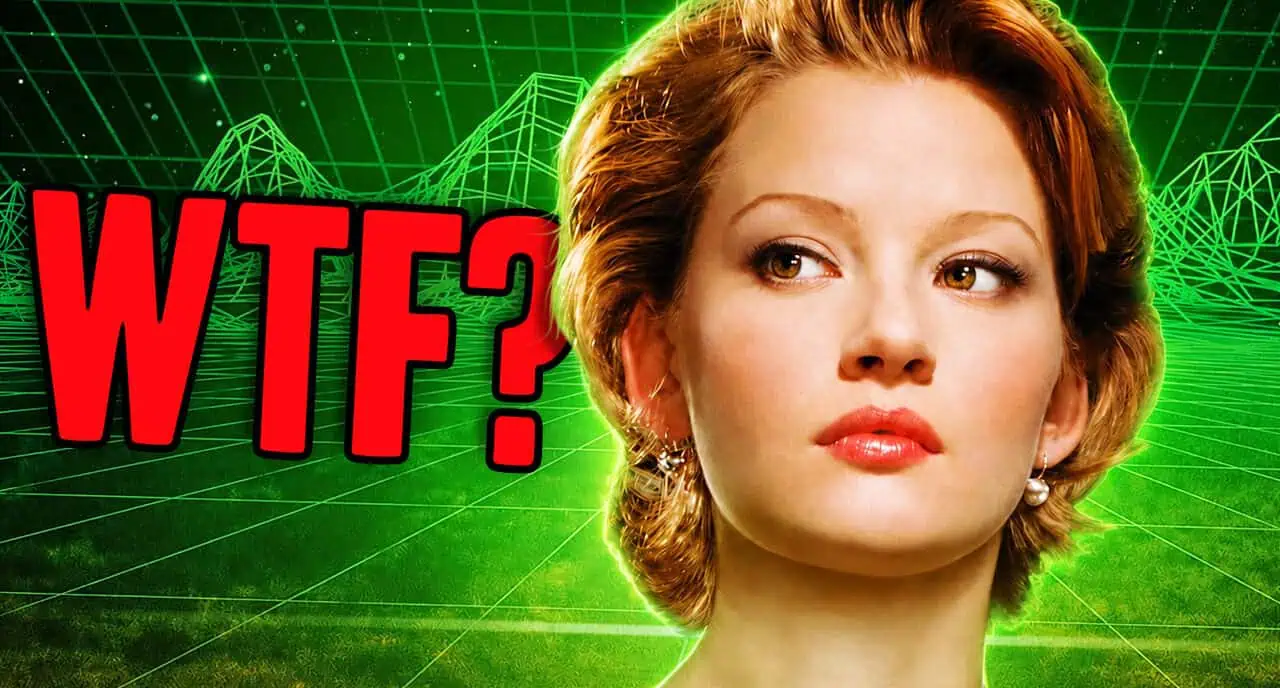

Did you know a novel published back in 1964 predicted concepts like virtual reality, artificial intelligence, and even the Simulation Hypothesis decades before those ideas entered mainstream culture? If you’re not much of a reader, that same novel was eventually adapted into both a television miniseries and a feature film. But what happens when you spend years making a slow-burning noir sci-fi mystery whose biggest twist is that we’re all living inside a simulation… only for The Matrix to arrive two months before your movie and completely redefine the genre?
Ouch. That’s got to hurt.
But here’s an even stranger question: what happens when the people running our simulation are unknowingly living inside another simulation themselves? No, we haven’t taken too many gummies. Thanks for checking. This is what happened to The Thirteenth Floor.
The Novel That Predicted the Future
The story actually begins decades earlier with Daniel F. Galouye’s 1964 novel Simulacron-3. The book follows scientists who create a virtual city for marketing research. Unlike traditional video game NPCs, however, the inhabitants possess genuine consciousness. They believe they’re real people living real lives, completely unaware they’re part of an elaborate computer simulation.
Wrapped around this concept is a murder mystery involving the death of the project’s lead scientist and the disappearance of another researcher. But while the mystery drives the plot, it’s the technological ideas that make Simulacron-3 feel astonishingly ahead of its time.
Galouye imagined virtual reality, digitally replicated human consciousness, simulated civilizations, and questions about artificial intelligence years before any of those concepts remotely existed. Forget AI, this was before America Online, cell phones, and beepers. That’s like staring at a toaster oven and somehow inventing the iPhone in your head. It’s more than a little unsettling.
The novel centers on scientist Douglas Hall, who investigates the mysterious death of his superior before uncovering impossible contradictions in his own reality. As Hall digs deeper, he begins to question whether he himself is actually real or merely another simulated consciousness living inside someone else’s experiment.
By the end, readers solve the murder while also confronting a far more disturbing possibility: what if our reality, our memories, and even our free will have all been manufactured by someone else?
From World on a Wire to The Thirteenth Floor
The novel first reached the screen in 1973 as the acclaimed German television miniseries World on a Wire. One of its biggest admirers happened to be Roland Emmerich. More than twenty-five years later, Emmerich would produce a new adaptation alongside director Josef Rusnak.
Interestingly, Rusnak’s own filmmaking career could almost be traced directly back to Emmerich. Originally interested in documentary filmmaking, Rusnak eventually attended film school after a girl he met encouraged him to pursue narrative filmmaking. As Rusnak jokingly put it: “It’s always a girl.” Fair enough.
He eventually worked as a gaffer on one of Emmerich’s student films, and the two became friends while attending the University of Television and Film in Munich. That friendship paid off years later. Not only would Rusnak direct The Thirteenth Floor, but he’d also serve as second-unit director on Emmerich’s 1998 Godzilla. Long before giant iguanas were running around Manhattan, however, Rusnak had already established himself in Germany. His first feature, Cold Fever, earned him the German Film Award for Best Director, proving he was much more than simply “Roland Emmerich’s friend.”
Turning Simulacron-3 into a Neo-Noir Thriller
After several attempts to collaborate again fell through, the explosion of virtual reality stories during the 1990s convinced Emmerich and Rusnak that the time was finally right to revisit Simulacron-3. Rusnak admired World on a Wire, but felt it functioned more as a faithful page-by-page adaptation than a film with its own identity. This version would be different.
Working from an early screenplay by Ravel Centeno-Rodriguez, Rusnak and Emmerich spent nearly eighteen months stripping the novel down to its essential ideas. Their goal wasn’t to adapt every philosophical discussion from the book. Instead, they wanted to transform its dense science-fiction concepts into an accessible noir mystery wrapped around murder, identity, and simulated reality.
The result was The Thirteenth Floor. Unfortunately, audiences weren’t quite ready for it.
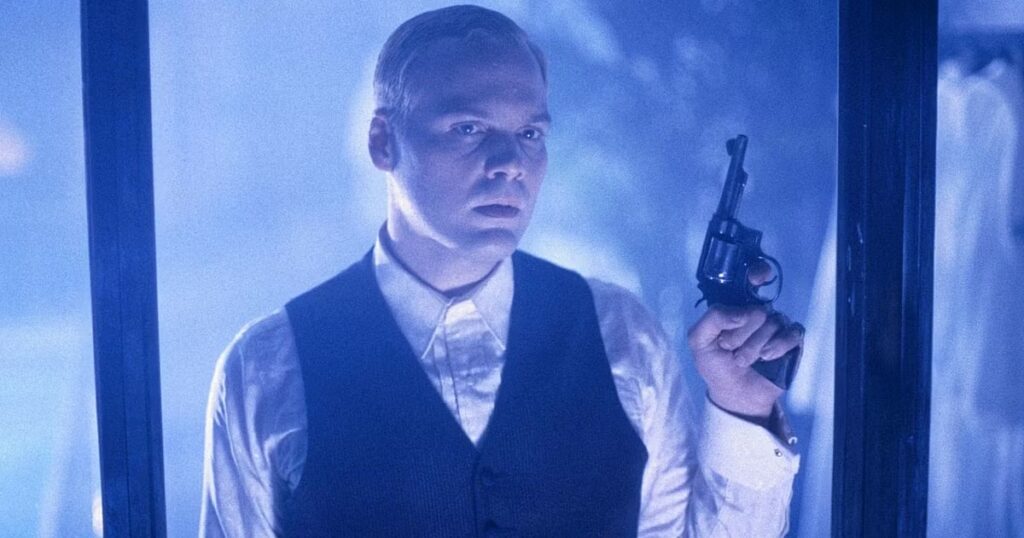
The Thirteenth Floor wastes little time establishing its mystery. The film opens in 1937 Los Angeles, where wealthy scientist Hannon Fuller wakes up beside a young prostitute before writing a cryptic letter to a friend. He leaves the note with the bartender at his hotel, returns home to his wife… and then suddenly wakes up in 1999 Los Angeles.
Confused but composed, Fuller heads to a dimly lit bar where, after a brief encounter with a mysterious stranger, he’s stabbed to death. The following morning, we meet Douglas Hall, Fuller’s protégé and closest colleague. Hall wakes up equally confused, this time covered in blood with no memory of the previous night. Things only get worse when police inform him that Fuller has been murdered.
Considering Hall inherits control of the company if anything happens to Fuller, Detective Larry McBain naturally views him as Suspect Number One. Not a great way to start your morning.
Enter the Femme Fatale
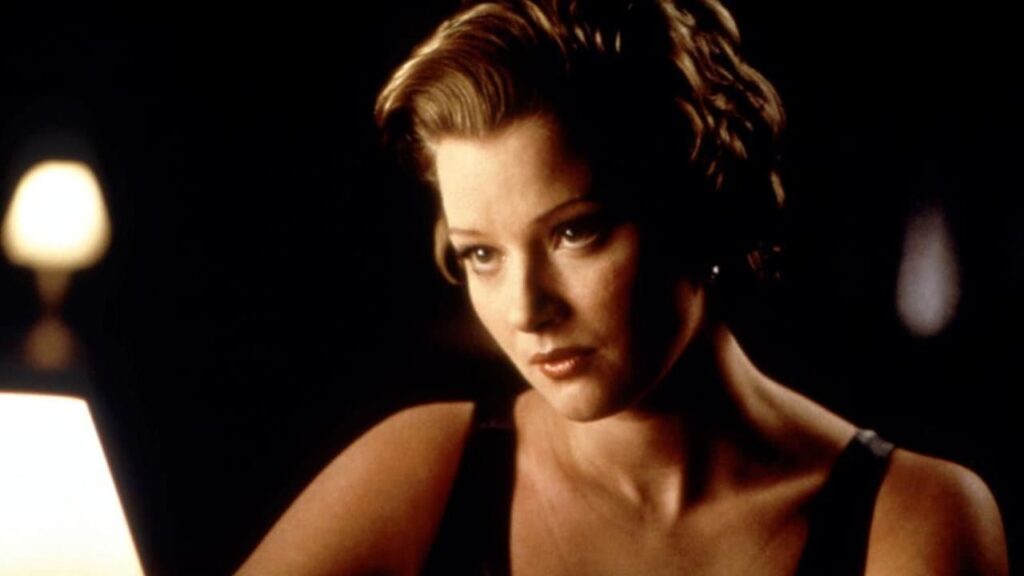
While Detective McBain questions Hall inside what might be the most aggressively ’90s luxury apartment imaginable, Hall notices an unfamiliar woman calmly sitting in his home. She’s Jane Fuller. According to her, she’s Hannon’s daughter. There’s just one problem: Hall had never even heard she existed.
At this point, The Thirteenth Floor is leaning hard into its noir influences. We’ve already checked off mysterious murders, smoky bars, glamorous strangers, and a beautiful woman connected to the victim. It’s basically daring someone to pour themselves a martini.
Hall returns to the company headquarters, where he meets fellow researcher Jason Whitney. Jason fills in both Hall and the audience on the technology they’ve been developing. And this is where things get wonderfully weird.
A Simulation Inside Reality
The company hasn’t simply built an advanced computer program, they’ve created an entire living civilization. Thousands of conscious individuals exist inside a perfectly simulated version of 1937 Los Angeles. Even more remarkably, researchers can temporarily project their own consciousness into simulated counterparts and physically experience that world through another person’s body.
Desperate for answers surrounding Fuller’s death, Hall decides to enter the simulation himself with roughly the same level of caution Willem Dafoe’s Green Goblin uses before trying experimental performance enhancers.
Inside 1937, Hall begins investigating Fuller’s final movements. He quickly discovers his late mentor wasn’t exactly spending his evenings reading philosophy books. Fuller had been using the simulation to indulge in nightlife, frequenting hotels and prostitutes while carrying on an entirely separate existence.
Unfortunately, Hall also makes a critical mistake. He accidentally reveals information that convinces hotel bartender Ashton that something about his world isn’t quite right. That little slip-up will have enormous consequences.
When the Simulation Learns the Truth
Back in 1999, Hall’s problems continue piling up. The mysterious man who tried to blackmail him conveniently winds up dead. Naturally, Hall becomes the prime suspect once again. Jane eventually bails him out, encouraging him to stop running from the mystery and actually solve it.
So Hall returns to 1937. This time Ashton finally reveals the significance of the letter Fuller left behind. Curious, Ashton followed Fuller’s instructions. He drove farther than he ever normally would. He ignored road signs. He kept going. Eventually, the world simply stopped. Ashton discovered the edge of his reality.
In that moment he realized everything he’d ever known, his memories, his city, every person he’d ever met, was artificial. Needless to say, he doesn’t take the revelation particularly well.
Vincent D’Onofrio absolutely sells this sequence. Ashton doesn’t become a mustache-twirling villain. He becomes someone whose entire existence has shattered in an instant. It’s one of the movie’s most unsettling scenes because his reaction feels understandable. If you learned tomorrow that every person you’ve ever loved was simply code, how exactly are you supposed to process that?
The Twist Gets Even Bigger
And somehow, that’s only the halfway point. As Hall continues investigating, reality itself begins malfunctioning. Objects briefly disappear. People behave strangely. Moments of déjà vu become increasingly common. It’s impossible not to think of The Matrix here, particularly whenever reality starts showing cracks beneath the surface.
Eventually Hall decides to repeat Ashton’s experiment. He drives beyond the limits of the world. Out in the middle of nowhere, the illusion finally collapses. Instead of roads and mountains, Hall finds an endless digital grid stretching into infinity, the unfinished architecture supporting his entire universe. It’s easily the film’s most memorable visual. Even today, the simplicity of the effect makes it strangely haunting. No giant CGI spectacle, no exploding cities, just an empty geometric void revealing that reality literally ends a few miles outside town.
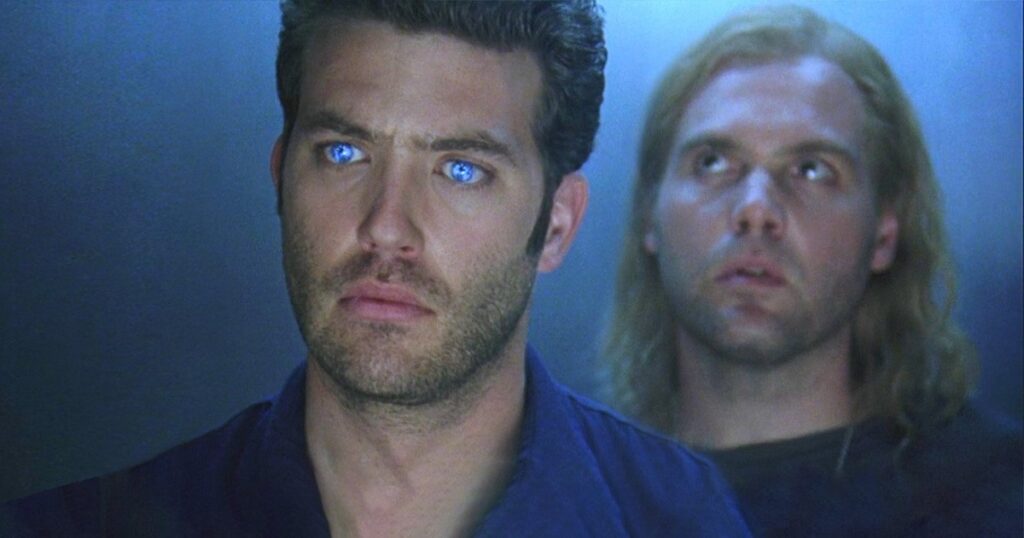
Meanwhile, things become even more chaotic. Ashton discovers a way to project himself into Hall’s reality by inhabiting Jason’s body. Now the unstable bartender has access to the real world. Or what everyone believes is the real world. Because The Thirteenth Floor still has one final reveal waiting.
Hall eventually discovers he isn’t living in reality at all. His 1999 Los Angeles is itself another simulation. The genuine world exists decades later, in the year 2024. Even more disturbing, Hall’s real-world counterpart turns out to be a thoroughly unpleasant human being who has been using simulated realities for his own amusement while treating Jane terribly. It’s a wonderfully cruel twist. The hero isn’t actually the hero. He’s merely a digital copy of someone significantly worse.
For a movie built almost entirely around philosophical ideas, The Thirteenth Floor does an admirable job of keeping its increasingly bizarre premise surprisingly accessible. Not every story beat lands. We’ll get to that. But the movie never completely loses the audience, even as it starts stacking simulations inside simulations.
Cast and Performances
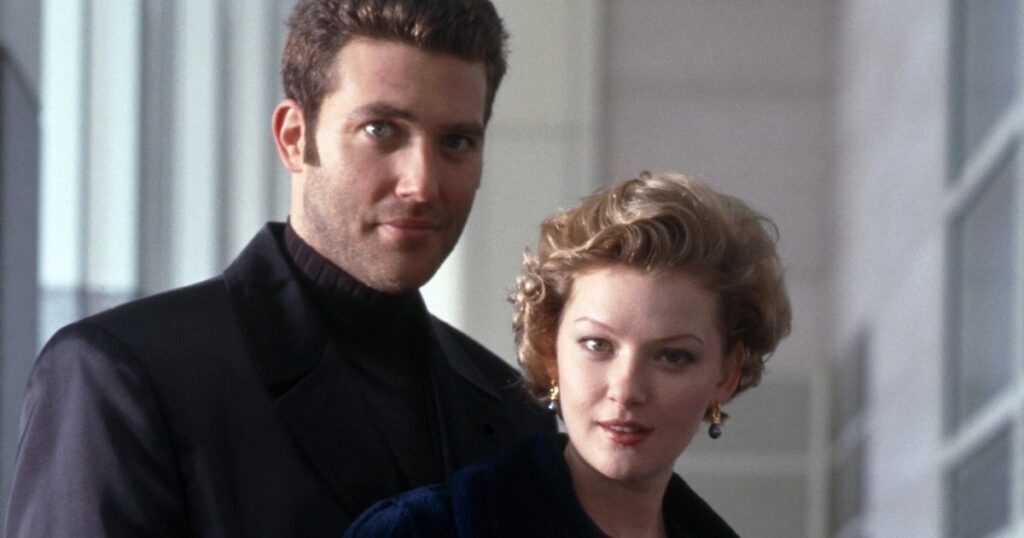
Douglas Hall is played by Craig Bierko, an actor many viewers probably recognize from later films like Cinderella Man or The Long Kiss Goodnight. Bierko gives a solid performance, although there’s something inherently suspicious about him. Maybe it’s just the face. He looks less like someone you’d trust with your future and more like someone with a complicated plan involving your wallet and your significant other. No offense, Craig.
Armin Mueller-Stahl plays Hannon Fuller, the scientist whose murder launches the story. Mueller-Stahl came into the production fresh off an Academy Award nomination for Shine, and his previous collaborations with Josef Rusnak made him a natural fit.
Jane Fuller is played by Gretchen Mol, who brings warmth to a role that could easily have been reduced to standard noir archetypes. She’s ultimately much more than a traditional femme fatale and becomes central to Hall’s journey through the film.
Detective Larry McBain, meanwhile, is portrayed by Dennis Haysbert. Whether you know him as Pedro Cerrano from Major League, President David Palmer from 24, or simply the man with one of Hollywood’s greatest voices, Haysbert brings immediate authority to every scene.
The real standout, however, is Vincent D’Onofrio. His performance as Ashton, and later as Jason under Ashton’s control, is easily the movie’s most fascinating. D’Onofrio somehow manages to make both versions of the character feel completely distinct while maintaining just enough overlap that you recognize they’re connected. Every scene with him carries an underlying sense of unease. You never quite know what he’s thinking. You just know you probably shouldn’t be alone in a room with him.
Visual Style and Production Design
One of The Thirteenth Floor‘s greatest strengths is its visual restraint. Unlike many late-’90s science fiction films, it never feels compelled to overwhelm viewers with flashy special effects or futuristic gadgetry. There are no fleets of flying cars, sprawling digital metropolises, or endless CGI showcases. Instead, the movie focuses on atmosphere.
The 1937 sequences are bathed in warm amber tones that evoke classic Hollywood noir. Every hotel lobby, cocktail lounge, and dimly lit street corner feels inviting, nostalgic, and just a little dangerous. The 1999 world couldn’t be more different. It’s all cool blues, polished metal, expensive apartments, and corporate offices. Ironically, the “real” world looks far more artificial than the simulated one. That’s a clever visual choice that subtly reinforces the film’s central question: if a world feels real, does it matter whether it actually is?
When the movie finally unveils the edge of reality, the effects remain surprisingly understated. Hall’s drive into the endless digital grid isn’t an explosive visual spectacle. It’s quiet, eerie, and oddly beautiful. More than twenty-five years later, it still works. Sometimes showing less is the better choice.
A Future That Doesn’t Feel Dated
The production design deserves a tremendous amount of credit. Because the filmmakers resisted the temptation to fill every frame with “future” technology, The Thirteenth Floor has aged remarkably well. Virtual reality is represented through subtle green laser lights and distorted visual effects instead of oversized helmets and cartoonish computer graphics. The futuristic settings consist mostly of stylish apartments, sleek office buildings, upscale bars, and modern architecture.
It’s a future grounded in believable design rather than spectacle. That decision pays off. Aside from a few recognizable buildings during the film’s final moments, very little feels trapped in 1999’s vision of tomorrow.
Most of the movie was filmed on location around Los Angeles, using existing architecture dressed with careful lighting and production design to suggest a near-future world. It’s a practical approach that often proves more convincing than expensive visual effects.
There’s even a fun bit of trivia attached to one of the film’s locations. Roger Ebert once highlighted a reader’s observation that the swimming pool featured in The Thirteenth Floor was the very same one seen in Cruel Intentions. Sony later confirmed it. It’s a small detail, but it illustrates just how effectively the filmmakers transformed familiar locations into something that felt futuristic.
Music That Matches the Mood
The score was composed by Harald Kloser, one of Roland Emmerich’s frequent collaborators. Although Kloser would later become associated with large-scale disaster movies like The Day After Tomorrow and 2012, The Thirteenth Floor gave him the opportunity to tackle something much more intimate. Rather than emphasizing action, the score leans into mystery and melancholy. There are stretches that carry a distinctly noir flavor, while others evoke the kind of emotional suspense horror fans might associate with Marco Beltrami’s early work on Scream. It’s an understated soundtrack that perfectly complements the movie’s measured pacing.
A Surprisingly Grounded Vision of the Future
By the time the film finally reaches the actual year 2024, the restraint continues. Instead of revealing some sprawling science-fiction metropolis, we’re shown a peaceful shoreline accented by a handful of futuristic buildings. That’s it. Even the “real” future isn’t obsessed with showing off. It’s another reminder that The Thirteenth Floor has never really been about technology. It’s about people.
In many ways, the film resembles Gattaca far more than The Matrix. Both movies use futuristic settings simply as vehicles to explore deeply human questions about identity, destiny, and free will. Sometimes that approach works beautifully. Other times… well…
Where The Thirteenth Floor Stumbles
As much as there is to admire here, The Thirteenth Floor can also become painfully slow. This is a film about simulated realities, artificial consciousness, digital civilizations, murder mysteries, and existential dread. On paper, that’s an incredible collection of ideas. In execution, however, there are stretches where surprisingly little actually happens. Sometimes it’s enjoyable to simply settle into the film’s atmosphere and soak in its noir aesthetic. Other times, you start feeling like Billy Madison desperately yelling at a third grader. “Today, Junior!”
The pacing can be glacial. Still, one thing the movie deserves credit for is its balance. It successfully blends science fiction, crime, horror, and noir without ever fully abandoning any one genre. It never devolves into an action movie, never becomes outright horror, and never forgets that the murder mystery is supposed to anchor everything else.
That restraint may frustrate viewers expecting nonstop twists, but it’s also part of what gives the film its unique identity.
Released at the Worst Possible Moment
Unfortunately, none of those strengths mattered once The Thirteenth Floor reached theaters. Its release timing couldn’t have been worse if someone had deliberately engineered it. The film opened in May 1999, just after Star Wars: Episode I – The Phantom Menace had become the biggest entertainment story on the planet. That alone would have been a difficult obstacle. But an even larger problem had arrived only weeks earlier. The Matrix.
Imagine spending years crafting a thoughtful, adult science-fiction mystery built around one enormous revelation: Reality isn’t real. Then another movie comes along first. It tells audiences reality isn’t real. It stars Keanu Reeves. It features groundbreaking visual effects. Bullet time. Insane martial arts choreography. Exploding helicopters. A leather trench coat that launched a thousand Halloween costumes. And it instantly becomes one of the most influential science-fiction films ever made.
Suddenly your own movie, one that explores remarkably similar philosophical territory, looks like yesterday’s news before audiences even buy a ticket.
It’s an impossible comparison. The Matrix made simulation theory feel cool. The Thirteenth Floor makes it feel lonely. One is an adrenaline rush. The other is a melancholy noir mystery. Neither approach is wrong. But in 1999, audiences had already chosen which version they wanted.
The Box Office Collapse
The result was brutal. The Thirteenth Floor opened nationwide in May 1999 and finished its domestic run with less than $12 million. Worldwide, it earned under $20 million against a production budget of roughly $16 million. While the modest budget prevented it from becoming an outright financial disaster, it was still a major disappointment.
The movie simply disappeared beneath the enormous shadow cast by The Matrix. It never really had a chance. Its biggest selling point had already become someone else’s cultural phenomenon.
Critical Reception
Critics weren’t especially kind to The Thirteenth Floor, either. Today, the film holds a 29% critics’ score on Rotten Tomatoes, reflecting the mixed-to-negative reviews it received upon release. Many reviewers appreciated the premise but felt the execution never fully lived up to it. Common criticisms centered on the film’s deliberate pacing, heavy exposition, and a third act that several critics believed became overly sentimental because of the romance between Douglas Hall and Jane Fuller. Others argued that the movie struggled to balance its philosophical ambitions with its noir framework. It was undeniably stylish, they said, but also emotionally distant and slower than its premise suggested.
Lawrence Van Gelder of The New York Times described the film as overplotted and ultimately illogical. Variety similarly criticized its reliance on exposition and felt the storytelling lacked urgency. Jonathan Rosenbaum of the Chicago Reader viewed it as another entry in the late-’90s wave of reality-bending science fiction that never quite realized the potential of its fascinating ideas.
Then there was CinemaScore. Opening-night audiences awarded The Thirteenth Floor a D+. For a grading system that’s generally known for being generous, that’s a rough score. It’s basically the cinematic equivalent of everyone in the office reacting to Paul Rudd’s Sex Panther cologne in Anchorman. Sixty percent of the time, it absolutely does not work every time.
The Film Found Its Audience Later
Thankfully, that wasn’t the end of the story. Like many overlooked science-fiction films, The Thirteenth Floor gradually found an audience through home video, DVD, cable television, and eventually streaming.
Today, the movie enjoys a far warmer reputation than it did in 1999. Its audience score on Rotten Tomatoes sits at 64%, while IMDb users have consistently rated it around a respectable 7.0 out of 10. That’s a significant turnaround. It suggests viewers have become much more receptive to the film once it was no longer being compared directly to The Matrix.
Time can be surprisingly kind to movies that arrive too early, or simply arrive at the wrong moment.
Why the Movie Was Misunderstood
I also think the marketing worked against the film. Just look at the title. The Thirteenth Floor. That sounds like a haunted hotel movie. You hear that name and immediately picture ghosts, cursed elevators, abandoned corridors, maybe somebody wandering around with a candle while creepy children sing nursery rhymes. Instead, you get a philosophical science-fiction noir centered around simulated consciousness. Those are very different movies.
Granted, there are genuine horror elements here. The opening murder is brutal. Vincent D’Onofrio gives one of the film’s creepiest performances. The idea that your entire existence could simply be corporate software is existentially horrifying. And the movie’s atmosphere often feels closer to psychological horror than traditional science fiction.
But despite all of that, this isn’t a horror movie. It’s a slow-burning mystery that uses horror as seasoning rather than the main course. If you walked into the theater expecting supernatural scares, you were probably confused.
Timing Was Everything
Even so, the title wasn’t the biggest obstacle. Timing was. It’s difficult to overstate just how crowded 1999 was for ambitious science fiction. The Matrix didn’t simply introduce audiences to simulation theory, it completely owned the conversation. Its imagery, action scenes, philosophy, special effects, and visual style immediately entered popular culture. People weren’t just watching it. They were quoting it. Debating it. Going back to see it again.
Meanwhile, The Thirteenth Floor quietly arrived with martinis, murder mysteries, hotel rooms, and existential dread. Its roots stretched all the way back to Simulacron-3, a novel published decades before cyberpunk became fashionable. Its heart was older. Its pacing was slower. Its thrills were psychological instead of physical. It wasn’t trying to compete with The Matrix. History simply forced the comparison anyway. That’s an incredibly difficult position for any movie to survive.
Why The Thirteenth Floor Feels More Relevant Today
Ironically, the very ideas that may have seemed abstract in 1999 feel remarkably current today. Artificial intelligence has become part of everyday conversation. Virtual reality technology actually exists. Researchers openly discuss digital consciousness, machine learning, and increasingly sophisticated simulations. Even the Simulation Hypothesis has become a genuine philosophical topic, thanks in part to figures like Nick Bostrom and the broader public interest surrounding AI.
Viewed through that lens, The Thirteenth Floor almost feels ahead of its time. More impressive still is the fact that these ideas originated with Daniel F. Galouye in the 1960s. Long before the internet, smartphones, AI assistants, and before anyone had coined phrases like “the metaverse.” That’s extraordinary. And it’s one of the biggest reasons the movie has aged so gracefully.
While some of the technology shown onscreen reflects its era, the central questions remain timeless. If a conscious mind can’t distinguish reality from simulation, does the difference actually matter?
That’s a question audiences are arguably more prepared to wrestle with today than they were a quarter-century ago.
Final Thoughts
In another year, The Thirteenth Floor might have been remembered as a stylish, intelligent, mid-budget science-fiction noir that successfully blended mystery, philosophy, and psychological suspense. Instead, it found itself released directly into the gravitational pull of one of the most influential science-fiction films ever made. That’s unfortunate. Because while The Matrix redefined the genre through spectacle and action, The Thirteenth Floor explored many of the same ideas through mood, character, and classic noir storytelling. It’s slower. It’s more introspective. And yes, there are stretches where it asks for more patience than some viewers will want to give. But it also offers a unique atmosphere that few science-fiction films have successfully replicated.
More than twenty-five years later, it’s no longer just “that other simulation movie.” It’s become a fascinating companion piece to The Matrix, one that asks many of the same questions while arriving at them from an entirely different direction.
And that’s what happened to The Thirteenth Floor. It was overshadowed by one of the greatest science-fiction movies ever made, but it refused to imitate it. Instead, it carved out its own corner of the genre, one built on mystery, melancholy, and the unsettling possibility that someone, somewhere, may be asking these very same questions about us.
A couple of previous episodes of this show can be seen below. For more, check out the JoBlo Horror Originals YouTube channel—and don’t forget to subscribe!












The comment section exists to allow readers to discuss the article constructively and respectfully, focused on the topic at hand.
What’s Not Allowed