


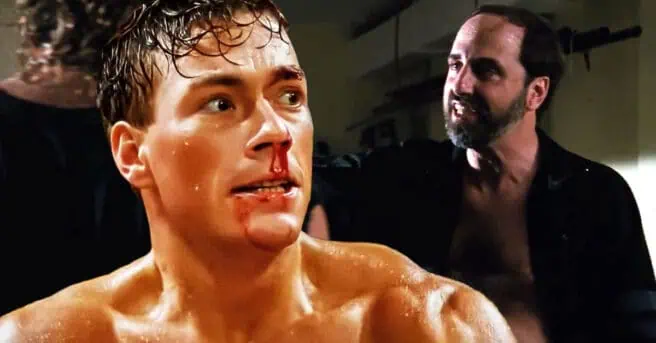
It delivered just as many roundhouse kicks, broken-glass punches, and gloriously excessive 80s action moments as the movies people endlessly praise today. So why doesn’t Jean-Claude Van Damme’s 1989 martial arts classic Kickboxer get the same respect? Was it simply overshadowed by Bloodsport arriving a year earlier? Or did this darker, meaner follow-up unfairly end up living in its predecessor’s shadow?
Either way, Kickboxer rules. It’s the movie that had audiences chanting “Nuk Su Kow!” from their couches. The one that allegedly pushed Van Damme to the edge during production. The one with two credited directors despite one insisting there should’ve only been one. And it may genuinely be one of the most underrated films in Van Damme’s entire career.
Van Damme Before Stardom
In 1987, Jean-Claude Van Damme wasn’t “The Muscles from Brussels.” He was an unknown martial artist sleeping in his car after arriving in Hollywood with $3,000 and a dream. His early résumé included:
- an uncredited soldier in Missing in Action
- an uncredited spectator in Breakin’
- getting fired as a stuntman from Predator
- and playing “Gay Karate Man” in Monaco Forever — which, to be fair, is apparently the actual credited character name.
The first role that truly got him noticed was Ivan the Russian in No Retreat, No Surrender. He barely spoke, but audiences remembered the spinning kicks, strange intensity, and screen presence immediately. That role led directly to Bloodsport.
Van Damme became obsessed with getting the attention of Cannon Films, the studio behind movies like American Ninja and Cobra. After repeatedly being ignored, he finally spotted Cannon co-founder Menahem Golan outside a building and made his pitch in person. Rejected again.
So Van Damme responded the only way a movie version of Jean-Claude Van Damme possibly could: by launching a roundhouse kick inches from Golan’s face. According to Van Damme, the stunt shocked everyone surrounding the producer and finally earned him a business card.
Soon afterward, he landed Bloodsport. Critics trashed the movie, but audiences loved it. The film became a massive hit, reportedly earning around $50 million on a tiny budget and turning Van Damme into an overnight action star.
Without Bloodsport, there is no Kickboxer.

Building Kickboxer
Instead of making a direct Bloodsport sequel, producer Mark DiSalle developed a similar story structure with a more emotional core. Van Damme helped craft the story alongside writer Glenn A. Bruce.
Van Damme reportedly told DiSalle he had always wanted a brother, inspiring the creation of Kurt and Eric Sloane. Eric, played by real kickboxing champion Dennis Alexio, is the arrogant world champion. Van Damme plays Kurt, the younger brother constantly standing in his corner.
The brothers travel to Thailand so Eric can prove himself in the birthplace of kickboxing. Instead, they run into Tong Po. The movie introduces him by having him casually kick a concrete pillar like it’s made of cardboard. Kurt immediately realizes they’ve wandered way too far into the narrow corridor.
Tong Po brutally paralyzes Eric during the fight, even kicking away the towel Kurt throws into the ring to stop the beating. Immediately afterward, the injured brothers are dumped into the street like garbage. Kurt vows revenge and begins the classic martial arts hero’s journey through Thailand.
Helping him navigate that journey is Winston Taylor, a retired Special Forces soldier and full-time party animal played by Haskell V. Anderson III. After being treated like absolute trash by nearly every Muay Thai gym in Thailand, Kurt finally finds legendary master Xian Chow, played beautifully by Dennis Chan. The training sequences that follow are pure martial arts movie heaven.
The Beautiful Insanity of the Training Sequences
Kickboxer understands that suffering builds character. Kurt undergoes brutal shin conditioning, impossible physical tests, and one unforgettable sequence involving raw meat tied to his pants while a dog chases him through Thailand. Van Damme later claimed that scene came from his real training experiences as a teenager, when someone tied meat to his arms and unleashed a German Shepherd after him. Thankfully, the dog in real life was apparently better trained than the one on set, which allegedly spent production wandering around with a permanent erection; a detail none of us needed, but now we all have to live with.
And then there’s the dancing scene. No martial arts movie, Bloodsport included, contains anything as weirdly lovable as Kurt getting drunk and dancing through Thailand to Beau Williams’ “Feeling So Good Today” while wearing what can only be described as the blouse of destiny. It’s insane. It’s perfect. And somehow it makes Xian even more lovable for orchestrating the whole thing.
Why Kickboxer Feels Different From Bloodsport
Structurally, the movies are similar. Tonally, they couldn’t feel more different. Kickboxer has a nastier streak running through it. Tong Po doesn’t simply beat Eric, he destroys him. The movie keeps raising the emotional stakes until the final fight becomes downright vicious.
Kurt learns his wheelchair-bound brother has been kidnapped and will be killed unless he intentionally loses the fight. Worse, Tong Po assaults Mylee and taunts Kurt about it before the match. Then the movie somehow gets even more brutal by introducing the infamous broken-glass hand wraps. Apparently somebody involved in production looked at Bloodsport and thought, “Not enough attempted murder.”
Once Kurt learns Eric has been rescued, the movie explodes into one of the most satisfying revenge payoffs in 80s action cinema. “Nuk Su Kow!”

Chaos Behind the Scenes
The production itself was nearly as intense as the movie. Producer Mark DiSalle viewed Kickboxer as his baby and decided he wanted directing credit alongside cinematographer-turned-director David Worth. Worth later claimed DiSalle barely directed the film and only informed him about the shared credit during production.
Meanwhile, Van Damme was already functioning as actor, choreographer, producer, and unofficial casting director. When the original actor playing Tong Po dropped out, Van Damme recruited his close friend Michel Qissi for the role. The problem? Production insisted Tong Po needed to be Asian. So Van Damme and Qissi got creative. Using makeup connections tied to Stan Winston’s team from the disastrous Predator experience, they transformed Qissi into Tong Po and flew him back to Thailand in full makeup without telling production it was him.
Legend says DiSalle met the disguised Qissi on the tarmac and immediately agreed they’d found the perfect Tong Po without realizing it was Van Damme’s friend. Qissi would go on to become one of the most memorable martial arts villains of the entire decade. And he almost changed the movie completely.
According to Qissi, an early draft had Tong Po killing the Sloane brothers’ mother during the opening fight. Qissi fought hard against the idea and likely saved the film from becoming unintentionally ridiculous.
Van Damme Under Pressure
Filming in Thailand gave the movie authenticity and gorgeous locations, but the pressure on Van Damme was enormous. Crew members described him as intense, exhausted, and constantly pushing himself physically. David Worth compared him to a racehorse, driven by brutal workouts and restrictive dieting.
Cinematographer Jon Kranhouse recalled Van Damme exploding at extras one day for not returning to set quickly enough. According to Kranhouse, nearly 100 extras stood up and walked out together afterward, forcing the crew to improvise around missing background performers during the final fight scene.
Dennis Chan later said Van Damme calmed down once he better understood the working conditions and pay situation for the extras. Even people who witnessed his outbursts consistently described him as hardworking and deeply committed.
The results speak for themselves. Van Damme reportedly insisted on the ultra-short shorts during the climax specifically to show off his legs, which were essentially their own special effects.
Filming the Final Fight
The final fight sequence was miserable to shoot. The arena was surrounded by burning kerosene torches that filled the set with smoke and soot. Crew members reportedly covered their mouths with towels that turned black by the end of filming. Meanwhile, many of the surrounding props were made of Styrofoam, creating a legitimate fire hazard. Michel Qissi even burned his face during production and had makeup applied directly over the injury the next day.
Still, the final fight became iconic and helped introduce Muay Thai to global audiences in a way few films ever had before. That’s part of why dismissing Kickboxer as a simple Bloodsport clone feels unfair. The movie has its own personality; darker, stranger, sweatier, and somehow more emotional beneath all the broken glass and screaming.

The Soundtrack and Style
The soundtrack deserves almost as much credit as the fight choreography. Music from Stan Bush and composer Paul Hertzog gives Kickboxer a completely unique atmosphere. “Streets of Siam,” “Fight for Love,” and “Never Surrender” practically inject pure 80s action cheese directly into your bloodstream. And that macho flute in the opening theme deserves its own award.
The movie also contains some genuinely beautiful cinematography, especially the nighttime training sequences featuring glowing “fire sticks” that were actually battery-powered lights created by the cinematographer. For a low-budget Cannon martial arts movie, Kickboxer often looks shockingly good.
Release, Critics, and Legacy
Released on September 8, 1989, Kickboxer was strategically placed during Labor Day weekend and opened strong, eventually earning roughly $50 million worldwide against a budget reportedly under $3 million.
Critics predictably dismissed it as a Bloodsport retread mixed with Rocky and The Karate Kid. But that criticism completely misses why these movies work. Nobody watches Kickboxer for realism. They watch for impossible training montages, terrifying villains, emotional revenge stories, and the moment the hero finally unleashes absolute hell in the final round. And in that regard, Kickboxer absolutely delivers.
The movie cemented Van Damme as a legitimate action star, helped popularize Muay Thai worldwide, spawned multiple sequels, and eventually received a reboot featuring Van Damme himself alongside Dave Bautista.
Still, compared to other action classics from the era, Kickboxer somehow remains underrated. Maybe it arrived too close to Bloodsport. Maybe critics never understood these movies in the first place. Or maybe Kickboxer was simply too weird, too angry, and too gloriously excessive to ever become fully mainstream.
Whatever the reason, the movie endures. Everybody loves a winner. And that’s what happened to Kickboxer.












The comment section exists to allow readers to discuss the article constructively and respectfully, focused on the topic at hand.
What’s Not Allowed