

A few weeks ago, we talked about the real-life tragedy of The Crow creator James O’Barr and the hard luck he endured before creating his masterpiece — and today, my friends, we’re talking about what happens when a heartfelt, grounded, and original movie gets caught in the Hollywood machine, manipulated by the studio, and re-skinned to look like a sequel that audiences believe has… no soul.
Or — are we all wrong about this tortured franchise?
This is The Crow: City of Angels — the first sequel in The Crow movie collection, and one that is often looked down upon, if not altogether forgotten, by fans of this character and series. But the bones of this movie tell a different story — one that, had the studio checked its authority at the door, might have won audiences over and sent this franchise down a much more successful path.
This is that story — let’s get into it!
The Crow: City of Angels is the 1996 follow-up to Tim Pope’s adaptation of The Crow. That movie is a much-beloved classic with a strong cult audience — and for good reason. This sequel, however, is the byproduct of that film’s success.
The movie follows Ashe, a single father and mechanic who is killed alongside his son in an act of gang violence, only for the mystical crow to swoop in and grant him the same deal Eric Draven got in the first — he will rise from the dead on Halloween to avenge his son, making his killers pay for their dastardly deeds.
He’s going to need some help, though — and that’s where Sarah comes in, our trusty little kid from the first film who’s now grown up and trying to live her own life. But in the tradition of Michael Corleone — as soon as she thinks she’s out, they pull her right back in!
The plot of this movie is so similar to the first that one could be forgiven for calling it a straight-up remake. In terms of story beats, we’re basically getting more of the same — but with less sting than the original. Aside from some very fun characters, there isn’t much deviation from what I guess could be called “The Crow formula” — tragic death, resurrection, revenge, and finally, justice. Don’t worry — we’ll get to the characters soon.
But let’s start at the beginning: how did this movie happen?
Well, as we can all assume, when a movie does well for a major studio, they demand more of that movie until the wheels fall off. Shortly after The Crow was released on home video to massive success, Miramax Pictures was eager to duplicate those dollars by pushing a new story with the beloved character — or, by nature of the comic book, a new character to take on the same mantle.

As we know, Brandon Lee was accidentally killed by a live round in a prop gun, which not only adds to the original film’s already dark legacy but also created a need for extreme sensitivity when bringing the sequel into production.
As such, the studio came to Tim Pope and James O’Barr to create an original sequel to build off the world they had previously established. This time, iconic comic book adaptation writer David S. Goyer was brought in to help pen the script. You’d know Goyer as the writer of The Dark Knight Trilogy, Man of Steel, and the Blade movies — making him the exact kind of talent this sequel needed.
The trio got to work and initially conceived a film that would’ve been radically different from its predecessor. Their early treatment was more experimental, spiritual, and character-driven — drawing inspiration from the 1987 film Wings of Desire — and intended to give Sarah (Mia Kirshner) a much larger role, even as a possible female Crow. An idea that we would later see realized in O’Barr’s comic series.
Miramax and the producers overruled the creative team, demanding a shorter, more action-focused film that echoed the first movie’s tone and style. Pope was removed from the final edit, and the film became a “carbon copy” of the original in structure — with an icky, studio-mandated layer pasted over it.
Early drafts included a tragic romance between Ashe (Vincent Perez) and Sarah. In the unused ending, Ashe chooses to remain in the mortal world to save Sarah (after the Crow is killed), leaving him trapped and unable to reunite with his son or Sarah in death.
Multiple alternate cuts and endings were filmed but excised by the studio, including long fantasy sequences and more abstract, metaphysical passages. And folks — this was just the beginning.
Goyer remained credited as screenwriter but expressed deep regret over not quitting when studio rewrites eliminated the film’s thematic core, later calling it “a master class in how not to adapt a comic book.”
All ideas that would’ve at least made the film feel like its own thing — which was of the utmost importance to Pope, Goyer, and most of all, James O’Barr. These guys wanted to make something as special as the first movie without retreading the same ground. But studios prefer a safer bet when it comes to making back their money.
This led to a watered-down script, sure — but there was still hope. I mean, the original film was great, right? So, remastering it in a sense could be a safe bet if done with care and purpose beyond the financial aspect.
To pull it off and deliver on this sequel, the cast was the next crucial piece of this twisted puzzle.
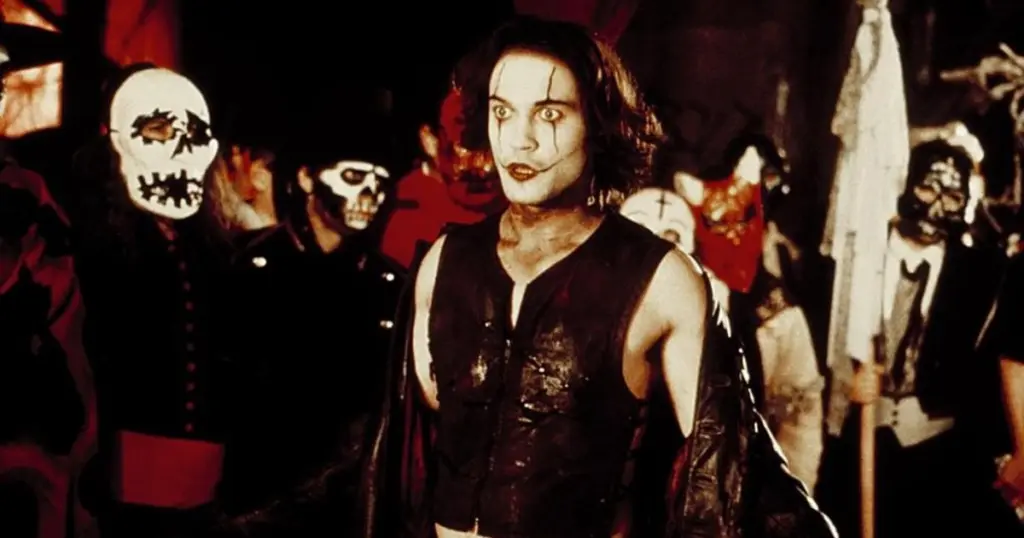
Jon Bon Jovi was briefly considered for the lead before Vincent Perez landed the role, partly due to his resemblance to the late Brandon Lee. Perez struggled with the film’s English dialogue and underwent coaching; he insisted on doing his own stunts for the final battle, which involved grueling, physically demanding scenes — including staying in the water for eight hours and enduring real whipping and hanging for effect. Perez described the emotional weight of the shoot, perceiving Ashe as a character enduring spiritual and physical extremes — “carrying all the sadness, the pain of the world.”
The cast rehearsed extensively for the different “kill” scenes to give each its own psychological arc — which, of course, sounds awesome, but in practice didn’t work out.
See, this movie’s kill scenes are extreme in some cases, and definitely indulgent. But the performance of Vincent Perez as Ashe seemed to make the dramatics of these scenes more goofy than anything else, as his line reads sounded more in line with a 90s soap opera than a Hollywood movie. He simply didn’t have the gravitas that Lee brought to the role — and being that this was the first sequel, a direct comparison couldn’t be avoided. Other than having the same general look and mannerisms as Lee, his performance lacked authenticity and, more importantly, subtlety.
However, with a supporting cast of wacky noir villains like Iggy Pop, Richard Brooks, and friend of the show Thomas Jane — there’s some fun to be had with the over-the-top performances of the film’s villains.
And perhaps the actor who carried the entire film on her shoulders was Mia Kirshner as Sarah — with the palest blue eyes I’ve ever seen. Seriously, out of context, you’d think she was a vampire… or like… already dead.
Fun fact: because it was the mid-90s, Tori Amos was originally offered the role of Sarah, which she declined because, according to her, she simply “didn’t like the character.”
But Kirshner was wonderful in her role, and helped bring some much-needed heart and soul to this movie.
Something that must be mentioned is that this movie’s cinematography, set design, and color grading are absolutely beautiful. Watching it feels like a slightly more polished version of The Crow, while maintaining the grit, grime, and grossness of the original. Some scenes make this post-apocalyptic Los Angeles look like a gothic nightmare, while others make it look like real parts of L.A. … yikes.
Also, you can’t be mad about seeing the Crow riding a black motorcycle, right? I mean… right?
Unfortunately, the set design and flashy camera work couldn’t hide the film’s lack of originality and lackluster budget. Where the original film had a budget of about $21 million, this one saw that number nearly cut in half — to $13 million — which might explain the lack of risks taken in production.
I’d assume most of the money went to the one set piece at the end for the final battle — which must’ve cost a lot for the location, extras, and even booking iconic band The Deftones to perform in the film. (Actually, I think at that time they hadn’t even released their first album yet, so maybe they got them at a discount.)
Digital effects and puppetry (including cost-cutting measures like using stuffed crows on fishing lines) drew criticism for appearing cheap compared to the original’s polished visuals. The film recouped only part of its budget, grossing about $18 million domestically and $25 million worldwide — ultimately losing money after marketing costs and marking it as a box office disappointment.
This resulted in the film being somewhat disowned by both O’Barr and Goyer. At one point, O’Barr attempted to write the script himself but reportedly found himself haunted by the thought of his good friend Brandon Lee dying during the making of the first film, and he quickly stepped away. His only request to Tim Pope was to make the story its own — to make it different. Unfortunately, O’Barr (like many of us) was not impressed with the result.
The cult of the original Crow led to high expectations, but City of Angels faced widespread criticism for its narrative confusion and visual muddiness. Pope and Goyer’s original artistic vision was widely acknowledged among fans and critics to have been more ambitious and character-driven than the final product.
Several creative decisions — such as the exclusion of O’Barr’s proposed The Crow: The Bride script (with a female protagonist) and the cutting of Sarah’s larger arc — are now cited as missed opportunities to innovate within the franchise. And you know what? I can’t help but agree.
And, silly as it sounds, because I don’t know where else to put this… Who is that guy crouching behind Ashe’s motorcycle? That’s a crew member who is not supposed to be visible there. I just find that hilarious. It kind of reminds me of those moments where you can see a boom mic creeping into the frame in a low-budget movie. It happens more than you think — and if you think it doesn’t… watch more schlock. You’re welcome.
So, in the end — studio interference fundamentally altered the tone, plot, and legacy of The Crow: City of Angels, reducing its ambition and complexity. The cast, especially Vincent Perez, endured tough physical conditions and poured emotional depth into their roles despite post-production disappointment. Budget limitations led to cut-rate effects and a “smaller” look compared to the original.
The lost original cut and conceptually bolder storylines continue to fascinate fans and are seen as missed opportunities for the franchise.
And, of course, the story doesn’t stop here — there were later attempts to bring The Crow back into popularity with the underrated The Crow: Salvation, the almost irredeemable The Crow: Wicked Prayer (the one with Edward Furlong), and of course 2024’s The Crow — a new adaptation that deviated drastically from the original and was the first to not be a sequel, but a reboot.
I honestly didn’t like that film — but I also didn’t hate it as much as you probably did. I think, on its own merits and free from comparison, there’s something to enjoy in there at times.
So the question now is: what did you guys think of this movie? And what do you think of the other sequels? Do you think this franchise should stay dead — or is there hope to one day recreate the magic that Tim Pope brought us all the way back in 1994?
Let us know in the comments below — and that is WTF happened to The Crow: City of Angels.








The comment section exists to allow readers to discuss the article constructively and respectfully, focused on the topic at hand.
What’s Not Allowed