


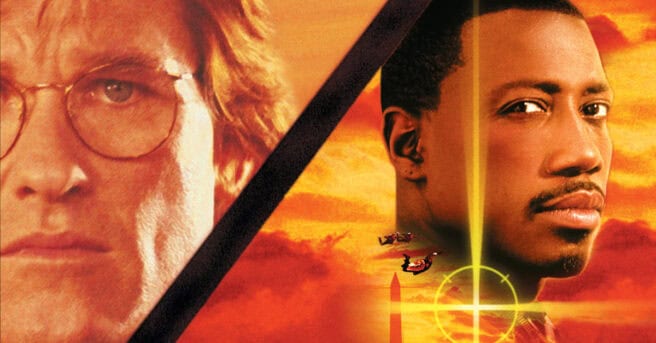
In an era where modern action films often lean on CGI-heavy spectacle and constant exposition, the underrated ’90s thriller Breakdown stands as something almost radical in hindsight. It’s stripped down, brutally efficient, and obsessed with one thing: sustained suspense. No lore dumps. No digital chaos. Just a man, a highway, and a nightmare unfolding in real time.
But the strangest part isn’t what Breakdown became, it’s how it got there. Because this movie wasn’t supposed to exist in this form at all. It began life as a troubled production, passed through a poker game deal, collided with a failed Stephen King adaptation, and only survived because its original concept legally couldn’t be marketed.
And at the center of it all: director Jonathan Mostow.
It Starts With a Poker Game
In the early 1990s, Jonathan Mostow wasn’t yet the polished Hollywood name he would later become. At the time, he had a mixed early career, including work on projects like Fright Show and the poorly received Beverly Hills Bodysnatchers. He was working, but not comfortably. During production struggles on the TV movie Flight of Black Angel, Mostow’s financial and professional situation hit a rough patch. Then, in a moment that sounds almost fictional, everything changed at a poker table.
While discussing his situation during a game, someone at the table revealed a connection to legendary producer Dino De Laurentiis, known for films like Manhunter, Blue Velvet, and Halloween II. That chance link led to Mostow showing his unfinished footage to De Laurentiis himself.
Impressed enough to see potential, De Laurentiis helped finance completion of Flight of Black Angel in exchange for distribution territory rights. More importantly, it established a working relationship that would change Mostow’s career.
The Stephen King Detour: Trucks
After collaborating successfully, Mostow and De Laurentiis moved on to a new idea: adapting Stephen King’s short story Trucks, previously loosely adapted into the infamous cult film Maximum Overdrive.
The plan was ambitious. The team spent a year developing the project, scouting desert locations, and building out a full production plan. Everything was ready to shoot. Then came the problem: they discovered they legally couldn’t market the project as a Stephen King adaptation. That one issue essentially collapsed the film’s commercial viability. Without the King branding, the studio interest evaporated. The project was stuck with locations already scouted and pre-production already spent.
Most directors would have walked away. Mostow didn’t.
Reinventing the Movie Into Breakdown
Instead of scrapping everything, Mostow reworked the project into something entirely new. He looked inward for inspiration, recalling long, isolated drives between Los Angeles and Las Vegas. Those empty stretches of highway, dotted with trailer parks and gas stations, became the emotional foundation for a new story. He combined that with Hitchcock-style paranoia and the stripped-down tension of films like Steven Spielberg’s Duel.
What emerged had almost nothing left of Trucks beyond its production skeleton. It became Breakdown, a grounded, nerve-tight thriller about isolation, trust, and disappearance in the middle of nowhere.
Ironically, Mostow remains grateful that the Stephen King adaptation fell apart. Without that failure, Breakdown might never have existed.

Casting the Ultimate “Everyman”: Kurt Russell
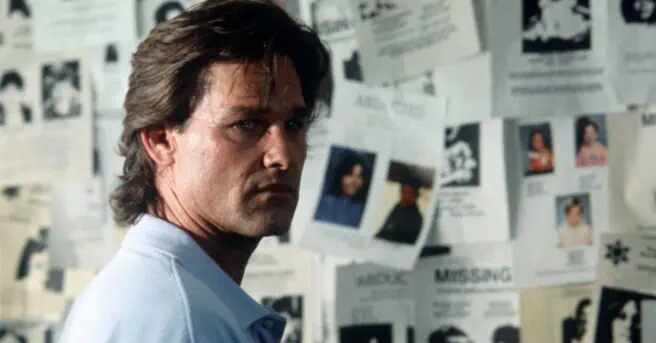
At the center of Breakdown is Jeff Taylor, played by Kurt Russell, an ordinary man pushed into extraordinary circumstances. Jeff isn’t a cop, soldier, or action hero. He’s just a guy traveling cross-country with his wife Amy when everything goes wrong. That’s the key. He’s relatable in a way most action protagonists aren’t. Russell plays him as grounded and human. Not invincible, just determined.
From the opening moments, the film quietly introduces its antagonistic world through small encounters: a near road incident, a hostile gas station exchange, and subtle tension that builds without explanation. The simplicity is deliberate. The film refuses to over-explain anything.
Jeff and Amy continue their trip, stopping for food, small comforts, and normalcy… until their Jeep breaks down in the middle of nowhere. And then Amy disappears.
The Nightmare Begins
What follows is a masterclass in escalating thriller paranoia. Jeff searches for his wife at a nearby diner, only to find no one has seen her. A truck driver he previously encountered denies any involvement. A local officer arrives but sides with the trucker, leaving Jeff completely alone.
From that point forward, the film becomes a pressure cooker. Jeff’s situation is made worse by how believable it all is. To everyone else, he looks unstable. A man insisting his wife vanished without evidence. The system doesn’t fail dramatically, it simply doesn’t believe him.
Kurt Russell’s performance anchors this tension. You can feel his desperation mounting as he tries to remain composed while everything collapses around him.
Eventually, he follows a lead that pulls him into a violent confrontation and a mountain chase sequence that ends with one of the film’s defining images: Jeff and his Jeep plunging off a cliff into a river below. No CGI spectacle. Just real stunt work and practical danger.

Survival, Lies, and Escalation
Jeff survives, but the nightmare intensifies. Amy, meanwhile, is still alive and attempting to manipulate her captors by promising them money Jeff doesn’t actually have. She claims he has access to $90,000, tying directly into an earlier joke involving a donut sweepstakes. That number becomes a dangerous bargaining chip.
What follows is a tightly constructed chain of survival sequences:
- Jeff infiltrating enemy territory
- Brutal close-quarters fights inside moving vehicles
- A tense semi-truck pursuit sequence
- Constant reversals of trust and control
One standout moment involves Jeff turning the tables on a villain played by M.C. Gainey, delivering one of the film’s most memorable lines as he snaps under pressure.
The action remains grounded throughout. No stylized excess. No digital shortcuts. Every set piece feels physical, weighty, and dangerous.
The Final Act: Pure Suspense
The final stretch escalates into near-operatic tension. Jeff discovers Amy trapped inside a freezer with limited air supply. A confrontation unfolds at the antagonist’s home, revealing an unsettling contrast: the villain has a normal family life, making his brutality even more disturbing.
From there, the film drives toward its final sequence:
- A semi-truck chase
- A three-way struggle between Jeff, Amy, and the antagonist
- A bridge-edge showdown
- And a final moment of violent resolution as the truck collapses and the threat is eliminated
No dialogue-heavy explanation. No emotional monologues. Just action telling an engaging thriller story. It ends as abruptly as it began.
Why Breakdown Works
One of the defining creative choices behind Breakdown was restraint. At one point, the studio pushed for an opening exposition sequence giving Jeff a tragic backstory as a war-zone cameraman. Jonathan Mostow resisted and ultimately won. Test audiences responded better to the lean version.
The idea was simple: audiences don’t need backstory to understand fear. They need behavior. That philosophy defines the entire film.
Practical Filmmaking in a CGI Era (Before CGI Took Over)
Looking back, part of what makes Breakdown feel so intense is its physicality. Real vehicles. Real stunts. Real environments. Even the score, composed by Basil Poledouris, leans heavily into Hitchcock-inspired tension, reinforcing the stripped-down thriller tone rather than overwhelming it.
There’s a tactile quality to everything – dust, heat, motion, impact – that modern effects-heavy filmmaking often smooths over. You feel the geography. You feel the danger.
Reception and Legacy
Released in 1997, Breakdown opened to strong critical reception and solid box office performance, earning over $50 million domestically. Critics frequently compared it to Hitchcock-style suspense thrillers, praising its tight structure and relentless pacing. It has since developed a reputation as one of the most effective modern “man-on-the-road” thrillers.
More importantly, it holds up. Because beneath all the production history and genre discussion, Breakdown succeeds on a simple premise: What happens when an ordinary person is removed from every system of safety and no one believes him?
Final Word
Breakdown wasn’t designed to be a spectacle. It was forced into existence through circumstance: a poker game, a failed adaptation, and a director unwilling to waste a good setup. What emerged is one of the most efficient suspense thrillers of its decade, built not on exposition or effects, but on momentum, performance, and pressure.
And that’s what makes this thriller endure. Not CGI. Not mythology. Just a highway, a missing wife, and a man who refuses to stop.













The comment section exists to allow readers to discuss the article constructively and respectfully, focused on the topic at hand.
What’s Not Allowed