
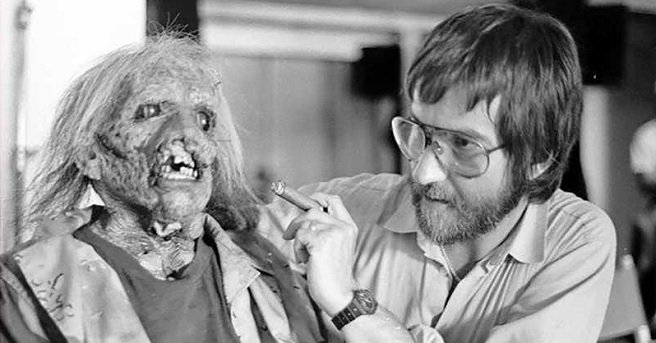
Author Scout Tafoya's six year journey to bring the world a book that covers the entire cinematic career of late master of horror Tobe Hooper has culminated in the publication of Cinemaphagy: On the Psychedelic Classical Form of Tobe Hooper, which can be purchased right now on Amazon.
Here's the book's description:
He directed The Texas Chain Saw Massacre, the most infamous and visceral horror film of all time. He directed Poltergeist, one of the most successful ghost stories of the 20th century. He was called a Master of Horror and he worked with screen legends James Mason, Neville Brand, Karen Black, Fred Willard, Dennis Hopper, Anthony Perkins, Mel Ferrer & Marie Windsor. He elegantly navigated the works of pulp legends Ambrose Bierce, Stephen King, Cornell Woolrich, & Richard Matheson. And yet Tobe Hooper is one of the most unsung film artists of the last fifty years.
How did the man famous for creating some of the most endearing images of terrible things, who did for the hardware store what Jaws did for the beach, become someone in need of rescue? Cinemaphagy is the study of an artist’s working life, his bountiful creativity, his ardent cinephilia, his prolific career in film and television, his lasting influence beyond the saw. Horror movie directors are too frequently pigeonholed as purveyors of the macabre but in truth Hooper was one of the most boldly experimental genre filmmakers in the game, fusing a Texan psychedelia with an earnest classical style gleaned from years watching classic films. Tobe Hooper’s life and work is like four years of film school, and every film he made, no matter how thankless, no matter how silly the assignment on paper, became a rich, roiling text on the political underside of the American cinema. No one made movies about cinema less ostentatiously and with more love.
Movies with lurid titles like Spontaneous Combustion and The Mangler hide essays about the history of labor, Cold War iconography, and the corrosive legacy of a culture built on lies. Tobe Hooper is still too often represented as a man with a monolithic legacy, the creator of one great film and nothing else. It’s well past time the depth and breadth of his obsessions and his gifts were discussed by a culture that ignored his years of hard work. Tobe Hooper directed The Texas Chain Saw Massacre but that is literally just the start of one of the most exciting, free, and expressionistic bodies of work in the American cinema.
It's really cool to see Hooper's entire career being celebrated in this way. Cinemaphagy sounds like a must-have for fans who appreciate Hooper films beyond the most popular titles, and maybe it will draw more fans to some of his less popular work.













The comment section exists to allow readers to discuss the article constructively and respectfully, focused on the topic at hand.
What’s Not Allowed